

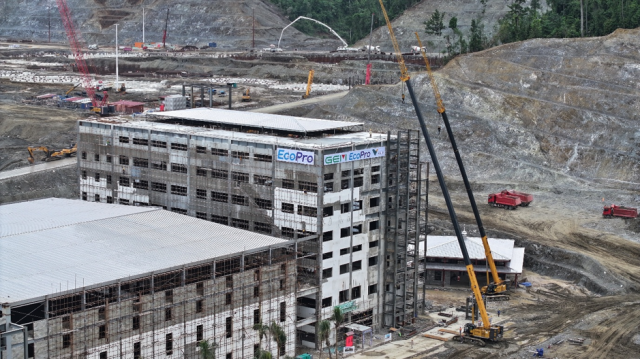
On July 5, EcoProBM reported through its internal communication channel, EcoTalk, that four key factors have driven its growth over the past decade: proactive infrastructure investment, technological innovation, trust in the capital market, and global production capacity expansion.
Founded in 1998 in Ochang, North Chungcheong Province, as a venture company with two employees, EcoPro transitioned from environmental and battery materials to establish EcoProBM in 2016 by spinning off its battery materials business. This decision was made to enhance its battery materials sector by developing high-performance NCA cathode materials and securing global clients like Sony and Samsung SDI.
In 2016, investment management company bnw invested 60 billion won in EcoProBM. Kim Jae-wook, chairman of bnw, stated, "We not only provided capital but also dispatched personnel to support EcoPro's growth, establishing a win-win model between the capital market and EcoPro." bnw recouped its investment when EcoProBM went public in 2019, achieving a three-year return of 91%.
With this funding, EcoProBM completed its fourth cathode material plant, capable of producing 500 tons per month, marking the beginning of a 1,000-ton monthly production era. The fourth plant also became the first in the world to mass-produce high-nickel CSG (NCM 811), a new material for electric vehicle batteries.
In 2018, EcoProBM developed the 'NCA 034' with 87% nickel content and doubled its production capacity within a year, rising to second place in the global NCA material market, following Japan's Sumitomo.
EcoProBM entered the KOSDAQ in 2019, raising 172.8 billion won, which facilitated the acquisition of a 50,000-pyeong site in the Pohang Yeongilman Industrial Complex and the commencement of construction for the CAM6 plant.
The EcoPro Group has built a competitive battery ecosystem known as the 'Closed Loop' system, integrating EcoProBM's cathode material plant with five affiliated companies in the Pohang Industrial Complex, including EcoPro Materials for precursors, EcoPro Innovation for lithium hydroxide, EcoPro CNG for recycling, and EcoPro AP for oxygen and nitrogen supply.
EcoProBM is expanding its footprint beyond South Korea into the global market. The company recently completed its Debrecen plant in Hungary, which has an annual capacity of 54,000 tons, bringing its total annual production capacity to 270,000 tons.
Through this capital increase, EcoProBM plans to intensify its investment in nickel refineries to maximize its competitiveness in cathode materials. The company aims to secure resource sovereignty through its investment in the BNSI refinery in Indonesia and establish a battery supply chain that meets the requirements for non-restricted foreign institutions.
EcoProBM explained that by internalizing raw materials, it aims to enhance cost competitiveness for ternary cathode materials and gain an advantage in securing orders from global cell companies and OEMs in the future.
Kim Jang-woo, CEO of EcoProBM, stated, "The support from the capital market has been crucial for EcoProBM's leap to becoming a global cathode materials company. We will fulfill our responsible role as a KOSDAQ-listed company by enhancing shareholder value."
Meanwhile, EcoProBM announced last month that it would initiate a capital increase of 1.2 trillion won to secure funds necessary for the second phase of investment in the Indonesian nickel refinery and the commencement of mass production at its Hungarian plant.
* This article has been translated by AI.
Copyright ⓒ Aju Press All rights reserved.