

South Korea's leading developer, Shinyoung, reported a revenue of 1 trillion won and an operating profit of 154 billion won last year, achieving both growth and stability. The company has been recognized for its proactive deleveraging strategy, which focuses on risk management during economic downturns. By accumulating retained earnings, Shinyoung has strengthened its capacity to respond to long-term market challenges.
According to the Financial Supervisory Service's electronic disclosure system, Shinyoung's consolidated revenue for last year was 1 trillion 16 billion won, with an operating profit of 154 billion won. This marks a 2.7% increase in revenue from the previous year, which was 975.3 billion won, and a 49.5% rise in operating profit from 103 billion won.
A closer look at the revenue breakdown reveals that sales from completed buildings surged from 356.3 billion won in 2024 to 591.6 billion won in 2025, a 66% increase in just one year. Successful completions of high-end landmark projects, including the 'Brighton' series in Yeouido and Hannam, contributed significantly to this influx of sales revenue.
However, Shinyoung's consolidated net profit last year was 75.3 billion won, a 67.8% decrease from 234 billion won the previous year. This decline is attributed to a one-time gain of 261.6 billion won from the sale of subsidiary shares in 2024. Despite this, the company managed to defend over 75 billion won in net profit through its core business of sales and development, leading to a perception in the market that the quality of its earnings has improved.
Shinyoung is also accelerating its debt reduction through significant sales revenue. The company's consolidated balance sheet shows that current liabilities, which indicate short-term borrowing pressure, decreased by 40.7% from 1.4686 trillion won in 2024 to 870.1 billion won last year. Notably, the company reduced its long-term liabilities significantly, from 632.9 billion won at the end of 2024 to 94.4 billion won at the end of last year, proactively mitigating liquidity risks.
Shinyoung's consolidated debt ratio also fell from 352.5% at the end of 2024 to 240.8% at the end of last year, a decrease of 111.7 percentage points. This reduction, despite a slight contraction in total assets from 2.96 trillion won to 2.46 trillion won, reflects the company's commitment to securing financial stability through prudent management.
Looking ahead, Shinyoung plans to accelerate new sales and next-generation development projects starting in the second half of the year, leveraging its strengthened financial foundation.
At the end of last year, Shinyoung's retained earnings reached 562.7 billion won (with unappropriated retained earnings of 555.2 billion won), marking a 13.6% increase from the previous year. Analysts suggest that this positions the company well for future large-scale mixed-use development projects once the housing market stabilizes.
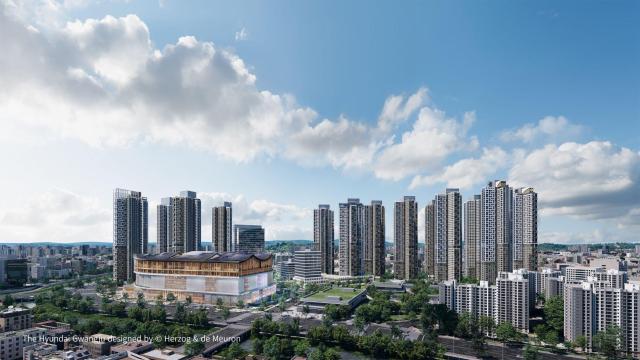
In September, Shinyoung will focus its efforts on the first phase of the Champions City project in Gwangju, which includes 3,216 housing units. This major landmark project will be developed on the former Jeonbang and Ilshin Textile sites and will feature 'The Hyundai Gwangju' and a luxury hotel. Shinyoung aims to capitalize on the semiconductor industry's growth in the region to drive successful sales and maintain momentum. Additionally, the company plans to expand its project pipeline into the metropolitan area next year.
A Shinyoung representative stated, "After successfully launching the first phase of the Gwangju Champions City project this year, we are preparing to introduce the second phase and new sales in four locations, including Incheon and Yangju, next year. We will leverage our accumulated liquidity and risk management capabilities to ensure stable execution of our new projects."
* This article has been translated by AI.
Copyright ⓒ Aju Press All rights reserved.