

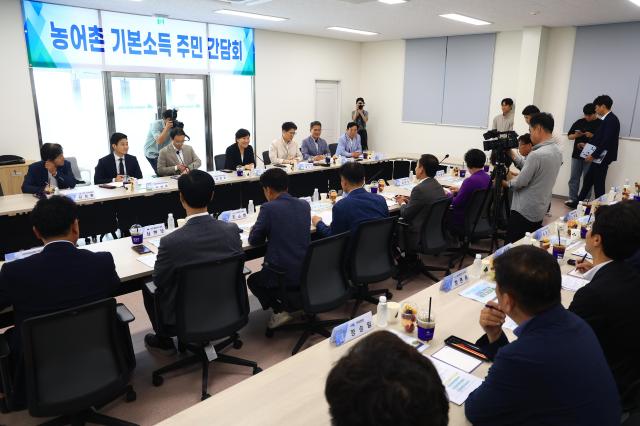
Song Mi-ryeong, Minister of Agriculture, Food and Rural Affairs, stated on July 5 that "Shinan County is leading a model that utilizes profits from renewable energy as a funding source for basic income," urging efforts to develop it into a new basic income model.
During her visit to the Anjwa Smart Farm and Solar City in Anjwa-do, Shinan County, Minister Song remarked, "Rural areas possess significant potential for renewable energy generation, making them a crucial pillar in the national energy transition."
At a local meeting, she received updates on the pilot project for basic income in rural areas and the progress of renewable energy initiatives. She also visited locations where basic income is utilized to gather feedback from local residents.
Shinan County is implementing a model that channels profits from renewable energy into basic income funding. This initiative provides local residents with 200,000 won (approximately $150, including an additional 50,000 won from the local government) each month in the form of local love gift certificates.
Since the introduction of basic income, positive changes have been observed in the region. The population of Shinan County, which had been below 40,000, has increased by 3,436, reaching 42,319 as of June, marking an 8.8% rise compared to a year ago. The number of local currency affiliated stores has grown by 149, with over 88.1% of the total disbursement of 35.4 billion won spent within the community.
Notably, local businesses are also experiencing a transformation. The introduction of basic income has led to the opening of an electronics store and an optical shop in Anjwa-myeon for the first time. Additionally, new businesses such as a tofu shop and a bedding store have emerged, indicating a revitalization of the local economy.
Concerns regarding the funding for the rural basic income have been addressed. The total project cost is structured with 40% from the national government, 30% from provincial and city governments, and 30% from the county. Instead of using county funds, Shinan County has matched the funding with a cooperative fund generated from solar power profits. Shinan's basic income initiative is recognized as a model for encouraging community participation and sharing profits with residents.
During the meeting, discussions were held on improving systems and policy support to link this initiative to the revitalization of rural economies. Suggestions were made for continued government interest and support for the expansion of various renewable energy income models.
In response, Minister Song emphasized, "We will spare no policy support to ensure that rural areas can transform into spaces that generate energy and income based on that energy."
During her visit to the Anjwa Smart Farm and Solar City in Anjwa-do, Shinan County, Minister Song remarked, "Rural areas possess significant potential for renewable energy generation, making them a crucial pillar in the national energy transition."
At a local meeting, she received updates on the pilot project for basic income in rural areas and the progress of renewable energy initiatives. She also visited locations where basic income is utilized to gather feedback from local residents.
Shinan County is implementing a model that channels profits from renewable energy into basic income funding. This initiative provides local residents with 200,000 won (approximately $150, including an additional 50,000 won from the local government) each month in the form of local love gift certificates.
Since the introduction of basic income, positive changes have been observed in the region. The population of Shinan County, which had been below 40,000, has increased by 3,436, reaching 42,319 as of June, marking an 8.8% rise compared to a year ago. The number of local currency affiliated stores has grown by 149, with over 88.1% of the total disbursement of 35.4 billion won spent within the community.
Notably, local businesses are also experiencing a transformation. The introduction of basic income has led to the opening of an electronics store and an optical shop in Anjwa-myeon for the first time. Additionally, new businesses such as a tofu shop and a bedding store have emerged, indicating a revitalization of the local economy.
Concerns regarding the funding for the rural basic income have been addressed. The total project cost is structured with 40% from the national government, 30% from provincial and city governments, and 30% from the county. Instead of using county funds, Shinan County has matched the funding with a cooperative fund generated from solar power profits. Shinan's basic income initiative is recognized as a model for encouraging community participation and sharing profits with residents.
During the meeting, discussions were held on improving systems and policy support to link this initiative to the revitalization of rural economies. Suggestions were made for continued government interest and support for the expansion of various renewable energy income models.
In response, Minister Song emphasized, "We will spare no policy support to ensure that rural areas can transform into spaces that generate energy and income based on that energy."
* This article has been translated by AI.
Copyright ⓒ Aju Press All rights reserved.