

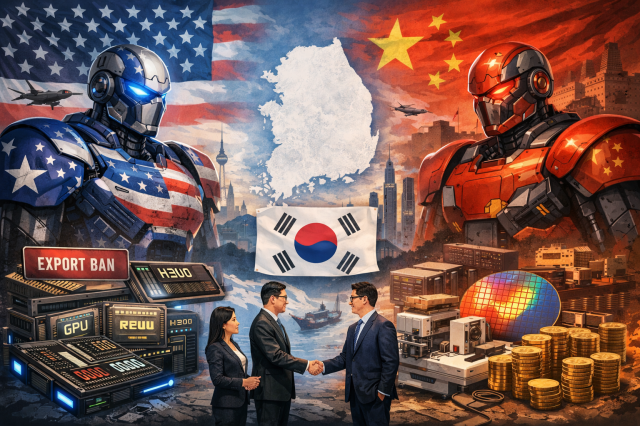
The Chinese government has identified a significant gap in artificial intelligence (AI) capabilities compared to the United States, assessing it at 68 to 32. In response, it has launched a national strategy to enhance its AI development to catch up with the U.S. Following U.S. sanctions that have restricted access to high-performance computing devices, China is mobilizing both public and private capital to acquire stakes in South Korean AI data centers and semiconductor firms.
According to sources in the IT and investment banking sectors, the Chinese government recently conducted an internal assessment of AI capabilities, concluding that the U.S. leads with a score of 68, while China lags at 32. This has prompted a rapid acceleration of its strategy to compete with the U.S. in the AI domain.
Despite external evaluations suggesting that the technological gap between the two nations is narrowing, the Chinese government believes its AI capabilities are still less than half of those of the U.S. Consequently, major corporations like Huawei and Tencent, along with various AI startups, are now actively pursuing government-led development initiatives.
The division of roles is clear. Reports indicate that the Chinese government is encouraging Huawei to focus on industrial AI, while Tencent is tasked with developing consumer-oriented AI applications. Huawei will handle AI applications for manufacturing and logistics, while Tencent will manage AI services for everyday consumers. The government also plans to significantly increase support for domestic AI model developers like DeepMind. This approach reflects a typical wartime mobilization strategy, with the state designating specific missions for companies and concentrating talent and capital to rapidly close the gap with the U.S.
A significant challenge remains in building the necessary infrastructure for AI operations. While China has rapidly expanded its AI data center capacity to levels comparable to the U.S., access to cutting-edge graphics processing units (GPUs) and other high-performance computing devices remains limited due to U.S. export restrictions. Although the U.S. allowed conditional exports of certain chips, including the H200, the approved quantities are restricted, and actual imports have effectively stalled amid ongoing U.S.-China tensions.
As a result, China is now looking to South Korea. The Chinese government is reportedly mobilizing both public and private capital to secure stakes in domestic AI data centers and pursue acquisitions of semiconductor processing companies.
This strategy goes beyond merely circumventing GPU access; it aims to establish a foothold in South Korea's AI operational infrastructure and semiconductor supply chain. With South Korea's world-class memory semiconductor production capabilities and ongoing government-led expansion of AI data centers, it represents the closest avenue for China to access computing resources while circumventing sanctions. Investment banking sources indicate that companies like Huawei and Tencent have attempted multiple acquisitions of semiconductor processing firms through subsidiaries with diluted Chinese capital and are actively seeking opportunities in the market.
The liquidity crunch in the domestic investment market is exacerbating this trend. Prolonged high interest rates and a stagnant recovery market have made it nearly impossible to initiate large-scale AI infrastructure projects without significant Chinese capital. Many domestic AI data center development projects are stalled at the funding stage, creating an environment where rejecting offers from Chinese investors is increasingly difficult, according to investment banking sources.
However, this close collaboration raises concerns about potential barriers to South Korea-U.S. AI technology exchanges. Recently, the U.S. Department of Commerce imposed export restrictions on Anthropic's top AI model, 'Mythos5,' partly due to concerns about the Chinese government's access to this technology through South Korea.
An investment banking source noted, "China is currently expanding its outreach to domestic infrastructure investors and is significantly interested in semiconductor processing. This is believed to be part of the Chinese government's strategy in the AI supremacy war against the U.S."
* This article has been translated by AI.
Copyright ⓒ Aju Press All rights reserved.