Korea Launches 24-Hour Foreign Exchange Market to Boost Won's Global Standing
by Jang SunaPosted : July 6, 2026, 08:40Updated : July 6, 2026, 08:40
Share
facebook
twitter
URL
Text size
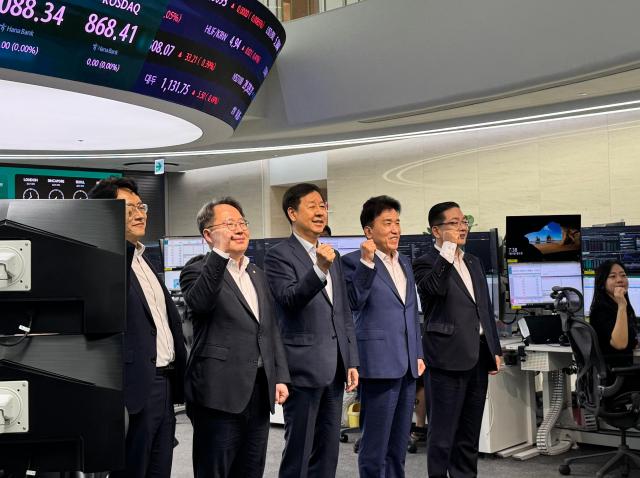
Finance Minister Koo Yun-cheol visits Hana Bank's dealing room on July 6 to commemorate the launch of the 24-hour foreign exchange market. From left: Moon Ji-sung, Deputy Minister of International Affairs at the Ministry of Finance, Kwon Min-soo, Deputy Governor of the Bank of Korea, Koo Yun-cheol, Kwon Young-joo, Chairman of Hana Financial Group, and Lee Ho-sung, President of Hana Bank. [Photo by Jang Seon-a]
Finance Minister Koo Yun-cheol visited Hana Bank's foreign exchange dealing room on July 6, the first day of the 24-hour foreign exchange market, stating it marks a "starting point for the global leap of the won." He emphasized the government's commitment to advancing the foreign exchange market and internationalizing the won without delay.
On this day, Koo inspected the market's operations and gathered feedback from domestic banks, overseas branches, and export companies. He was accompanied by Kwon Min-soo, Deputy Governor of the Bank of Korea, Kwon Young-joo, Chairman of Hana Financial Group, and Lee Ho-sung, President of Hana Bank.
Starting from this day, the won-dollar foreign exchange market will operate 24 hours a day from 6 a.m. on Monday to 6 a.m. on Saturday, excluding weekends and January 1. The government explained that this measure is a key task in modernizing the foreign exchange market to enhance accessibility and promote the internationalization of the won.
Koo highlighted that the 24-hour foreign exchange market is a reform measure reflecting the fundamentals of the Korean economy, confirmed by robust external soundness, record-high current account surpluses, and inclusion in the World Government Bond Index (WGBI), as well as high demand from foreign investors.
He added, "The 24-hour operation is not just an extension of trading hours; it is a core infrastructure to achieve accessibility and convenience at the level of advanced markets. Ultimately, this will enhance the attractiveness of our capital market and the won."
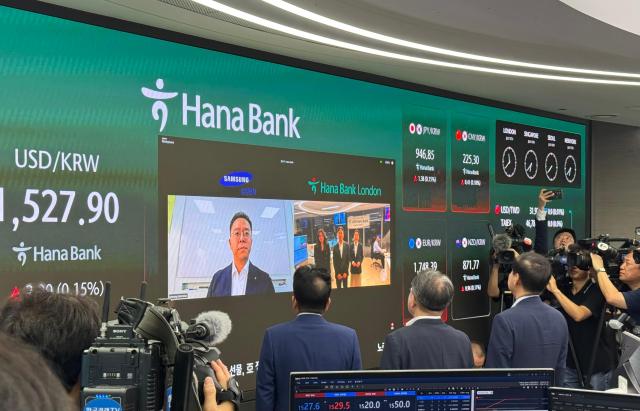
Finance Minister Koo Yun-cheol communicates via video with Hana Bank's London branch during his visit to Hana Bank's dealing room in Seoul on July 6. [Photo by Jang Seon-a]
Koo connected via video with the finance team of Samsung Electronics, the country's largest exporter, and foreign exchange dealers at Hana Bank's London branch to hear their insights.
Joo Min-kyung, a member of Samsung Electronics' finance team, noted, "From 2 a.m. to 9 a.m., it was impossible to manage global risks in the foreign exchange market. Now, export companies like Samsung Electronics can respond immediately to global geopolitical risks, which will significantly aid in currency risk management."
Lee Sung-pil, head of Hana Bank's London branch, expressed satisfaction that the time zone constraints in the won-dollar market have been completely resolved and pledged to aggressively explore local demand for won FX trading.
In response, Kwon Min-soo, Deputy Governor of the Bank of Korea, predicted that the 24-hour operation would significantly broaden the depth and breadth of the foreign exchange market. He urged that efforts be made to enhance won liquidity at companies like Samsung Electronics and Hana Bank. He added that the Bank of Korea would actively address any institutional improvements needed in collaboration with the government, companies, and banks.
During a demonstration, Lee Seok-jin, head of the won-dollar trading team at Hana Bank, explained the current market situation, stating, "The won-dollar exchange rate is currently forming at 1,528 won. As it is the first day of market expansion, trading is not yet active, but we expect it to gradually increase."
Koo encouraged stakeholders, including the government, the Bank of Korea, banks, securities firms, foreign exchange brokerage companies, and export-import businesses, to prepare for the 24-hour operation through regulatory and internal rule adjustments, workforce enhancements, and pilot trading. He assessed that the 24-hour trading would provide new benefits and opportunities for market participants, allowing export-import companies to respond to real-time currency risks and financial institutions and brokers to expand their business opportunities.
He also emphasized that ensuring the stability of the foreign exchange market and the successful implementation of the system is the most important task, stating that the government would maintain thorough market monitoring and trading support systems while advancing follow-up foreign exchange market reform tasks, including the establishment of an offshore won payment system aimed for full operation by January 2027.