

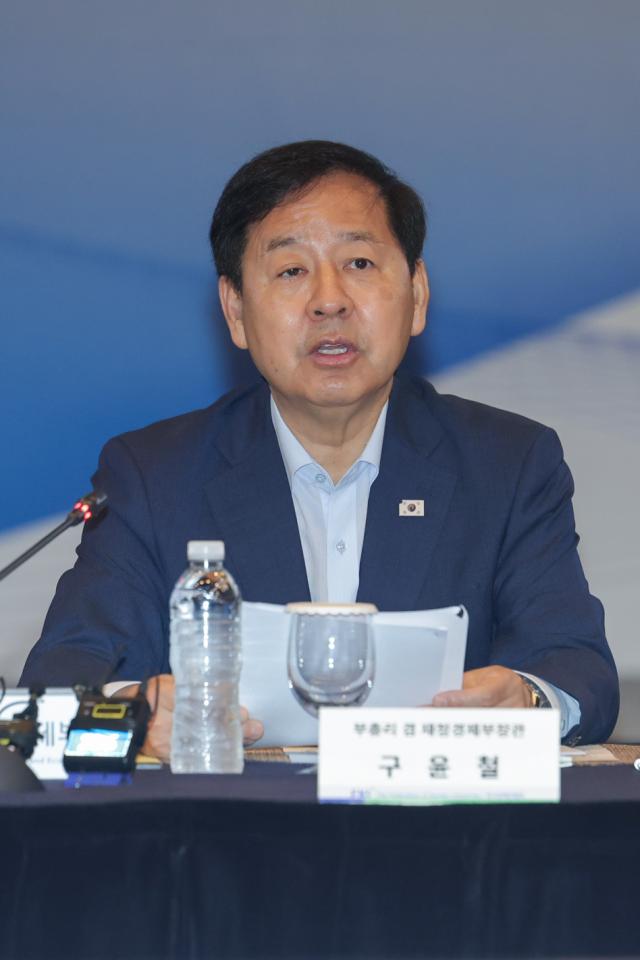
Deputy Prime Minister and Minister of Economy and Finance Koo Yun-cheol emphasized the need for a new institutional framework to foster the development of the service industry in the age of artificial intelligence (AI) and convergence. The government plans to swiftly implement regulatory improvements to seize the AI agent commerce market and accelerate the establishment of a basic law for service industry development.
The Ministry of Economy and Finance held the second meeting of the public-private Task Force for Strengthening Competitiveness in the Service Industry, chaired by Koo, at the Westin Chosun Seoul on July 6.
The meeting addressed strategies for the development of the K-service industry in the AI and convergence era, the industrial growth and global expansion of K-culture, and policy recommendations to invigorate the service sector. Attendees included representatives from various government ministries, including the Financial Services Commission, the Ministry of Culture, Sports and Tourism, the Ministry of Agriculture, Food and Rural Affairs, and the Ministry of Trade, Industry and Energy, as well as organizations such as the Korea Economic Association, the Korea Chamber of Commerce and Industry, the Korea Federation of Small and Medium Enterprises, the Korea International Trade Association, the Federation of Korean Service Industries, the Korea Institute for Industrial Economics and Trade, the Korea Culture and Tourism Institute, and the Korea Tourism Organization.
In his opening remarks, Koo stated, "The world is entering a critical national effort to adapt to the AI revolution, which is set to change the economic and industrial paradigm."
He continued, "The Yoon Suk-yeol administration is actively promoting three mega projects centered on semiconductors, AI data centers, and physical AI to create an unparalleled and irreplaceable South Korea. Enhancing the competitiveness of the service industry, which accounts for 60% of the gross domestic product (GDP), is crucial for the next phase of economic leap forward."
Koo assessed that the service industry is at a transformative juncture where it intersects with AI, leading to innovations in manufacturing, public services, and everyday life, particularly noting that changes in AI-based services are already emerging in the shopping sector.
He remarked, "We must take the lead in the new AI agent commerce market, where AI goes beyond product recommendations to autonomously compare products, place orders, and handle payments. We will swiftly prepare regulatory improvements to demonstrate the entire shopping process with AI agents."
The government also plans to proactively establish a regulatory framework for new mobility services that combine AI autonomous driving with automobiles and urban air mobility (UAM). Additionally, it aims to accelerate public service innovations by integrating AI into tax collection, treasury management, new drug evaluations, and civil complaints.
Koo stressed the importance of establishing a legal foundation for the development of the service industry. He stated, "It is time to reshape the framework for service industry development. We urgently need to enact a basic law for service industry development that boldly opens up inter-industry barriers and focuses on support for research and development (R&D), tax incentives, and financing."
He cited examples such as autonomous delivery robots, fractional investments in real estate and copyrights, the integration of content and distribution, and subscription services for home appliances, explaining that there is an increasing trend of converged services across multiple ministries. He called for bold regulatory rationalization through non-action opinions to assess the feasibility of new business initiatives in advance.
On the same day, the Korea Institute for Industrial Economics and Trade presented a strategy for the development of the K-service industry in the AI and convergence era. The institute noted that the service industry accounts for 70% of domestic employment and 60% of added value, with service trade growing faster than goods trade.
The three main strategies proposed for service industry development include boosting exports, rationalizing domestic value, and leading global new services. The importance of a cross-ministerial policy coordination and support body to address gaps in policy support during this era of industrial convergence between manufacturing and services, as well as among services, was also emphasized.
During discussions on the industrial growth and global expansion strategy for K-culture, Professor Shim Sang-min from Sungshin Women's University noted that K-culture is entering a phase of expansion into K-everything. He suggested that for sustainable growth, innovations in production, investment, and distribution, along with integrated policy initiatives and a cultural shift in perception, are necessary.
On this day, the Korea Economic Association delivered policy recommendations identified in the service industry to the government. Participating companies presented 20 policy proposals and issues faced in areas such as content and beauty, and government and private attendees discussed problems and solutions.
The government plans to reflect the discussions from this meeting in future policy initiatives related to the service industry.
* This article has been translated by AI.
Copyright ⓒ Aju Press All rights reserved.