SEOUL, July 15 (AJP)-South Korea's financial system is becoming increasingly awash with cash, adding to the Bank of Korea's case for an interest-rate hike that could come as early as Thursday, as abundant liquidity continues to fuel red-hot asset markets from stocks to housing.
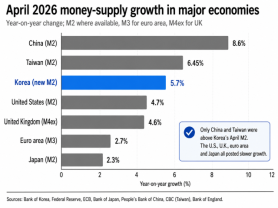
Broad money, or M2, under the Bank of Korea's current definition averaged 4,184.4 trillion won ($2.81 trillion) in May, up 5.8 percent from a year earlier, slightly faster than April's 5.7 percent increase.
On a seasonally adjusted basis, M2 expanded by 32.2 trillion won, or 0.8 percent, from the previous month, accelerating from a 0.6 percent rise in April.
An alternative calculation under the central bank's previous methodology painted an even stronger picture of liquidity growth.
Under the old definition, which included investment fund shares, M2 averaged 4,789.0 trillion won, up 11.7 percent from a year earlier and 2.2 percent from the previous month. Annual growth accelerated from 10.4 percent in April, extending a run of double-digit increases.
The difference between the two measures largely reflected investment fund shares, which are excluded from the revised definition.
Those holdings surged 61.7 percent from a year earlier, contributing 6.1 percentage points to the old M2's annual growth and underscoring how strongly money has flowed into investment products during this year's asset rally.
The composition of money holdings also illustrated where liquidity is accumulating.
Transferable savings deposits jumped by 24.3 trillion won in May after increasing by just 700 billion won in April as more funds migrated in highly liquid accounts to join the booming stock market.
Money trusts with maturities of less than two years rose by 3.8 trillion won, reversing a 3.2 trillion-won decline a month earlier, as semiconductor companies increased trust deposits.
By contrast, time deposits and installment savings with maturities of less than two years fell by 4.7 trillion won, mainly because households reduced their holdings.
The divergence became even more apparent when viewed by sector.
Nonfinancial corporations increased their M2 holdings by 30.1 trillion won from the previous month, while other financial institutions added 11.8 trillion won. Social security organizations, local governments and other public-sector entities increased holdings by another 3 trillion won.
Households and nonprofit organizations, meanwhile, reduced their money balances by 19 trillion won, suggesting retail investors continued shifting cash into assets outside traditional bank deposits as stock and property markets gathered momentum.
The central bank cautioned against interpreting the figures as a direct measure of household wealth or income, noting that money holdings are affected by borrowing, consumption, investment activity and shifts into nonmonetary financial assets.
Other liquidity indicators pointed in the same direction.
Narrow money, or M1, averaged 1,398.2 trillion won, rising 10 percent from a year earlier and 1.9 percent from the previous month.
Liquidity at financial institutions, known as Lf, climbed 8 percent on year to 6,309.0 trillion won, while the broadest liquidity measure, L, increased 9.2 percent to 8,053.8 trillion won.
The figures reinforce a dilemma facing policymakers ahead of Thursday's monetary policy meeting. While higher borrowing costs are intended to cool inflation and curb speculative demand in stocks and housing, the latest data suggest the financial system remains flush with liquidity, giving policymakers another reason to tighten policy even as higher interest rates risk weighing on an economy still heavily dependent on exports.

Copyright ⓒ Aju Press All rights reserved.