

SEOUL, July 21 (AJP) - Nine years ago, a South Korean Go master sat across a board from a machine that was not supposed to be beatable. On March 13, 2016, in the fourth game of a five-game match against Google DeepMind's AlphaGo in Seoul, Lee Sedol became the only human ever to defeat that particular artificial intelligence, snapping three straight losses along the way.
He would go on to lose the fifth game and the series overall, four games to one. But that one win, built around a move at position 78 so unexpected that Go commentators later nicknamed it the "divine move," became one of the defining moments in the early public understanding of what AI could and could not do. Lee retired from professional play in 2019, saying that even the best human could never again claim the top spot in Go, calling AI "an entity that cannot be defeated."
Nine years later, another South Korean player picked up where Lee left off, and went further.
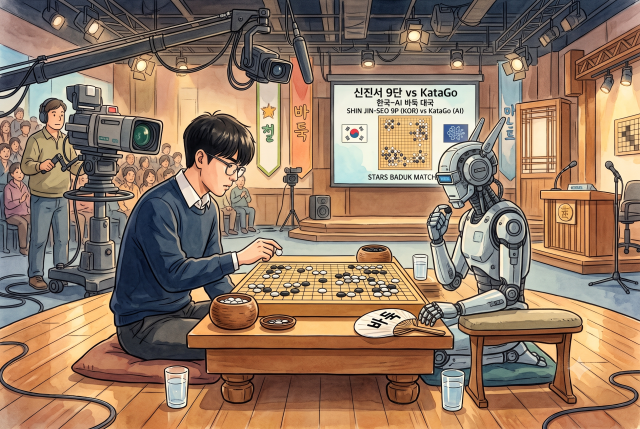
Shin Jin-seo, the world's top-ranked Go player since 2019 and, at 26, the sport's most dominant active figure, defeated KataGo, one of the strongest Go-playing AI systems in the world, in the deciding third game of a three-game match held Tuesday in Seoul. Since turning professional at age 12 as the youngest player ever to do so in South Korea, Shin has built a career defined by consistency rather than single dramatic upsets. He has held the world number one ranking by rating points continuously since 2019 and has won nine major international titles, including three LG Cups and the 2023 Ing Cup, one of Go's most prestigious world championships.
Shin won two games to one, closing out the series with an 11.5-point victory after 221 moves and roughly three hours and twenty minutes of play. The event, called the SSEN and KED Go Match, was staged at a KED TV studio in central Seoul.
KataGo is a free, open-source Go program built by American developer David Wu and first released in 2019, three years after AlphaGo's match against Lee. Unlike AlphaGo, which was developed and run internally by Google DeepMind on proprietary hardware, KataGo was designed to reach superhuman strength through self-play alone, learning purely by playing itself millions of times rather than studying human game records, and to do so on far more modest computing power. It has since become one of the most widely used Go engines in the world, adopted by players and researchers alike for its ability to estimate territory and score in addition to simple win probability.
The margin of victory, in some ways, was less remarkable than the terms under which it happened. AlphaGo played Lee in 2016 with no handicap at all, meeting him as a true equal on the board. KataGo, by 2025 standards a far more advanced program, needed to give Shin a two-stone head start just to play him even, and still lost the match. Most Go experts had expected Shin would be doing well to win a single game. Instead, he won two.
The symbolism was not lost on the Go world. Where Lee's 2016 win stood as a lone flicker of resistance in an otherwise total defeat, a single game salvaged from a series he had no real chance of winning, Shin's performance nine years later looked more like an argument that the gap between human and machine, while still real, had not closed in the AI's favor alone. If anything, the fact that KataGo needed a handicap to stay competitive suggested developers themselves have come to treat an unhandicapped human loss as close to a foregone conclusion, making Shin's win with a head start a different kind of statement than Lee's had been.
Shin's road to the win was not smooth. He lost the opening game after being caught off guard early, then rallied to take the second and third. In the deciding game, playing with the two-stone advantage, he entered with a projected win probability of 99 percent, a number that had collapsed dramatically late in each of the two earlier games, at move 70 in game one and move 160 in game two, as KataGo clawed back territory. This time, Shin held that 99 percent probability from start to finish.
He had said before the match that he intended to avoid heavy fighting and win on territory instead, a more conservative approach than his usual style. He kept that promise. KataGo opened game three differently than it had the first two, taking an unfamiliar corner point that left Shin thinking for roughly two minutes before he responded. From there, both sides settled into a quiet, territorial contest with little direct confrontation. By move 80, Shin had begun pressing KataGo's white stones and building a large formation of black territory stretching from the upper side of the board toward the center, a foundation that held for the rest of the game.
Shin played with five hours on the clock plus one 30-second overtime period. KataGo, running without an overall time limit, was required to move within 20 seconds each turn on a dedicated system built from four Nvidia RTX 3090 graphics cards hosted on the Tygem online Go server. Because KataGo is software, its moves were physically placed on the board by a human proxy, Lee Dan-bi, a professional with the Korea Baduk Association.
For the win, Shin received 250 million won, about $169,000, including his match fee, along with a luxury Genesis G90 sedan as a victory prize.

Copyright ⓒ Aju Press All rights reserved.
![[UPDATES] Go community shocked over Sedols sudden departure](https://image.ajunews.com/content/image/2016/05/20/20160520095434345273_278_163.jpg)

![[UPDATES] Sedol stimulates nerve for match with AI](https://image.ajunews.com/content/image/2016/03/08/20160308101012577920_278_163.jpg)