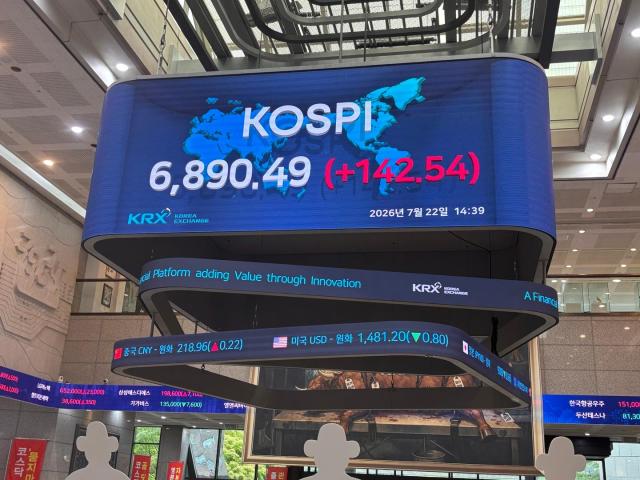
The KOSPI rose 0.74 percent to close at 6,797.70 points after surging as much as 6 percent during the session, but gave up most of its gains in late trading. The junior KOSDAQ, meanwhile, fell 0.30 percent to 751.09.
Foreign investors purchased 2.61 trillion won (US$1.9 billion) worth of KOSPI shares, bringing their net buying over the past three sessions to 3.46 trillion won, according to the Korea Exchange.
The latest inflows mark a sharp turnaround in foreign investors’ stance after weeks of heavy selling. They dumped 19.8 trillion won during the week spanning late June and early July before trimming their net selling to 4.1 trillion won the following week. They then returned as net buyers last week and have further accelerated their purchases this week.
The buying spree was concentrated in semiconductor and technology shares, with foreign investors purchasing a net 3.18 trillion won worth of electrical and electronics stocks over the past three trading sessions.
Samsung Electronics, the key beneficiary of the inflows, rose 0.58 percent to close at 260,500 won, while SK hynix edged down 0.33 percent to 1,830,000 won as investors locked in profits following recent gains.
Among other large-cap technology shares, Samsung Electro-Mechanics climbed 2.67 percent to 1,345,000 won and Samsung Electronics preferred shares gained 2.27 percent to 185,100 won, while Samsung Biologics fell 1.65 percent to 1,372,000 won.
Automakers outperformed, with Hyundai Motor advancing 4.76 percent to 418,000 won and Hyundai Mobis jumping 6.99 percent to 513,000 won. Shipbuilder HD Hyundai Heavy Industries also gained 2.88 percent to 464,500 won, while Samsung C&T rose 3.06 percent to 354,000 won.
On the junior KOSDAQ, robotics shares remained a bright spot despite the broader index's decline, as Samsung Electronics' newly established robotics division continued to fuel expectations for physical AI.
Robotics software developer NRobotics jumped 29.89 percent to 2,390 won and service robot maker Hyulim Robot gained 9.70 percent to 6,900 won, while Lightron Fiber-Optic Devices rose 6.67 percent. The broader index, however, gave up its early gains as profit-taking spread across technology shares.
The recent sell-off, which sent the KOSPI down about 20 percent this month, has made valuations more attractive, encouraging foreign investors to return to the market.
Wall Street investment banks Morgan Stanley and JPMorgan have also struck a more optimistic tone on South Korean stocks. Morgan Stanley maintained its 9,000-point KOSPI target this week, saying the recent selloff has brought the market close to a bottom.
JPMorgan also reaffirmed its 12-month target of 12,500, citing resilient corporate fundamentals and continued earnings momentum led by semiconductors.
The positive outlook has also been driven by expectations that the AI-driven memory-chip upcycle will last longer than previously anticipated. Morgan Stanley said concerns over tighter memory supply in 2027 and 2028 have increased, describing the recent pullback in semiconductor shares a buying opportunity.
A stabilizing South Korean won has also improved sentiment toward local assets by easing concerns over foreign capital outflows. The currency weakened slightly on Wednesday, however, with the dollar-won exchange rate rising to 1,479.50 in afternoon trading from 1,473.40 in the previous session.
Still, analysts cautioned that whether foreign buying develops into a sustained trend will largely depend on earnings from U.S. technology giants, beginning with Alphabet after the U.S. market closes Wednesday.
Alphabet, one of the world's four largest hyperscale cloud operators, previously projected capital spending of $180 billion to $190 billion this year, roughly double last year's level, as it expands AI infrastructure. If the company maintains or raises its spending outlook for next year, expectations for memory demand could strengthen further, providing another catalyst for Korean chip stocks.
The cautious mood was reflected across Asia. Japan's Nikkei 225 erased an intraday gain of more than 2 percent to end 0.18 percent lower, while Taiwan's benchmark index rose 1.34 percent even as chipmaker TSMC slipped 0.41 percent.

Copyright ⓒ Aju Press All rights reserved.