SEOUL, July 23 (AJP) —South Korean small and medium-sized enterprises (SMEs) are falling behind on bank loan repayments at the fastest pace in 11 years, further exposing an economy heavily dependent on large chipmakers and a few big manufacturers.
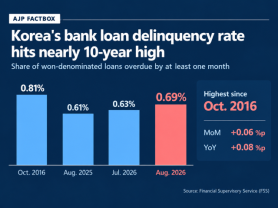
According to data released Wednesday by the Financial Supervisory Service (FSS), the delinquency ratio, the share of bank loans that were more than one month overdue, rose to 0.67 percent at the end of May from 0.61 percent in April and 0.64 percent a year earlier.
It marked the highest level since October 2016, when the restructuring of major shipbuilders and shipping companies, including STX Offshore & Shipbuilding and Hanjin Shipping, pushed the large corporate loan delinquency rate to a record 2.67 percent.
Banks recorded 3.3 trillion won ($2.4 billion) in newly delinquent loans during May, up from 2.9 trillion won the previous month, while they cleared 1.5 trillion won of bad loans through write-offs and sales, down from 1.6 trillion won a month earlier. The monthly new delinquency ratio also edged up to 0.13 percent from 0.12 percent in April.
The deterioration was driven primarily by corporate borrowers. The delinquency ratio on corporate loans jumped to 0.84 percent from 0.74 percent a month earlier and 0.77 percent a year earlier.
Among them, the ratio for SMEs rose to 1.00 percent from 0.90 percent a month earlier and 0.95 percent a year earlier, reaching its highest level since May 2015. Delinquencies among large corporations also climbed to 0.27 percent from 0.22 percent a month earlier and 0.15 percent a year earlier, the highest since September 2021.
Within the SME sector, the delinquency ratio for incorporated SMEs increased to 1.11 percent from 0.98 percent a month earlier, while that for sole proprietors rose to 0.84 percent from 0.78 percent.
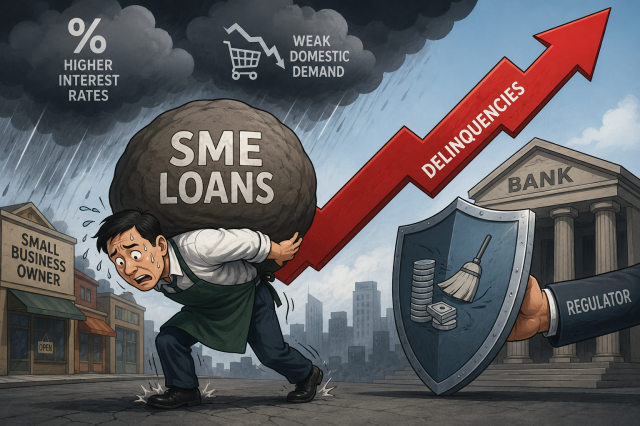
The rise reflects prolonged weakness in domestic demand has made it harder for smaller businesses that rely heavily on local consumption to repay their loans.
Another factor is the government's push to steer more bank lending toward businesses with growth potential rather than household borrowing. While the policy has expanded funding for these companies, some are taking longer to generate stable cash flow, making it harder for some companies to repay their loans.
Kim Young-do, a senior researcher at the Korea Institute of Finance (KIF), said in a February report that banks could face growing pressure to expand lending to businesses while limiting the risks that come with it.
While household loan delinquencies also rose from the previous month to 0.45 percent, they remained below the 0.47 percent recorded a year earlier, indicating that the overall increase was driven mainly by corporate borrowers.
The FSS warned that delinquency rates could continue to rise as corporate lending expands and higher interest rates increase borrowing costs. The regulator said it would encourage banks to clean up bad loans and set aside more money to absorb potential losses.

Copyright ⓒ Aju Press All rights reserved.