

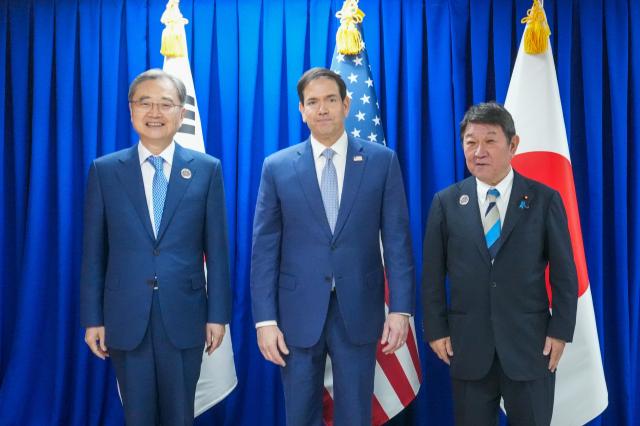
SEOUL, July 23 (AJP) - The foreign ministers of South Korea, the United States and Japan met Wednesday for the second time in just over two weeks, a pace the three governments framed as the point itself, a show of alignment staged in front of Southeast Asia's assembled diplomats in Manila.
Foreign Minister Cho Hyun sat down with US Secretary of State Marco Rubio and Japanese Foreign Minister Motegi Toshimitsu on the margins of the ASEAN-related foreign ministers' meetings, the annual cluster of talks that draws the region's major powers to one venue. The three discussed regional and global affairs, economic security and the Korean Peninsula, the Ministry of Foreign Affairs said.
The trilateral format has become the main vehicle for coordinating policy among the three allies. South Korea and Japan are each bound to the United States by mutual defense treaties. Still, the two neighbors have no such treaty with each other, and their cooperation has historically swung with the state of bilateral relations. The three-way framework, elevated to leader level at the Camp David summit in 2023, was built to keep that coordination running regardless.
Cho said holding the meeting only two weeks after the first trilateral of the year, on the sidelines of the NATO summit on July 7, showed the weight all three countries place on the format. Convening again at the ASEAN meetings, where the region's main players gather, allowed the three to send a united message about strengthening cooperation, he said. Rubio and Motegi welcomed the short interval and agreed to keep tightening coordination, the ministry said.
On North Korea, the three reaffirmed long-standing positions. They will hold to the principle of denuclearizing the peninsula while maintaining firm deterrence, keep their North Korea policies closely coordinated, and continue communication and cooperation aimed at preserving peace and stability through dialogue and diplomacy.
The language on the wider region was more pointed, if never explicit. The ministers exchanged views on attempts to change the status quo unilaterally, and reaffirmed their commitment to maritime security and to international law as reflected in the United Nations Convention on the Law of the Sea, including freedom of navigation and overflight in the Indo-Pacific, Southeast Asia included. None of that names a country. In diplomatic usage, however, those phrases are the standard vocabulary for China's assertiveness in the South and East China seas, and delivering them in Manila, in the region where those disputes play out, gives them their edge.
Economic security took up a substantial share of the agenda. The term covers the newer terrain where trade and national security overlap, from who controls supplies of critical minerals to who can be cut off from advanced technology. The three ministers agreed that cooperation among trusted partners has never been more essential amid continued volatility in the global economy, and committed to deepening work on nuclear power, critical minerals and critical and emerging technologies.
They also agreed to expand cooperation on protecting advanced technology, diversifying supply chains and building their resilience, and responding to economic coercion, another phrase without a named target that governments in all three capitals have used to describe Chinese trade pressure on countries that cross Beijing politically. One entry on the list was newer for this format: Arctic security, an area of growing attention as melting ice opens shipping routes and resource competition in the far north.
Beyond security, the three noted that their cooperation has been widening into transnational crime response, disaster relief and humanitarian assistance, and agreed to push for concrete, visible results.
The ministers agreed to activate consultations across sectors and levels on the momentum of Wednesday's meeting and to work toward outcomes that deliver benefits their citizens can feel, the ministry said. They reaffirmed their intention to meet as often as possible, including at multilateral gatherings.
Copyright ⓒ Aju Press All rights reserved.
