

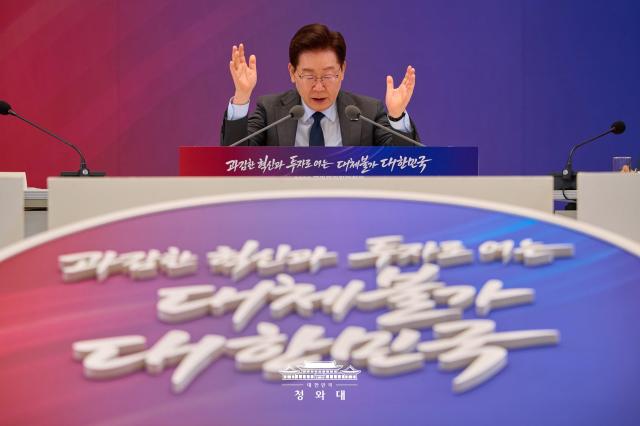
SEOUL, July 23 (AJP) -Normalizing property prices distorted by "abnormal" demand and supply is the purpose of housing policy, South Korean President Lee Jae Myung said Thursday, calling for a broad social consensus on how to balance housing supply, lending restrictions and taxation to prevent the country from following Japan's decades-long property bust.
"Real estate is one of the biggest challenges facing the Republic of Korea," Lee said in opening remarks at a nationally televised housing policy forum held at the KBS annex in Seoul.
"Looking at the assets held by Korean households, real estate accounts for the largest share," he said. "There is broad public consensus that measures are needed to address property prices."
Lee warned that South Korea should draw lessons from Japan, where soaring land and property prices in the late 1980s culminated in the collapse of one of the world's largest asset bubbles.
"Japan once suffered greatly because of its property problem," Lee said. "Prices continued to rise until they reached their limit and burst like a balloon, leading people to speak of the 'lost 20 years' and the 'lost 30 years.'"
"There are quite a few people who worry that we, too, may be racing toward that peak."
The forum came as the government searches for a policy formula capable of cooling Seoul's increasingly unaffordable housing market without undermining household finances, suppressing legitimate demand or further discouraging residential construction.
Lee stressed that the government was not seeking to force housing prices lower artificially but to normalize distortions created by imbalances in demand and supply while reconciling competing interests over land, credit, taxation and the basic purpose of housing.
"A house is a place to live, but it is also an investment asset," he said.
He acknowledged that expanding supply remained essential but argued policymakers faced practical and political limits over where and how new homes could be built.
"If the government tries to release greenbelt land, nearby residents ask why good land should be destroyed," Lee said.
"Some argue that we should build homes even at the cost of some environmental damage. In any case, there are clear limits to supply."
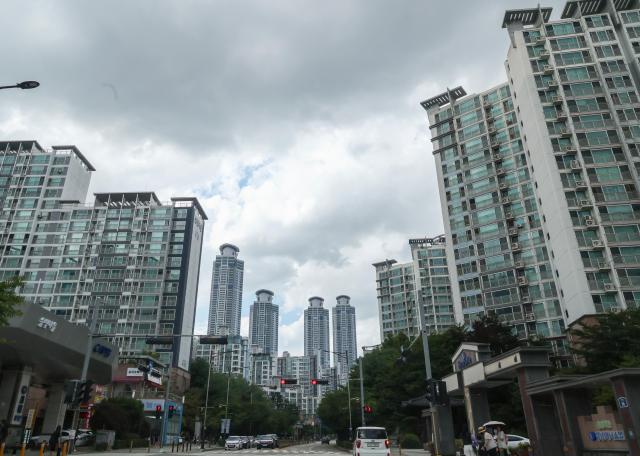
The president also revisited the long-running debate over whether taxes should be used to influence housing demand and supply, saying such intervention could depart from taxation's original purpose and therefore remained open to legitimate public debate.
He took a similar view of mortgage lending, describing finance as "half public" because banks ultimately lend money entrusted to them by society.
"Who should be given the opportunity to use finance can ultimately be translated into a question of policy," Lee said.
"There are those who believe people should be allowed to use finance to buy homes for profit. But if that causes housing prices to rise excessively, people who actually need homes end up suffering."
South Korea's housing market has long forced successive governments to balance protecting homeowners' wealth with improving affordability for younger and lower-income households. Restrictions on borrowing may curb speculative demand but also make it more difficult for first-time buyers to enter the market, while supply measures often take years to translate into completed homes.
Lee said making such trade-offs was among the most difficult responsibilities of government.
"When one side is pushed down, another side tends to rise," he said. "The power to bring competing sides to a final conclusion is power itself. That is why public officials are elected or appointed."
"Even if it brings some conflict and resistance, isn't this what people elected someone like me to do?" he added. "When authority is exercised, responsibility must be taken in proportion to that authority. The greatest virtue of a public official is taking responsibility."
Lee said officials must be prepared to withstand criticism and political resistance but should first gather and reconcile as many opinions as possible, which he said was the purpose of Thursday's forum bringing together policymakers, academics, financial experts, real estate professionals, civic groups and members of the public.
Jin Mi-yoon, a professor at Myongji University's Graduate School of Real Estate, at the debate argued that Korea's biggest supply problem was not merely fewer homes being built but a breakdown in the entire housing pipeline.
"What is most concerning today is that the housing supply chain — from permits to construction starts and ultimately occupancy — has been broken," Jin said.
She warned that today's decline in construction starts would eventually translate into fewer completed homes and properties available for sale, placing greater pressure on housing costs for working- and middle-class households.
Jin called for targeted financial and tax support to revive housing construction, with priority given to projects most likely to proceed quickly to actual building.
She also urged more active management of redevelopment and reconstruction projects, which are frequently delayed by rising construction costs, disputes among association members and deteriorating project economics.
"Various types of housing must be supplied at prices people can afford," Jin said.
She further proposed fostering professional rental housing operators so the rental market could provide stable housing while helping tenants move gradually toward homeownership.
Official data illustrate the uneven nature of the housing recovery. Nationwide housing completions fell 17.8 percent in 2025, while Seoul presales plunged 53.3 percent. Although construction starts rose 27 percent year-on-year during the first five months of 2026, that improvement has yet to translate into a sustained increase in completed housing.
The government plans to begin construction on 1.35 million homes across the Seoul metropolitan area between 2026 and 2030, equivalent to about 270,000 homes annually. It also aims to develop roughly 60,000 additional homes on underused public land while starting construction on more than 62,000 public housing units this year, including 18,200 in third-generation new towns.
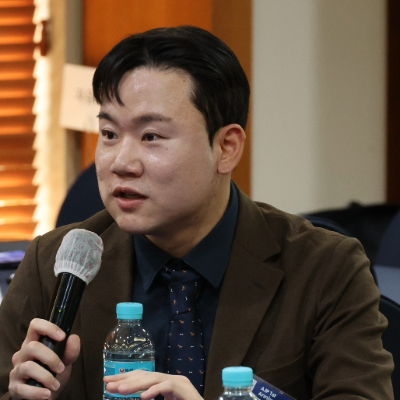
Kim Young-do, a senior research fellow at the Korea Institute of Finance, proposed imposing a macroprudential levy on borrowers taking unusually large mortgages, arguing that excessive use of society's limited lending resources should carry an explicit cost.
Such a levy could be targeted at borrowers purchasing expensive homes and help reduce the tendency for transactions in luxury properties to push up prices across the broader market, although he acknowledged it would not be a cure-all.
Kim argued that existing tools—including loan-to-value and debt-service-ratio regulations and lending quotas—mainly restrict the quantity of credit. Policymakers should also consider whether price-based measures could work more efficiently.
"The housing market is too complex to be treated with a single regulation," Kim said. "The core of demand-control policy is an appropriate combination of measures, and the order of priority is also important."
Lee's administration has already introduced some of the toughest mortgage restrictions in recent years, progressively tightening loan ceilings, reducing loan-to-value ratios and imposing stricter borrowing limits on higher-priced homes in Seoul and surrounding areas.
Even so, the capital's housing market has continued to climb. Seoul apartment prices rose 0.30 percent in the second week of July, extending gains to a 75th consecutive week, while jeonse deposit prices increased 0.28 percent. Household borrowing has also remained elevated despite tighter lending rules.
The government aims to limit household loan growth to 1.5 percent this year and reduce household debt to around 80 percent of gross domestic product by 2030, while the Bank of Korea raised its benchmark interest rate to 2.75 percent on July 16, its first increase since January 2023, citing inflation, household debt and an overheating property market.
Lee said public attitudes toward housing appeared to be evolving, with greater emphasis being placed on homes as places for stable living rather than simply vehicles for investment. He also said there was growing agreement that young people, newlyweds and families with several children deserved special consideration.
Expressing confidence that consensus was achievable, Lee said another round of discussions chaired by the prime minister could be held if necessary.
Copyright ⓒ Aju Press All rights reserved.
