Panic flashes across online stock forums. "Save me. I'm trapped at 22,000 won," one investor wrote, unsure whether to sell or keep holding a Samsung Electronics 2x leveraged exchange-traded fund bought near that price.
The desperation reflects what is becoming a familiar pattern.
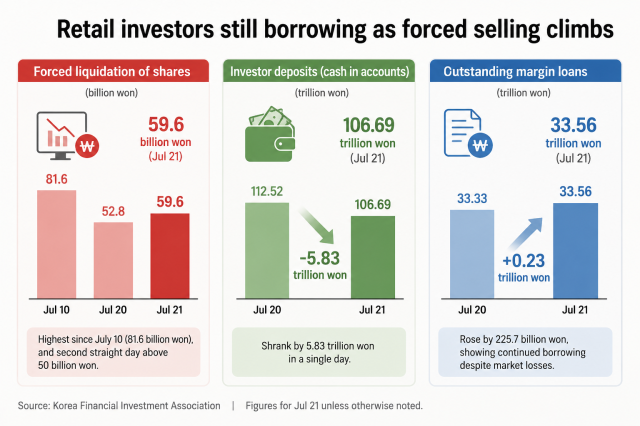
According to the Korea Financial Investment Association, brokerages forcibly liquidated 59.6 billion won ($43 million) worth of shares purchased on margin Tuesday, the highest amount since July 10, when forced selling reached 81.6 billion won. It also marked the second consecutive session above 50 billion won after Monday's 52.8 billion won.
Investor deposits — cash available in brokerage accounts for stock purchases — shrank by 5.83 trillion won in a single day to 106.69 trillion won.
Outstanding margin loans, however, rose by 225.7 billion won to 33.56 trillion won, suggesting many retail investors remain willing to borrow despite mounting losses.
The losers are leaving, but plenty more are waiting to buy the dip. Despite nearly 20 percent declines in both the KOSPI and KOSDAQ over the past month, speculative appetite remains remarkably resilient.
Seoul's stock market, until recently the world's best-performing major equity market this year, has joined the ranks of the worst performers in July.
The decline in investor deposits does not necessarily mean the speculative fever has broken. Deposits fall whenever investors buy stocks, withdraw cash or settle transactions. But when deposits decline while margin borrowing continues to rise, the pattern suggests demand is increasingly being financed with leverage rather than fresh cash.
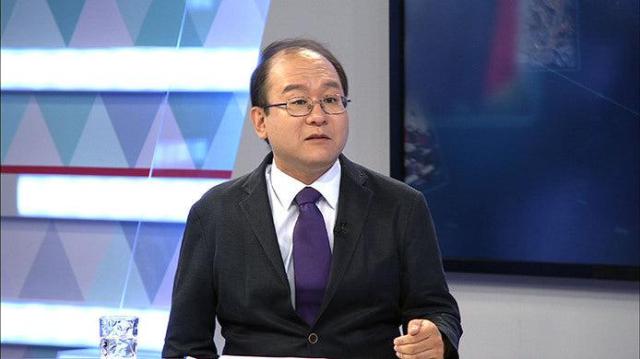
Yang Jun-sok, professor of economics at the Catholic University of Korea, said policymakers originally hoped to redirect speculative money away from real estate and into productive investment through the stock market.
Instead, the rally exceeded expectations.
"At first, the government encouraged people to invest in the stock market," Yang said. "Now it finds itself with another speculative force to calm."
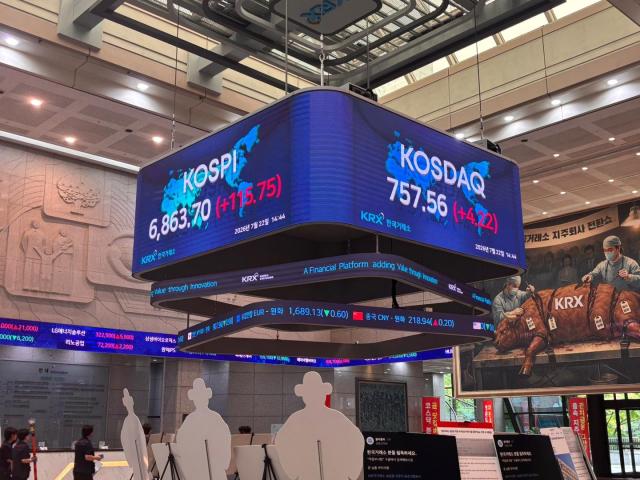
South Korea's benchmark KOSPI became the world's best-performing major stock index this year as the AI boom propelled Samsung Electronics and SK hynix sharply higher. At one point, the two chipmakers accounted for more than half of the benchmark's market capitalization, leaving the index unusually dependent on just two AI-related stocks while amplifying volatility through leveraged products tied to them.
The government has since tightened controls on single-stock leveraged ETFs, suspending new listings and banning promotional campaigns until market conditions stabilize.
Authorities also raised the minimum cash deposit for new or additional purchases to 30 million won from 10 million won and plan to increase the minimum trading unit from one share to 20 shares later this year while strengthening investor education, risk disclosures and safeguards against excessive price deviations.
The measures are intended to slow new speculative demand rather than force existing investors to unwind their positions.
Officials have also stopped short of delisting the products altogether, arguing that doing so could trigger another wave of selling.
Presidential Policy Chief Kim Yong-beom said Sunday that delisting the funds was "hard to imagine" because of the market disruption it could cause.
Instead, regulators are exploring ways to reduce volatility, including narrowing gaps between market prices and net asset values and easing selling pressure generated by ETF rebalancing near the market close.
The government's challenge is to engineer what economists call an orderly deleveraging — reducing leverage gradually without triggering a disorderly cascade of forced liquidations.
In theory, margin borrowing should slow, existing loans should be repaid over time and forced selling should steadily diminish.
So far, the numbers suggest otherwise. Although outstanding margin loans remain below their June peak, they increased again in the latest session, indicating leveraged dip-buying remains alive.
"There are still people saying stocks should be bought when they become cheaper," Yang said. "That means demand has not yet been suppressed."
Evidence of investor distress is nevertheless mounting. The proportion of overdue margin purchases ending in forced liquidation climbed rapidly from 1.1 percent on July 16 to 4.6 percent Monday and 5.7 percent Tuesday.
Under Korea's margin trading rules, investors who fail to settle purchases within two business days face automatic liquidation at the market opening, adding to selling pressure and increasing the likelihood of further margin calls.
Yang said repeated warnings from regulators, academics and market professionals, along with mandatory investor education, have done little to curb speculative demand.
"In the end, investors may have to learn the hard way," he said. "Unless they experience forced liquidations themselves, they will continue to view leveraged ETFs as useful and relatively safe. The market itself created that false sense of security."
He recalled a legal dispute following the 1997 Asian financial crisis, when a Korean state-owned financial institution unsuccessfully sued a U.S. investment bank in New York after suffering losses on complex derivatives. The court rejected the institution's argument that it had not fully understood the products.
"Fundamentally, investors have a responsibility to understand what they are buying, even if nobody explains it to them, especially when the product is complex," Yang said. "That is what Korean investors are now learning."
Faster deleveraging before a bigger shock
"Korea's market rose too far, too fast," Yang said. "Because the rally developed over such a short period, it may be better to reduce leverage quickly rather than drag the adjustment out."
He argued Korea's AI-driven rally far outpaced comparable gains in the United States or Taiwan.
While the S&P 500 reached repeated record highs over several years and Taiwan's benchmark remained broadly diversified despite TSMC's dominance, Korea's surge became unusually concentrated in a handful of AI-related shares.
The Bank of Korea's first interest-rate increase since January 2023 — raising the policy rate to 2.75 percent on July 16 — is part of that effort to cool speculative excess.
The government's dilemma is becoming increasingly clear.
It wants to reduce leverage and curb speculation without triggering the kind of market collapse that would inflict heavy losses on millions of retail investors and undermine confidence in its broader capital-market agenda.

Copyright ⓒ Aju Press All rights reserved.