SEOUL, July 23 (AJP) - For U.S. trading partners—foes and allies alike—it has become nearly impossible to keep up with tariff rates during President Donald Trump’s second term.
The levy on South Korean imports has swung from 25 percent to 10 percent, back toward 25 percent, down to 15 percent and then back again to 10 percent — all in little more than a year.
The next number could be 12.5 percent.
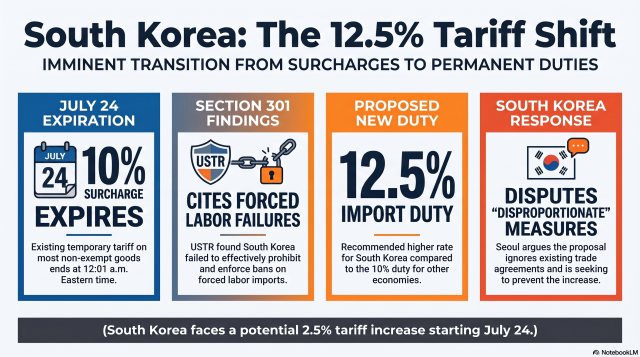
A temporary 10 percent U.S. surcharge on imports from South Korea and most other trading partners expires at 12:01 a.m. Eastern time on Friday. The Trump administration is preparing to replace it with tariffs imposed under Section 301 of the Trade Act of 1974, citing the alleged failure of dozens of economies to block imports made with forced labor.
South Korea has been provisionally placed among economies facing a proposed 12.5 percent tariff, rather than the 10 percent rate reserved for countries judged to have stronger or partial restrictions on forced-labor imports. U.S. Trade Representative Jamieson Greer told lawmakers Wednesday that the final action could be released as soon as Thursday.
If the proposal is adopted with similar product coverage, the additional tariff burden on many Korean exports would rise by 2.5 percentage points overnight.
"It is at least somewhat reassuring that most of our major competitors fall into the same group subject to the 12.5 percent tariff," Rep. Park Sun-won of the Democratic Party, a former first deputy director of South Korea's National Intelligence Service, told AJP.
"South Korean companies are fighting for survival to secure an edge over their overseas rivals."
South Korean Industry Minister Kim Jung-kwan traveled to Washington this week for meetings with senior U.S. officials as Seoul sought to preserve the 15 percent tariff ceiling negotiated last year and prevent another increase in the cost of accessing its second-largest export market.
Yet the constantly shifting tariff rates tell only part of the story.
Economists interviewed by AJP said Trump's tariffs are reshaping U.S. political coalitions, raising costs for American businesses and households, fragmenting global trade and steadily eroding confidence in agreements reached with Washington.
"The tariffs have reshaped voter coalitions," said Kevin Milligan, professor of economics at the University of British Columbia.
"Farm states like Iowa have suffered because their inputs — machinery, potash and other supplies — have become more expensive," he said. "Their agricultural exports have suffered from counter-tariffs imposed by other countries."
"This has eroded President Trump's support in states like Iowa that have been heavily affected."
Trump's first major blow to South Korea's export economy came through automobiles.
On March 26, 2025, Trump invoked Section 232 of the Trade Expansion Act, a national security provision, to impose a 25 percent tariff on imported automobiles and selected parts. The vehicle tariff took effect on April 3, followed by covered auto parts on May 3.
Automobiles are among South Korea's largest exports to the United States, making the measure particularly consequential for Hyundai Motor, Kia and their extensive network of suppliers.
Days later, Trump unveiled his "Liberation Day" trade program, imposing a 10 percent baseline tariff on most imports while assigning higher country-specific reciprocal tariffs to dozens of trading partners. South Korea received a 25 percent rate despite the Korea-U.S. Free Trade Agreement having eliminated duties on most bilateral merchandise trade.
The 10 percent baseline took effect on April 5, while South Korea's 25 percent reciprocal tariff formally began on April 9.
It survived for barely a day.
After global financial markets tumbled and governments pressed Washington to negotiate, Trump suspended the higher country-specific tariffs for 90 days. Beginning April 10, eligible South Korean products were again subject to a 10 percent tariff rather than 25 percent.
The reciprocal tariff never applied universally. Automobiles, steel, aluminum and other products already covered under Section 232 remained outside the measure, as did semiconductors, pharmaceuticals, energy products and several other categories.
That distinction remains crucial because there has never been a single tariff rate covering every South Korean export.
Trump escalated his metals policy in June 2025 by doubling Section 232 tariffs on many steel and aluminum products to 50 percent. Washington later introduced more differentiated treatment, allowing some Korean steel and aluminum derivative products to receive a 15 percent tariff floor beginning in June 2026 while core metal products continued to face rates as high as 50 percent.
The original 90-day pause was due to expire in July 2025. Trump instead extended negotiations until Aug. 1 while warning South Korea that the 25 percent reciprocal tariff would return unless the two governments reached an agreement.
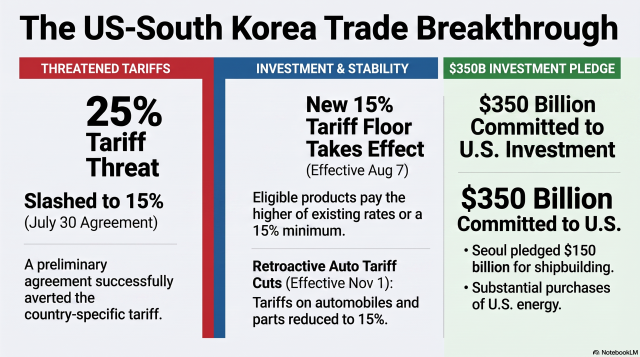
A preliminary deal emerged on July 30.
Washington agreed to reduce the threatened tariff to 15 percent. In return, Seoul pledged a $350 billion investment framework in the United States, including $150 billion linked to shipbuilding and another $200 billion for strategic industries.
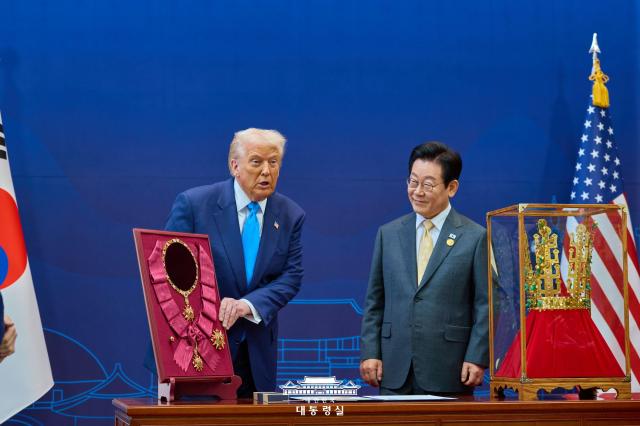
Trump and President Lee Jae Myung finalized the core terms during their October summit in Gyeongju. A joint fact sheet later stated that the United States would generally apply whichever was higher — the existing tariff or 15 percent — to qualifying South Korean products. The agreement also lowered total tariffs on South Korean automobiles, auto parts, timber and lumber to 15 percent.
The stability proved temporary.
On Jan. 26, Trump accused South Korea's National Assembly of moving too slowly to implement legislation supporting the investment package and declared that tariffs on South Korean automobiles, lumber, pharmaceuticals and other products would rise from 15 percent to 25 percent.
The announcement included neither an implementation date nor a formal revision to the U.S. tariff schedule. Two days later, Trump said the two countries would "work something out," effectively leaving the 15 percent arrangement intact.
For Seoul, the episode underscored that even a negotiated trade agreement backed by a massive investment pledge could be reopened through a presidential social media post.
Milligan said that unpredictability may ultimately prove more damaging to the United States than the economic cost of any individual tariff.
"I think the biggest long-run impact is the complete erosion of trust in 'deals' made with the United States," he said.
"Canadians and many other governments have watched President Trump rip up commitments and walk away from solemn agreements."
"Trust in the United States has forever been broken, and this will have serious long-term consequences because countries will hesitate to strike deals if they believe America's word can no longer be relied upon."
The legal foundation of Trump's reciprocal tariff system collapsed on Feb. 20 when the U.S. Supreme Court ruled 6-3 that the International Emergency Economic Powers Act did not authorize the president to impose tariffs.
The ruling invalidated the emergency-based tariff system under which South Korea had first faced a 25 percent tariff before negotiating it down to 15 percent. It did not affect tariffs imposed under separate authorities, including Section 232 measures covering automobiles and metals.
Trump responded by invoking Section 122 of the Trade Act, allowing the administration to impose a temporary 10 percent import surcharge for up to 150 days beginning Feb. 24 and expiring Friday.
Washington simultaneously began constructing a more durable replacement under Section 301, which authorizes trade action against foreign practices deemed unreasonable or burdensome to U.S. commerce.
The Office of the U.S. Trade Representative opened investigations into 60 economies accounting for more than 99 percent of U.S. imports. Its June report concluded that South Korea had failed to adequately prohibit imports produced with forced labor and that the failure burdened U.S. commerce.
Seoul has rejected the proposed 12.5 percent tariff as disproportionate, arguing that South Korea's labor protections, cooperation with the United States and bilateral trade commitments warrant different treatment.
The investigation nevertheless illustrates the administration's ability to move from one legal authority to another — emergency powers, national security statutes, a temporary balance-of-payments provision and now an unfair-trade investigation — while keeping tariffs at the center of U.S. trade policy.
Kenneth Rogoff, professor of economics at Harvard University and former chief economist of the International Monetary Fund, described the approach as an effort to use trade policy as an instrument of personal and political power.
"Trump's weaponization of tariffs, and his use of them as a tool of individual power, will surely undermine U.S. leadership in the global economy over the long run," Rogoff said.
"The inevitable balkanization of global trade will also undermine the dominance of the U.S. dollar."
Costs for American companies and workers
Trump has repeatedly argued that tariffs will revive manufacturing, encourage companies to build factories in the United States and reduce dependence on foreign supply chains.
Milligan offered a sharply different assessment.
"For the U.S. economy, there is nothing good," he said.
"Manufacturing employment is down as exports suffer, while the cost of imported inputs such as Canadian aluminum has risen."
U.S. manufacturing employment declined from about 12.64 million in June 2025 to 12.60 million in June 2026, according to seasonally adjusted Bureau of Labor Statistics data. Employment in motor vehicle and parts manufacturing fell by more than 21,000 over the same period.
Tariffs designed to protect one domestic industry can simultaneously raise costs for downstream manufacturers using imported steel, aluminum and intermediate goods. Exporters may also face retaliation abroad, while households ultimately bear part of the burden through higher retail prices.
David Laibson, the Robert I. Goldman Professor of Economics at Harvard University, summarized the impact succinctly.
"U.S. tariffs have damaged the global trading system, hurting most U.S. households, most U.S. firms, and all U.S. trading partners."
Rogoff said the tariffs had caused less macroeconomic damage than initially feared, although the longer-term structural risks remained significant.
"The effects on the U.S. economy have been relatively modest," he said, adding that Trump's immigration crackdown, particularly on highly skilled workers, "will ultimately have a much greater impact."
"The global economy has also proved surprisingly resilient despite the arbitrary nature of the tariffs and the broader erosion of confidence in U.S. global leadership."
IMF projections reflect that combination of resilience and drag. The fund forecasts global growth of 3 percent in 2026 and 3.4 percent in 2027 while expecting world trade volume growth to slow from 5 percent in 2025 to 3.5 percent this year.
"The broader global economy: the impact is bad, but not as bad as feared," Milligan said.
"For Canada, which is the most dependent on U.S. trade, the impact has been much larger. But not for the world as a whole."
A policy that may outlast Trump
The political consequences are harder to isolate.
Trump has simultaneously pursued sweeping changes in immigration, taxation, foreign policy and the federal bureaucracy, making it difficult to determine how much of his declining approval ratings can be attributed specifically to tariffs.
"As for the political impact in the United States, he has taken so many dramatic actions that it is difficult to isolate any one policy as the dominant driver of his low approval ratings," Rogoff said.
He nevertheless expects aggressive tariff policy to continue through the remainder of Trump's presidency and perhaps beyond.
"I strongly expect Trump to continue to use tariffs aggressively for the next two and a half years," Rogoff said.
"Frankly, things may not change that much after 2028, given that the Democratic Party is dominated by the hard left, who are very protectionist, while any Republican successor will likely need to embrace Trump's policies to secure his political support."
For South Korea, the immediate question is whether Friday's expiring 10 percent surcharge will be replaced by the proposed 12.5 percent tariff, a modified rate with broader exemptions or yet another last-minute compromise.
Today, the tariff facing a Korean exporter depends not only on the country of origin but also on the product itself, its tariff classification, its metal content and the particular U.S. trade law being invoked.
The broader lesson extends well beyond tariff schedules.
The Korea-U.S. Free Trade Agreement may continue to set the underlying tariff on most Korean products at or near zero, but it has not shielded exporters from additional duties imposed under U.S. domestic trade laws. Nor did Seoul's promise to invest $350 billion in the United States permanently settle the tariff question.
After more than a year of threats, negotiations, court rulings and fresh investigations, the tariff on South Korean exports is once again no longer a fixed number.
It is a moving target.
Copyright ⓒ Aju Press All rights reserved.