There is a war raging in the Middle East, oil is creeping back into the headlines, and an American midterm election is closing in fast enough that every policy in Washington now wears a campaign button.
Into this crowded battlefield, Donald Trump has opened a second front — not with missiles, but with tariff schedules. Section 301, Section 122, Section 338, a Depression-era statute nobody in Congress remembered still existed: the instruments keep changing, but the intent doesn't. Trump wants leverage, and he has decided that tariffs are the lever he trusts most.
Seoul has spent the past year absorbing blow after blow from that lever — a 25 percent reciprocal tariff talked down to 15, a forced-labor tariff of 12.5 percent it fought and lost, and the looming shadow of a second Section 301 investigation into "structural overproduction" that could push the total right up against the ceiling Korea thought it had already negotiated. On paper, this looks like a country perpetually on the back foot, absorbing terms rather than setting them.
But look past the tariff schedule and a different picture appears. Korea isn't just a defendant in this trade war. It may be one of the few countries holding a card the United States actually needs.
America's tariff strategy is built for leverage over goods — cars, steel, semiconductors made somewhere else. It is not built for leverage over capacity. And capacity is exactly what the United States has run short of.
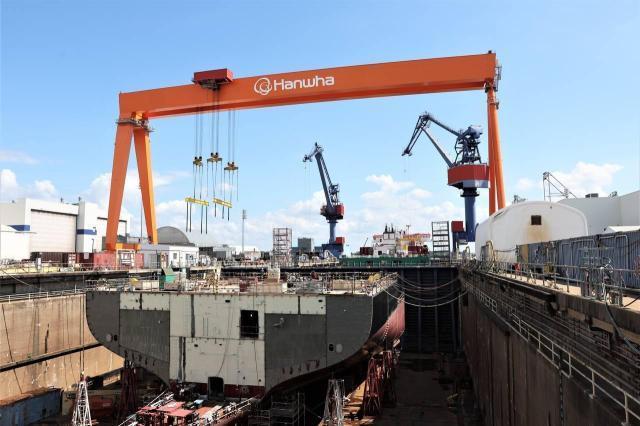
Take shipbuilding. The U.S. Navy wants more ships. It doesn't have the yards, the welders, or the supply chains to build them at the pace a rising China demands. Korea does. Hanwha's yard in Philadelphia — modest by Korean standards, but sitting on one of the largest graving docks in the country — is already building missile-tracking vessels for the Missile Defense Agency's Golden Dome program.
Hanwha Ocean's home base in Geoje dwarfs anything America has: the world's largest dry dock, a crane rated at nearly a thousand tons, and a production line capable of turning out everything from LNG carriers to destroyers. When Trump asked Korea's president at the G7 whether Seoul could simply build ten warships for the United States, it wasn't a rhetorical question. It was an admission of dependency dressed up as a favor.
Semiconductors tell a similar story, just one rung further up the value chain. Washington can write all the export-control rules it likes, but it cannot manufacture its way out of a shortage of advanced logic and memory chips overnight — the fabs, the yield curves, the decades of process knowledge sit in Korea (and Taiwan), not in Ohio or Arizona. Every AI ambition the U.S. has, from data-center buildouts to defense applications, runs through chips that Korea's foundries help supply.
Then there's the piece that rarely makes the tariff headlines but may matter most in the next decade: power. The AI race is no longer just a software race — it is an energy race. Training and running frontier models at scale requires electricity in quantities the American grid is not currently built to deliver.
Korea's nuclear expertise, its small modular reactor programs, and its manufacturing base for reactor components position it as a supplier not just of ships and chips, but of the physical infrastructure that keeps AI's engines running.
Add in Korea's growing footprint in "physical AI" — robotics, automation, the hardware layer where artificial intelligence meets the real world — and a pattern emerges: America has the algorithms, Korea increasingly has the machines that let those algorithms do anything in the physical world at all.
This is the trade that nobody is writing into the tariff schedules, but it's the one that actually matters.
The United States has extraordinary strength in software, in model architectures, in the frontier of AI research.
What it lacks — and increasingly cannot build fast enough on its own — is the industrial substrate underneath that software: the ships, the chips, the reactors, the physical hardware that turns intelligence into capability.
Korea has spent decades building precisely that substrate, quietly, without much of the swagger that attends Silicon Valley product launches.
That asymmetry is the leverage Seoul has been sitting on all along.
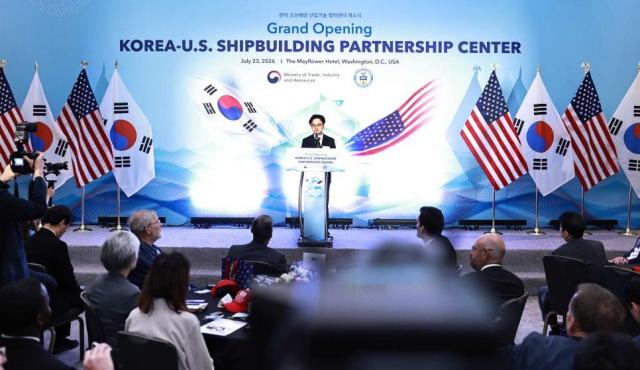
Every dollar of the $350 billion in U.S. investment Korea has already pledged, every new shipyard cooperation center opened in Washington, every joint research project on AI-assisted ship design — these aren't just concessions extracted by American pressure.
They are also Korea buying itself a seat at a table where its manufacturing base becomes indispensable rather than optional.
Commerce Secretary Howard Lutnick can talk about judging the partnership by ships actually built rather than meetings held, and he's right to — but that standard cuts both ways. If the ships get built, they get built because Korea can build them and the U.S., for now, largely cannot.
The Real Negotiation
None of this means Korea can simply shrug off a 12.5 percent tariff or wave away the threat of a steeper one on overproduction.
Trade wars fought with real tariffs cost real money, and Korean exporters will feel every percentage point. But there's a difference between a country negotiating from need and a country negotiating from utility. Korea is doing the latter, whether or not Washington's tariff announcements make that obvious.
Fair play, as the old bargaining maxim goes, has never been the currency of negotiation — leverage is.
Trump understands this instinctively, which is why he keeps reaching for new legal tools to manufacture leverage where none existed before. What his administration may be slower to recognize is that leverage runs in both directions.
The country that can build the ships, fab the chips, and power the reactors that America's AI ambitions depend on is not simply a tariff target. It is a supplier the United States cannot easily replace — and in the arithmetic of bargaining, that fact is worth more than any concession wrung out of a Section 301 hearing.
*The author is the managing editor of AJP.
Copyright ⓒ Aju Press All rights reserved.