

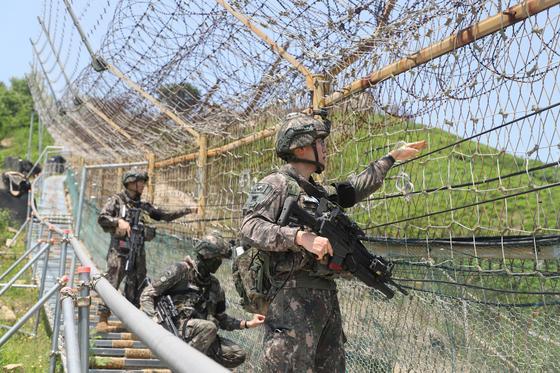
According to the Joint Chiefs of Staff on Thursday, the Army’s Ground Operations Command will begin the inspection with I Corps and expand it to all subordinate corps.
The review will look into whether other corps have changed guard operation guidelines at the discretion of their commanders, as I Corps did. It will also examine the operation of crew-served weapons and troop deployment at front-line guard posts and general outposts.
A military official said the inspection will not be limited to I Corps, which was at the center of the controversy, but will cover all corps-level units.
“We plan to check whether guard units are properly carrying out their functions, including the operation of crew-served weapons, and take necessary measures if needed,” the official said.
The Ground Operations Command oversees six corps: five regional corps, including the Capital Corps and I, II, III and V Corps, as well as the VII Maneuver Corps.
The controversy began after it was revealed that I Corps, which oversees the western front, had changed its guard operation guidelines in the first half of this year so that live ammunition would not be loaded into crew-served weapons, including K6 heavy machine guns and K4 automatic grenade launchers, at front-line guard posts and general outposts.
In front-line units, South Korean troops are generally required to keep such weapons loaded with live ammunition. But I Corps reportedly changed the guideline at the corps commander’s discretion, keeping ammunition in ammunition boxes rather than loaded into the weapons.
The measure was reportedly intended to prevent accidental discharges. However, critics have raised concerns that the change could weaken the military’s readiness to respond to emergencies in front-line areas near the border.
The Joint Chiefs of Staff, which oversees military operations, had not been briefed on the change in I Corps’ guard operation guidelines.

Copyright ⓒ Aju Press All rights reserved.
