

SEOUL, July 31 (AJP) - South Korea will establish a strategic investment account worth more than 20 trillion won ($14 billion) at the Korea Investment Corp. to supply long-term equity capital to artificial intelligence, semiconductors and other industries deemed critical to national competitiveness.
The fund’s initial capacity to make new investments, however, is expected to be limited to about 600 billion won because most of its capital will consist of government-held shares rather than readily deployable cash.
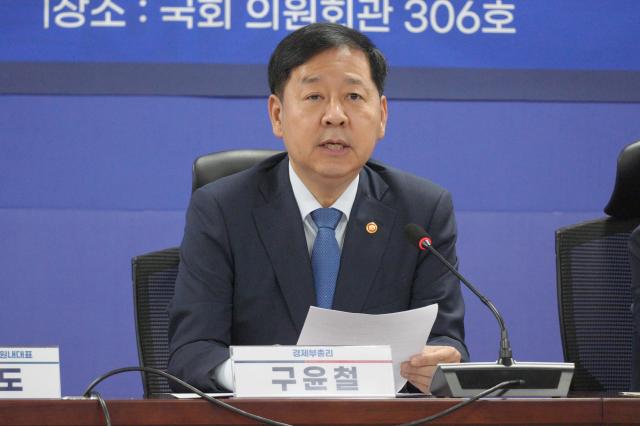
The Ministry of Economy and Finance unveiled the plan Friday at an emergency economic meeting chaired by Finance Minister Koo Yoon-cheol, detailing the funding, governance and investment structure of what it calls a Korean-style strategic sovereign wealth fund.
Rather than creating a separate institution, the government will establish an independently managed account within KIC, which currently invests foreign-exchange reserves and other public assets primarily in overseas markets.
The government plans to submit revisions to the Korea Investment Corp. Act in August and seek parliamentary approval by the end of the year, with investment operations scheduled to begin in 2027.
The account will initially be capitalized with more than 16 trillion won in government-held shares in state-run financial institutions, including the Korea Development Bank, the Export-Import Bank of Korea and the Industrial Bank of Korea, as well as about 4 trillion won in shares received in lieu of inheritance and gift taxes.
The government will transfer the public-sector shares without weakening its control of the institutions or breaching statutory ownership requirements, making immediate sales of most of the holdings unlikely.
Dividends from those shares and proceeds from selective sales of tax-in-kind holdings are expected to provide an initial investment pool of about 600 billion won, with additional government contributions, retained returns and other fiscal resources potentially expanding its capacity later.
The structure builds on a proposal announced in January, when the government first outlined plans for a 20 trillion won sovereign investment vehicle financed with state-owned and tax-in-kind shares.
Officials initially considered creating a separate management body but decided earlier this month to use KIC, citing the institution’s two decades of investment experience and its network of foreign sovereign wealth funds and global asset managers.
The account will target AI, semiconductors, robotics, biotechnology, defense, energy, nuclear power, aerospace and other strategic sectors, while also investing in infrastructure such as data centers and energy clusters.
It may invest in overseas companies considered important to South Korea’s supply chains and industrial ecosystem and serve as an anchor investor to draw private and foreign capital into major domestic projects.
Unlike conventional policy funds that mainly offer loans, guarantees or investments with predetermined exit periods, the strategic account will focus on direct equity investments without a fixed maturity or liquidation deadline.
The account may also acquire stakes from the Korea Fund of Funds, the National Growth Fund and other state-backed vehicles as they approach their usual four- to eight-year investment horizons, allowing public capital to remain invested in promising companies for longer.
KIC will exercise voting rights in proportion to its holdings and may engage with portfolio companies under stewardship principles, although detailed rules governing such involvement and a target rate of return have yet to be set.
Officials have cited Singapore’s Temasek as a reference for the long-term equity investment model, although the Korean vehicle will operate as a separate account within KIC rather than as an independent state holding company.
A firewall will separate the strategic account from KIC’s existing foreign-exchange reserve mandates across assets, accounting, personnel and investment decisions, preventing losses or policy-related risks from spilling over into reserve management.
The government will determine eligible sectors and broad investment priorities, while KIC’s board and a dedicated strategic investment committee will decide on individual transactions, supported by newly recruited specialists in direct investment, industrial analysis and risk management.
Returns generated by the account will be used for reinvestment, dividends to the government or transfers to the Treasury, with the government set to establish detailed investment and risk-management rules before the fund begins operations next year.
Copyright ⓒ Aju Press All rights reserved.
