

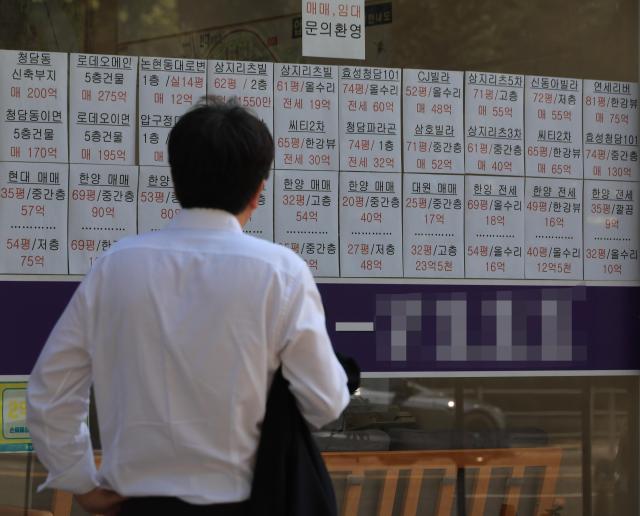
Wealthier property owners face sharply higher tax bills under the latest overhaul, while millions of retail investors are still reeling from the collapse of the stock bubble that followed the government's approval of highly leveraged ETF products, a debacle that has prompted regulatory tightening and raised the prospect of class-action lawsuits.
Under a new property tax code unveiled Monday by the Ministry of Economy and Finance, the government is reshaping the Comprehensive Real Estate Tax to reward owner occupancy rather than property ownership, while imposing heavier tax burdens on investors, owners of multiple homes and holders of high-value residential properties.
The overhaul is one of the Lee administration's boldest attempts to tackle South Korea's chronic housing speculation and widening wealth inequality by discouraging investment demand while protecting genuine homeowners.
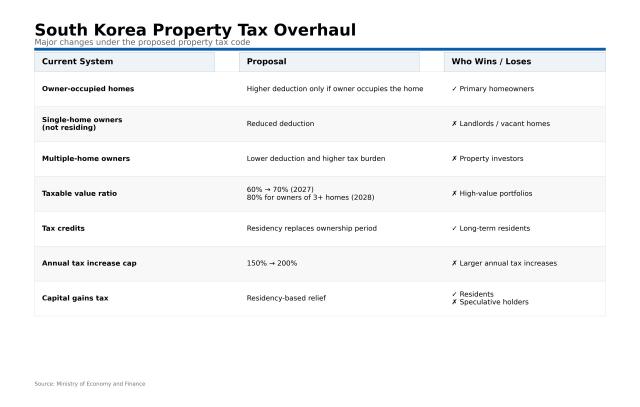
For owner-occupied single homes, the tax-free threshold will rise to 1.4 billion won (about $1 million) in officially assessed property value from the current 1.2 billion won, reducing taxes for many households that actually live in their homes.
The benefits, however, will no longer automatically apply simply because a person owns only one home.
Owners of a single home who lease it out or do not reside in it will lose much of the preferential treatment.
While the 1.4 billion won exemption threshold will remain, only 900 million won will qualify for the basic deduction, significantly increasing their taxable amount compared with owner-occupiers.
Owners of multiple homes will face even steeper burdens.
Instead of receiving a uniform 900 million won deduction, their tax-free allowance will now depend on how much of their portfolio consists of owner-occupied housing. Investors who do not live in any of their homes will see the deduction reduced to just 400 million won.
The government will also gradually raise the taxable value ratio — the proportion of a property's assessed value subject to taxation.
For owner-occupied homes and owners of up to two homes outside designated speculative districts, the ratio will increase to 70 percent from 60 percent beginning next year. Owners of three or more homes and properties in speculative zones will see the ratio eventually climb to 80 percent beginning in 2028.
The tax rate structure will also be overhauled.
Rather than applying different tax schedules based primarily on the number of homes owned, the government will shift toward taxing the total value of residential assets, meaning expensive property portfolios will face higher effective tax rates regardless of the number of homes.
Another major change replaces ownership with residency as the basis for tax relief.
Current tax credits reward homeowners based on both age and years of ownership. Under the new system, long-term residency will become the principal criterion, giving larger tax breaks to people who actually live in their homes instead of those who simply hold appreciating assets.
The government also plans to raise the cap on annual tax increases to 200 percent from 150 percent, allowing tax liabilities for some property investors to rise more sharply than under the current system.
Capital gains tax rules will likewise shift toward rewarding occupancy rather than ownership, with long-term deductions increasingly tied to the length of time a homeowner actually resides in the property.
The finance ministry estimates that owner-occupied homes worth up to roughly 3 billion won at market prices will generally pay less tax, while high-end homes, investment properties and multiple-home owners will shoulder significantly larger tax bills.
The property overhaul comes only days after the government was forced to tighten rules on leveraged single-stock ETFs, which had become one of the defining financial controversies of Lee's early presidency.
The products, introduced as part of efforts to deepen South Korea's capital markets, helped fuel a speculative trading mania centered on AI-related stocks before the market suffered one of its sharpest corrections on record.
Billions of dollars in retail wealth were wiped out as individual investors crowded into leveraged products, leaving regulators scrambling to impose emergency restrictions.
Lee, whose approval rating has already slipped below 50 percent, now faces class action from investor groups.
On Monday, the Citizens' Coalition for People's Livelihood Measures filed a criminal complaint with the Seoul Metropolitan Police Agency against President Lee, Presidential Chief of Staff for Policy Kim Yong-beom and Financial Supervisory Service Governor Lee Chan-jin, accusing them of abuse of authority and obstructing the exercise of rights over the launch of the leveraged ETF products.
The civic group argued that Lee and his senior economic aides were responsible for the decision to introduce leveraged single-stock ETFs and urged investigators to examine whether the policymaking process violated relevant laws and administrative procedures.
The products became possible after the Cabinet approved revisions to the Enforcement Decree of the Capital Markets Act on April 21, with the amended rules taking effect a week later. The first 2x leveraged ETFs tracking Samsung Electronics and SK hynix were listed on May 27.
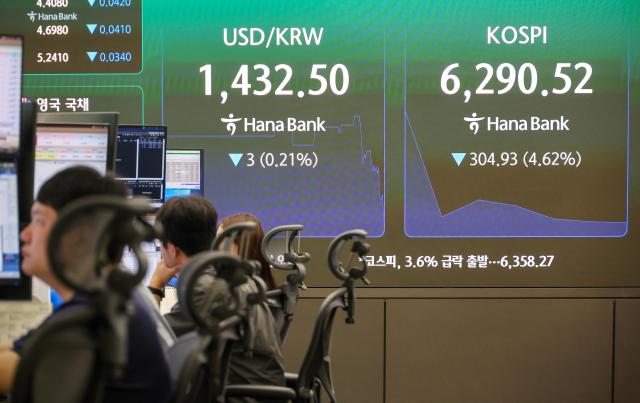
Since their introduction, market volatility has intensified sharply. During July alone, the Korea Exchange activated sidecar trading curbs 13 times and imposed three marketwide circuit breakers as leveraged trading amplified swings in AI-related stocks.
Copyright ⓒ Aju Press All rights reserved.
