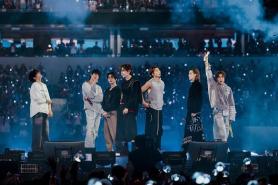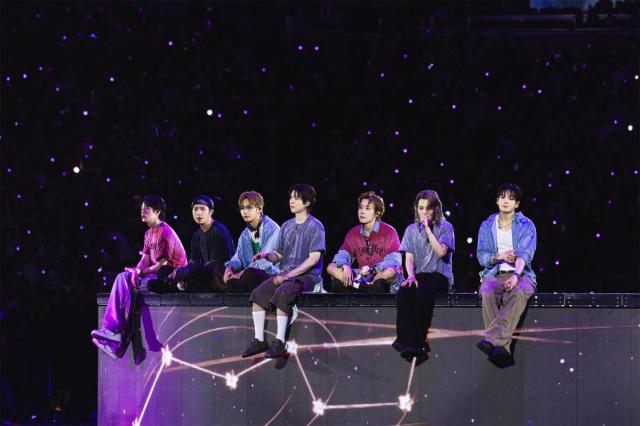
Two sold-out nights at MetLife Stadium passed without a word from the stage about the group's Grammy withdrawal. The jumbotron told a different story.
For two and a half hours at MetLife Stadium in East Rutherford, New Jersey, on Saturday night, the biggest band in the world played 23 songs and said nothing at all about the Grammy Awards.
This was three days after the group had announced it would not submit its music to the 69th ceremony. The omission was noticeable enough that Billboard's reviewer flagged it, reporting that no direct extension of the statement came from the stage, and that RM instead told the crowd he wanted to stay positive and would never take their love for granted.
The statement itself, posted on July 29 to all seven members' Instagram accounts, ran to three sentences. "We have decided not to submit to the Grammys this year," it read. "We hope that music can be heard and loved as music itself, rather than being divided by region or language. We thank ARMY and everyone who is always with us."
No grievance was named, no condition set for returning, and no mention made of the new category that had prompted the decision. Whatever the group had to say on the subject, it had said, and evidently considered the matter closed.
The audience did not consider it closed. Before the encore, when personalized signs from the floor went up on the stadium screens, the cameras lingered on messages that had nothing to do with love or gratitude.
Fans held up placards and cardboards with messages written on them: "BTS Are Bigger Than the Grammys," "Who Needs a Grammy When You Have an ARMY?" and "ARMY's Winner Album of the Year, BTS, ARIRANG." One sign read, "Beyond categories, the music is ours."
That last one is a more precise statement of the argument than anything produced by the institution it criticizes, and it was written by hand, on cardboard, by someone who paid for a ticket.
Recording Academy CEO Harvey Mason Jr. needed considerably more words to make his case, and made a weaker one.
Responding on July 29 to the group's withdrawal, he said he was saddened but understood and respected the decision, then moved to correct what he saw as a misreading of the new Best Asian Pop Music Performance category.
It was created to celebrate the depth and diversity of Asian pop, he said, and more categories mean more artists recognized, never to divide but to expand who is recognized by the Recording Academy's 15,000 voters. He added that submitting in a genre category does not exclude an artist from the General Field, and that recognition in one and recognition in the other are not mutually exclusive.
He was defending the rulebook against an objection that was never about the rulebook.
Nobody has claimed the Recording Academy formally bars Asian artists from Record, Song, or Album of the Year. The claim is that those 15,000 voters considered BTS five times between 2021 and 2023, during the group's commercial peak, and declined five times, and that the sorting has already been happening without any rule requiring it.
A homemade sign got to the heart of this in six words. The chief executive took several paragraphs and arrived somewhere adjacent.
This is what has changed in the week since the announcement, and it is why the story has not settled. The refusal is no longer in the group's hands, and the argument is being carried by people who did not clear it with anyone.
That distinction matters because of the criticism the withdrawal drew in Seoul. Korean commentators noted quickly that this might be strategy rather than principle, pointing out that most of ARIRANG is in English and would not have qualified for the Asian pop category anyway, and that the General Field was never a realistic prospect.
The reasoning is sound and worth taking seriously. HYBE has a communications department, and communications departments do not issue statements from seven accounts simultaneously by accident.
What HYBE does not have is control over what people write on cardboard. Nobody approved "Who Needs a Grammy When You Have an ARMY?" and the camera operator who put it on a screen the size of a house was making an editorial choice in real time.
A corporate statement can be walked back, clarified, softened in a follow-up interview. A stadium cannot.
The venue itself supplied the rest of the argument without anyone needing to make it. BTS had already played MetLife once this year before Saturday, performing "Dynamite" at the first World Cup final halftime show on July 19 alongside Madonna, Shakira, Coldplay and Justin Bieber, in front of the largest television audience available on the planet.
"Dynamite" is the song that earned the group its first Grammy nomination in 2021, and it is performed entirely in English, meaning it would not qualify for the Asian pop category the Recording Academy has now built for artists like them. The song that opened the door in 2021 would be turned away at the new one.
The show that followed was not the work of a group seeking anyone's approval.
Reviewing Saturday night, NJ Arts described members who looked visibly older and harder, dressed in black behind dark sunglasses, with tattoos and weathered faces visible on the overhead screens. The famous precision had loosened into something easier, the members lingering with one another and wandering the stage rather than holding formation.
Thirteen of the 23 songs came from ARIRANG, an album built around Korean culture, and at one point the stage was ringed in light arranged to evoke the taegeuk at the center of the South Korean flag.
Six weeks after the Recording Academy announced a category for music that makes meaningful use of an Asian language, BTS filled an American football stadium twice with a show that centers Korea and asked nothing of anyone.
Submissions for the 69th Grammy Awards close on August 28, and nominations arrive in November. Whoever is named in the Best Asian Pop Music Performance category will be named without the participation of the largest act the category was designed to attract, and the Recording Academy will have to explain the absence to an audience that has already stated its position in marker on cardboard.
BTS plays Gillette Stadium in Foxborough on Wednesday and Thursday, then Baltimore, Arlington, Chicago, and four nights in the Los Angeles area in September, where the ceremony itself will be held in February.
Copyright ⓒ Aju Press All rights reserved.