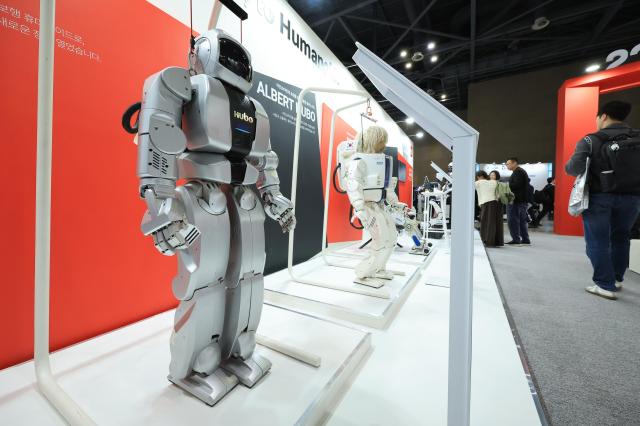
The Daejeon-based museum added 23 items to its national heritage registry for science and technology, bringing the total to 115 since the program began in 2019.
A special exhibition featuring HUBO runs through Dec. 6.
Three other robotics entries made this year's list, including MAHRU and AHRA, humanoids that operate over a wireless network, a six-axis industrial robot that helped Korea break its reliance on foreign technology, and Crabster CR200, the country's first underwater walking robot.
Professor Oh Jun-ho's team at the Korea Advanced Institute of Science and Technology (KAIST) unveiled HUBO in late 2004, as Korea raced to catch up with Japan's Honda and its ASIMO.
The 125-centimeter, 55-kilogram biped could walk, grasp objects and move each of its five fingers.
A successor, DRC-HUBO, carried Team KAIST to first place at the U.S. Defense Advanced Research Projects Agency's Robotics Challenge in June 2015, clearing the disaster-response course in 44 minutes and 28 seconds.
Rainbow Robotics, spun off from the team, now counts Samsung Electronics as its largest shareholder.
Han Jae-kwon, a robotics professor at Hanyang University, said the robot gave Koreans pride in matching a feat only Japan had achieved.
"HUBO is the beginning of that history, we believe," he told AJP in February, referring to the country's humanoid development.
AJP Takeaways
- South Korea's National Science Museum added 23 items, including the KAIST humanoid robot HUBO (KHR-3), to its national science and technology heritage registry on Nov. 10, 2026.
- The registry, launched in 2019, now holds 115 items. This year's robotics entries also include Mahru and Ahra, a six-axis industrial robot and the underwater walking robot Crabster CR200.
- HUBO was unveiled by Professor Oh Jun-ho's KAIST team in late 2004, and a successor model won the DARPA Robotics Challenge in June 2015.

Copyright ⓒ Aju Press All rights reserved.