SEOUL, August 4 (AJP) - South Korea's stock market is becoming "uninvestable" as extreme volatility erodes investor confidence in the KOSPI, Bloomberg reported on Tuesday.
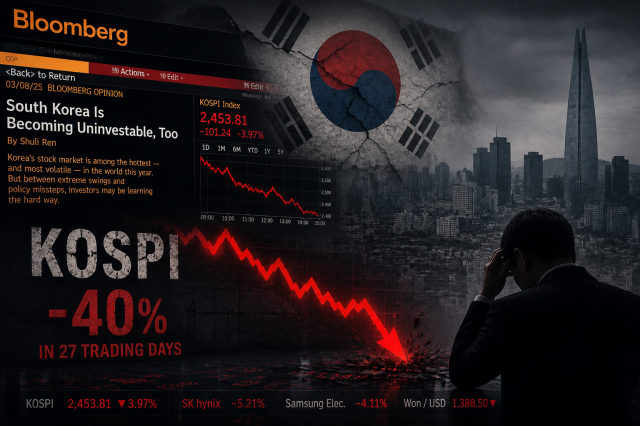
In a column headlined "South Korea Is Becoming Uninvestable, Too," the daily's columnist Shuli Ren warned, "In recent years, global asset managers have complained that China is uninvestable, mainly over two issues - the government's policy failures and its disregard for investors. Unfortunately, similar concerns are surfacing over South Korea."
"South Korea is home to the world's hottest and most volatile stock market this year," Ren wrote. "The KOSPI's near 40% tumble in just 27 trading days is comparable to China's market crash in 2015."
"But with an easing of the global AI stock rout, it's natural to ask if the benchmark index is destined for a rebound. Bulls might argue that unlike China a decade ago, [South] Korea's business fundamentals are sound," she said, adding that the country's two memory chipmakers Samsung Electronics and SK hynix are "direct beneficiaries of the AI infrastructure boom," accounting for more than half of the KOSPI, which is starting to look "seductively cheap."
But she said the benefits of the artificial intelligence (AI) boom and low valuations alone are not enough to justify expectations for a market rebound.
Ren then advised investors to "stay far, far away" from the KOSPI, saying, "Before predicting a rebound, we should ask if the recent selloff and the government's clumsy attempt to lift the KOSPI have traumatized a new class of investors and stigmatized the market."
Ren cited excessive volatility as the biggest challenge facing the South Korean stock market, with the KOSPI moving more than 5 percent in a single trading day on 33 occasions this year, compared with four times for Japan's Nikkei 225 and none for Hong Kong's Hang Seng Index.
She attributed much of the volatility to single-stock leveraged exchange-traded funds (ETFs) introduced in late May, which intensified market swings, concluding that the KOSPI will "continue to whipsaw."
"This rout might just reinforce [South] Koreans' long-held impression that their home market was a value trap. Unlike China, where tight capital controls prevent locals from cross-border trading, [South] Koreans are free to invest in whichever market they fancy," she wrote, forecasting that discouraged South Korean investors "might just pack up and never return" to the KOSPI.
Copyright ⓒ Aju Press All rights reserved.