SEOUL, August 05 (AJP) - Seoul will bankroll a Kookmin University plan to knit self-driving cars, delivery robots and air taxis into a single artificial intelligence system for the capital, committing up to 8 billion won, about $5.6 million at current exchange rates, over as long as nine years.
Kookmin University said Tuesday that its Automotive Convergence College had been selected for the Seoul Anchor 10 Challenge, one of the funding tracks in the city's 2026 regional talent development system.
The system, known by the English acronym ANCHOR, is the Ministry of Education's rebranded version of RISE, the framework that hands central government money for university funding to provincial and metropolitan governments to spend on their own priorities. The ministry announced the reorganization in April, saying the earlier version had produced regionally tailored projects without results that students could feel.
The Anchor 10 Challenge is the long-horizon research piece of that structure. Universities pick their own target rather than answering a government-written brief, and the money is meant to run through to patents and commercial licensing rather than stopping at published papers.
Nine years of funding is not guaranteed at the outset. Seoul's public notice for the program set an initial phase running to February 2028, with the extension going to the top half of participating universities at a mid-term review.
Kookmin University will run the work through a unit it calls the AI-SAT Mobility Project Group, led by Shin Sung-hwan, a professor in the Automotive Convergence College. The acronym stands for sense, act and trust, covering a system that reads the city's traffic environment, decides how to move through it, and does so in a way residents are willing to accept.
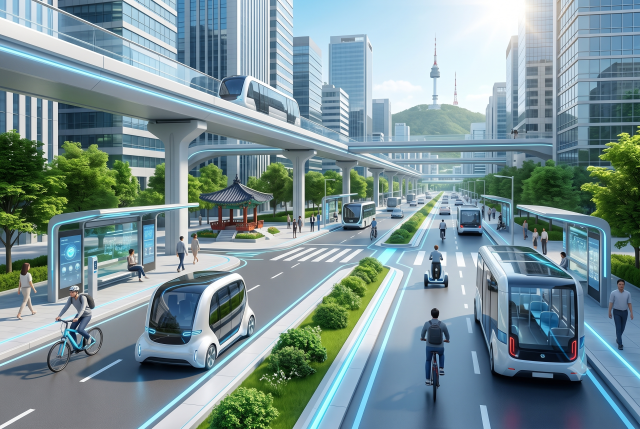
The technical goal is a platform the university has named AI-Defined Mobility, or ADM, which would place autonomous vehicles, mobile robots and urban air mobility aircraft under one decision-making layer instead of leaving each to operate on its own logic. Urban air mobility refers to the small electric aircraft, often described as air taxis, that South Korean transport planners expect to begin carrying passengers over cities within the next several years.
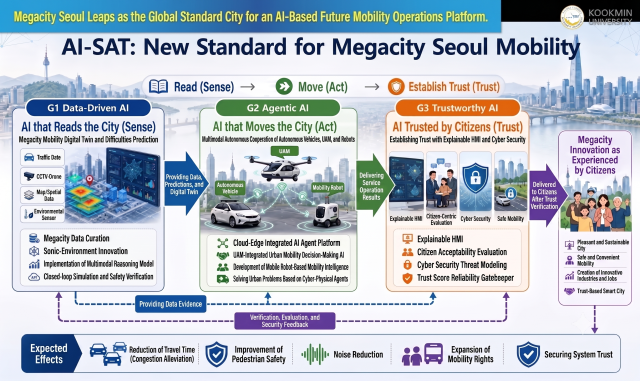
Researchers plan to use the platform to work through five problems the city has flagged: traffic congestion, accident risk, urban noise, restricted movement for elderly and disabled residents, and public distrust of autonomous systems.
Testing will happen on Seoul streets rather than in a laboratory. The university said it would gather data with the metropolitan government and district offices in congested areas, accident hotspots and neighborhoods that generate frequent noise complaints.
Among the technologies to be validated is vehicle-to-everything communication, or V2X, the system that lets cars exchange information directly with traffic signals, road sensors and one another. The project also covers communication security for urban air mobility aircraft and robots, along with a testing environment designed to track public willingness to use the technologies over an extended period.
Joining Shin on the research team are professors Yang Ji-hyun, Kim Jong-chan, Lim Se-jun, Song Kyo-won, Jeon Sang-hoon, Lee Seung-mok and Kim San-min.
For Kookmin University, the award lands in its 80th anniversary year and slots into KMU VISION 2035: EDGE, the mid-to-long-term strategy the school proclaimed last October. Mobility is one of eight fields the university has designated for concentrated investment, alongside automotive engineering, software and autonomous driving research.
Other Seoul universities picked for the same track this year are pursuing sharply different targets. Dongguk University is working on optical semiconductors for AI applications, while Sookmyung Women's University is pursuing anti-aging therapies aimed at extending healthy lifespan by a decade.
"This selection came on the strength of the convergence research capacity Kookmin University has built up in automotive and mobility engineering and artificial intelligence," Shin said. "We will carry out the project so the results connect to patents and technology commercialization, and contribute to the growth of Seoul's future mobility industry."
---
AJP Takeaways:
● Kookmin University said Tuesday its Automotive Convergence College was selected for the Seoul Anchor 10 Challenge, a city research track funding up to 8 billion won, about $5.6 million, over as long as nine years.
● The AI-SAT Mobility Project Group, led by Kookmin University professor Shin Sung-hwan, will build a platform called AI-Defined Mobility that places autonomous vehicles, mobile robots and urban air mobility aircraft under a single decision-making layer.
● Field testing will run on Seoul streets with the metropolitan government and district offices, covering congested areas, accident hotspots and neighborhoods with frequent noise complaints, and validating vehicle-to-everything communication and communication security for aircraft and robots.
● Funding is not guaranteed for the full term. Seoul's public notice set an initial phase running to February 2028, with the extension going to the top half of participating universities at a mid-term review.
Copyright ⓒ Aju Press All rights reserved.