

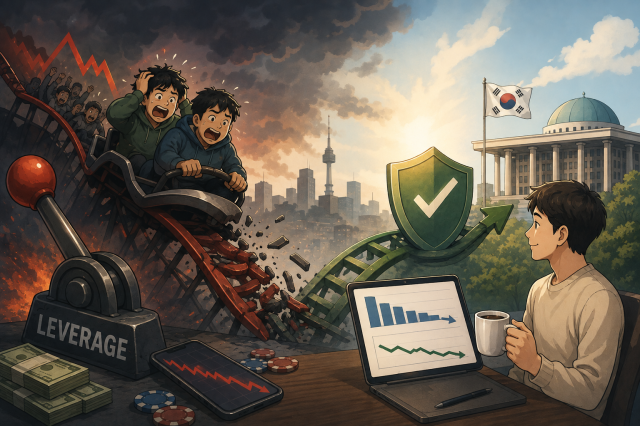
Retail investors poured hundreds of trillions of won into newly launched single-stock leveraged exchange-traded funds (ETFs) linked to the country's two major chipmakers Samsung Electronics and SK hynix, fueling one of the sharpest boom-and-bust cycles in the country's stock market history.
Circuit breakers were activated on consecutive trading days for the first time, as investors who had borrowed heavily to buy stocks were forced into widespread selling as prices collapsed. Regulators, meanwhile, came under fire for failing to curb the rapid spread of highly speculative products.
But the mood has shifted. Both regulators and investors are now navigating a gradual retreat from leverage after one of the most volatile episodes in the country's stock market history. The clearest sign is how quickly leverage itself is disappearing.
Trading in 16 leveraged and inverse ETFs linked to Samsung Electronics and SK hynix has collapsed since regulators raised the minimum cash deposit requirement to 30 million won (about US$20,000) on July 31.
Turnover fell from roughly 12.4 trillion won on July 30 to about 3 trillion won on the day the rule took effect, before dropping again to around 1.2 trillion won two trading days later — about one-tenth of the level seen before the regulation.
Other indicators also point to a broad reduction in risk-taking. According to the Korea Financial Investment Association (KOFIA), outstanding margin loans — money borrowed from brokerages to buy stocks — fell below 30 trillion won at the end of July for the first time in six months. The balance has shrunk by nearly 10 trillion won from its June 24 peak of 38.6 trillion won, meaning more than a quarter of margin financing has disappeared in little over a month.
Loans backed by stocks also declined sharply. Outstanding balances fell to about 25.4 trillion won as of July 31, down nearly 3 trillion won from 28.1 trillion won on March 5. The decline was compounded by a wave of forced liquidations after the market's sharp selloff, as investors either repaid debt voluntarily or had their positions liquidated by brokerages after failing to meet margin requirements. Those liquidations totaled 103.8 billion won on July 30 and 122.0 billion won on July 31 following consecutive market-wide circuit breakers.
Taken together, the data point to a broad deleveraging across South Korea's retail investment market rather than a retreat confined to leveraged ETFs alone.
For regulators, that appears to be the intended outcome. Authorities tightened suitability requirements and tripled the minimum cash deposit for single-stock leveraged ETFs after the products came to dominate ETF trading within weeks of their launch. Officials argued the products had magnified volatility by encouraging short-term speculation around just two companies that dominate the country's equity market.
Early data suggest the measures are beginning to have the intended effect. Trading in single-stock leveraged ETFs has fallen sharply while the broader market has remained orderly, indicating that speculative activity has cooled without causing broader market disruption.
Investors, meanwhile, also appear to be drawing lessons from one of the most violent corrections in the market's history.
The KOSPI has recovered above the 6,300 level after plunging nearly 44 percent from its late-June peak, but margin borrowing and leveraged ETF trading remain well below the levels seen before the selloff. The contrast suggests many retail investors are still reluctant to return to highly leveraged bets.
That shift is no longer confined to the domestic market. After buying a net $3.79 billion of the Direxion Daily Semiconductor Bull 3X Shares ETF (SOXL), a leveraged fund designed to deliver three times the daily return of the Philadelphia Semiconductor Index, in July, Korean retail investors turned into net sellers at the start of August. On Aug. 3 alone, they sold a net $664 million — nearly one-fifth of their total July purchases — before returning to modest net buying the following day.
The selling did not signal a broader retreat from U.S. equities. Korean investors remained net buyers of U.S. stocks, purchasing a net $278 million in early August, while rotating into semiconductor companies including Micron Technology, Sandisk and SK hynix's U.S.-listed ADR, all of which ranked among their most-bought stocks over the period.
The pattern suggests investors are becoming more selective, shifting away from leveraged products while maintaining confidence in the long-term AI investment theme.
The retreat from leverage, however, does not mean the underlying risks have disappeared. It is changing who bears them.
According to Bloomberg, demand has surged for over-the-counter derivatives known as "crash puts" or "stability notes." The products are designed to protect investment banks against the unlikely but potentially devastating scenario in which a stock loses roughly half of its value in a single trading session.
Instead of keeping that risk themselves, banks pay other investors to take it on in exchange for higher returns.
Goldman Sachs and BNP Paribas have reportedly marketed such products linked to Samsung Electronics and SK hynix, offering double-digit returns to investors willing to absorb losses if an extreme one-day market collapse occurs.
South Korea's experience reflects a broader trend. As leveraged ETFs continue to expand globally, financial institutions are developing increasingly sophisticated ways to redistribute the risks created by those products rather than keeping them on their own balance sheets.
The speculative frenzy may be cooling. Whether the risks have been reduced - or simply redistributed - may prove to be the market's next lesson.
AJP Takeaways:
— South Korea's retail investors have sharply reduced leverage since July 31, 2026, after regulators tripled the minimum cash deposit requirement for single-stock leveraged exchange-traded funds (ETFs) from 10 million won to 30 million won.
— Trading in Samsung Electronics and SK hynix leveraged and inverse ETFs has fallen by about 90 percent, with daily turnover dropping from roughly 12.4 trillion won on July 30, 2026, to around 1.2 trillion won two trading days after the new rules took effect.
— Margin borrowing has also declined significantly. Outstanding margin loans fell below 30 trillion won at the end of July 2026 for the first time in six months, down nearly 10 trillion won from the June 24, 2026 peak.
— Outstanding loans backed by stocks declined to about 25.4 trillion won as of July 31, 2026, indicating that investors are relying less on borrowed money to invest in equities.
— According to Bloomberg, investment banks including Goldman Sachs and BNP Paribas have marketed over-the-counter derivatives such as "crash puts" and "stability notes" that transfer extreme market risk to investors willing to accept higher potential returns.

Copyright ⓒ Aju Press All rights reserved.
