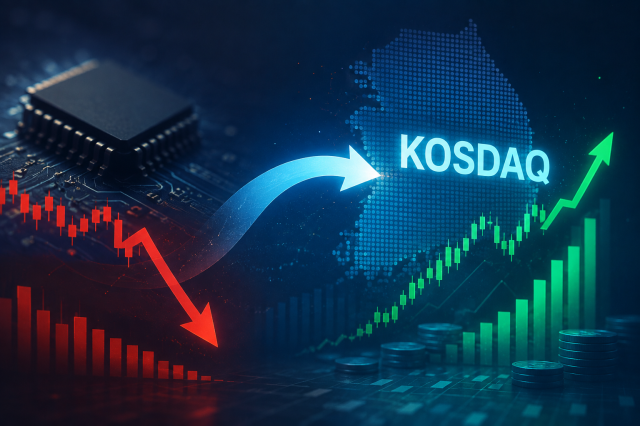
SEOUL, August 9 (AJP) - South Korea's junior KOSDAQ market has regained momentum after stricter rules on single-stock leveraged and inverse exchange-traded funds (ETFs) took effect, as short-term capital that had been concentrated in such products linked to heavyweight stocks flowed into other areas of the market.
According to the Korea Exchange on Sunday, the KOSDAQ rose 23.89 percent to 798.81 points last Friday from 644.78 about a week earlier, just before the rules took effect. The junior index gained for five consecutive sessions, with buy-side circuit breakers repeatedly triggered, signaling strong buying demand.
Trading also picked up, with average daily transactions increasing 13.4 percent from 5.08 trillion won (about US$3.61 billion) in the final week of July to 5.76 trillion won in the first week of August.
By contrast, trading volume in single-stock leveraged ETFs, which totaled 13.9 trillion won as of July 30, fell sharply to the 1 trillion won range under the stricter rules, which require higher minimum deposits along with other measures that reduce access.
Market analysts said demand that had flowed into leveraged ETFs, driven by hopes of profiting from high volatility, shifted into other stocks, helping boost activity in the KOSDAQ market.
KOSDAQ-linked ETFs also saw heavy trading last week, with KODEX KOSDAQ 150 Leverage, KODEX KOSDAQ 150 Futures Inverse and KODEX KOSDAQ 150 repeatedly ranking among the most-traded ETFs.
Institutional investors were net buyers of KOSDAQ shares during the same period, purchasing 956.1 billion won, while retail investors also bought a net 120.5 billion won. Foreign investors, meanwhile, were net sellers, offloading 1.12 trillion won.
As money that had sought quick gains through leveraged products linked to large-cap stocks moved into smaller companies, rallies broadened across KOSDAQ-listed firms, with many of the top gainers being small- and mid-cap stocks rather than the largest companies by market capitalization.
According to the Korea Exchange on Sunday, the KOSDAQ rose 23.89 percent to 798.81 points last Friday from 644.78 about a week earlier, just before the rules took effect. The junior index gained for five consecutive sessions, with buy-side circuit breakers repeatedly triggered, signaling strong buying demand.
Trading also picked up, with average daily transactions increasing 13.4 percent from 5.08 trillion won (about US$3.61 billion) in the final week of July to 5.76 trillion won in the first week of August.
By contrast, trading volume in single-stock leveraged ETFs, which totaled 13.9 trillion won as of July 30, fell sharply to the 1 trillion won range under the stricter rules, which require higher minimum deposits along with other measures that reduce access.
Market analysts said demand that had flowed into leveraged ETFs, driven by hopes of profiting from high volatility, shifted into other stocks, helping boost activity in the KOSDAQ market.
KOSDAQ-linked ETFs also saw heavy trading last week, with KODEX KOSDAQ 150 Leverage, KODEX KOSDAQ 150 Futures Inverse and KODEX KOSDAQ 150 repeatedly ranking among the most-traded ETFs.
Institutional investors were net buyers of KOSDAQ shares during the same period, purchasing 956.1 billion won, while retail investors also bought a net 120.5 billion won. Foreign investors, meanwhile, were net sellers, offloading 1.12 trillion won.
As money that had sought quick gains through leveraged products linked to large-cap stocks moved into smaller companies, rallies broadened across KOSDAQ-listed firms, with many of the top gainers being small- and mid-cap stocks rather than the largest companies by market capitalization.
"The heavy concentration in large-cap stocks that arose around single-stock leveraged ETFs has eased, while more cash has built up, creating more favorable conditions for money to flow into the KOSDAQ," said Kwon Beom-seok, an analyst at Samsung Securities.
But it remains to be seen whether the KOSDAQ, which marked its 30th anniversary last month yet remained below 1,000 points, is headed for a recovery after years of doldrums.
AJP Takeaways:
- South Korea's KOSDAQ index rose 23.89 percent, from 644.78 to 798.81, between approximately July 31, 2026, and Aug. 7, 2026, following the implementation of stricter rules on single-stock leveraged and inverse exchange-traded funds (ETFs), with buy-side circuit breakers repeatedly triggered over five consecutive sessions of gains.
- Average daily trading value on the KOSDAQ increased 13.4 percent, from 5.08 trillion won in the final week of July 2026 to 5.76 trillion won in the first week of August 2026, while trading volume in single-stock leveraged ETFs fell from 13.9 trillion won as of July 30, 2026, to the 1 trillion won range.
- Institutional investors net-bought 956.1 billion won and retail investors net-bought 120.5 billion won in KOSDAQ shares during the week of Aug. 3–7, 2026, while foreign investors net-sold 1.12 trillion won.
- Rally gains broadened beyond large-cap stocks, with many top-performing KOSDAQ-listed companies during the week being small- and mid-cap firms as capital that had concentrated in single-stock leveraged products shifted into other areas of the market.
- The KOSDAQ market marked its 30th anniversary on July 1, 2026, but remained below the 1,000-point threshold as of Aug. 7, 2026, leaving its longer-term recovery trajectory uncertain.
Copyright ⓒ Aju Press All rights reserved.