

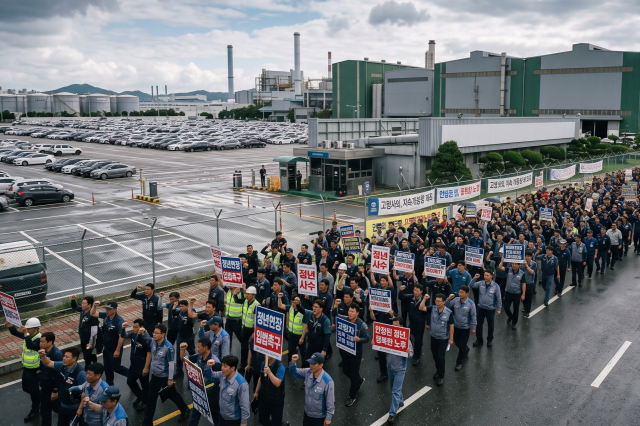
SEOUL, August 21 (AJP) - Every production line at South Korea's largest automaker went down Friday morning as workers began their first full-day strike in a decade, a walkout that turns on how long they get to keep their jobs rather than on how much they are paid.
Morning-shift members of the Hyundai Motor union, who normally clock in at 6:45 a.m., did not come to work. The afternoon shift that starts at 3:30 p.m. will not report either, leaving plants in Ulsan, Jeonju and Asan without production for 16 hours across the day. The union counted about 39,000 members taking part, office staff included.
The full day will bring the union's strike total for the year to 60 hours, and double that in stopped line time. Industry estimates put cumulative losses through Friday at 55,200 vehicles and more than 2.3 trillion won ($1.65 billion) in revenue. Hyundai does not publish its own figures.
Pay was not the obstacle. The company put an offer on the table at the 15th bargaining session on July 8 that included a monthly base wage increase of 89,000 won ($64), performance pay worth 350 percent of monthly base pay, a lump sum of 10 million won ($7,174) and 15 shares of company stock. The union turned it down and has since built its campaign around three demands that sit outside the wage package entirely.
The largest of the three is the retirement age. South Korean law requires employers to set retirement at 60 or later, and the union wants Hyundai to extend that toward 65, timed so that a departing worker can draw the national pension without a gap. Hyundai already rehires retirees for up to two years, which the union considers a substitute rather than a solution.
At Tuesday's session, the company proposed settling the timing of any extension through a supplementary agreement once the National Assembly changes the law, and taking up the reinstatement question at the end of the year. The union rejected both.
Hyundai's position is that all three items fall outside this year's wage talks, that there are no grounds to reinstate members who were lawfully dismissed for illegal acts during past union activity, and that politicians have to settle the retirement age before a single company can.
The second demand concerns the bonus. Hyundai pays an annual bonus set as a multiple of monthly base pay, currently 750 percent, and the union wants it raised to 800. The union argues that fixed pay, including base wage, makes up only 54.8 percent of what a member takes home, which forces workers into overtime and weekend shifts to hold a living income. It pointed to the company's retained earnings, which are accumulated profits rather than cash on hand, and which grew from 11.4 trillion won ($8.2 billion) in 2007 to 101.3 trillion won ($72.7 billion) as of last year.
Talks have gone nowhere since. The two sides met 16 times starting May 6, and Tuesday's session at the Ulsan plant broke up after less than three hours with no date set for the next one. Money Today quoted Lee Jong-chul, the union's branch chairman, as saying the next session would wait until working-level talks produced something better. The last time the union struck this hard was 2016, when it logged 106 hours of strikes and 212 hours of stopped lines.
Friday's walkout is not Hyundai's alone. The Korean Metal Workers' Union announced at a press conference Wednesday that roughly 90,000 workers across the auto sector would stop work over two days, with parts makers, subcontractors and Hyundai Motor Group affiliates halting Thursday and assembly plants following Friday. Union officers were due at the group's Yangjae-dong headquarters in Seoul for a rally at 2 p.m.
Underneath that action sits a second dispute. An amended trade union law now recognizes that a prime contractor carries employer responsibility toward workers it does not directly employ, but the Korean Metal Workers' Union (KMWU) says Hyundai and affiliates, including Hyundai Mobis, Hyundai Wia and Hyundai Glovis, have refused to post notice of bargaining demands or to attend. About 80 percent of the 20,000 KMWU members seeking such talks work for Hyundai Motor Group companies, according to Ulsan Journal.
The retirement age fight reaches well past the auto industry. South Korea crossed into super-aged status in December 2024, when people 65 and older passed 20 percent of the population, and the country now has one of the world's longest life expectancies alongside one of its lowest birth rates. A worker who leaves at 60 cannot claim the national pension until 63 today, and that threshold rises to 65 by 2033.
The National Assembly has been circling the problem for a year. The governing Democratic Party set up a special committee on extending the retirement age in November 2025, the government accepted phased extension in principle in March, and the discussion was then pushed past the June 3 local elections. The committee has been working toward a bill for the regular session that opens next month, built around a staged increase toward 65 starting near the end of the decade. Business groups have argued for rehiring schemes instead, which is the same argument Hyundai made at the bargaining table this week.
The union plans to strike for four hours on each of the next two working days, Monday and Tuesday, and will convene its central strike committee on Tuesday to decide whether to go further.
Kang Sung-ho, who leads the metal union's Kia branch, made the demographic case at Wednesday's press conference. "About 2,000 workers reach retirement age and leave the floor every year," he said, adding that once the income gap between retirement and the first pension payment is taken into account, extending the retirement age is a task that can no longer be put off.
Copyright ⓒ Aju Press All rights reserved.
