

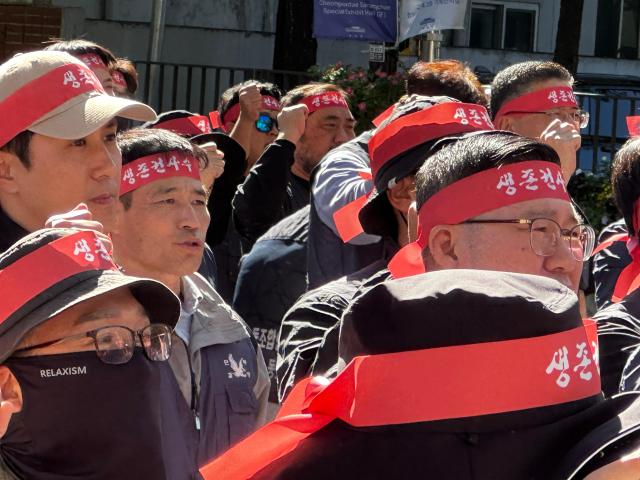
About 850 to 900 workers from Sacheon, South Gyeongsang Province, joined the first of three planned demonstrations involving KAI’s roughly 3,800 union members.
“We’ve protested outside the Fair Trade Commission before, but fewer than 100 workers attended then,” Lim Byung-jin, publicity director of the KAI labor union, told AJP.
“The second rally is confirmed for October 20, with about 1,200 workers expected. We’re still coordinating the third rally, which will likely take place in early November,” he added.
Among the protesters was Choi Young-jin, who joined one of KAI’s predecessor companies in 1995, four years before KAI was formally established.
“It feels like Hanwha is getting KAI for next to nothing,” Choi said.
He described the mood inside the company as sour. By his estimate, more than 90 percent of employees view Hanwha’s growing involvement negatively, and the concern runs deepest among veterans who helped build the aircraft maker.
The protests follow Hanwha’s accumulation of a combined 15.89 percent stake in KAI through three affiliates: Hanwha Aerospace with 9.90 percent, Hanwha Systems with 4.98 percent and Hanwha Aerospace USA with 1.01 percent.
Now KAI’s second-largest shareholder, the conglomerate changed the stated purpose of its holdings from simple investment to management participation in May. The state-run Export-Import Bank of Korea remains the largest shareholder with 26.41 percent.
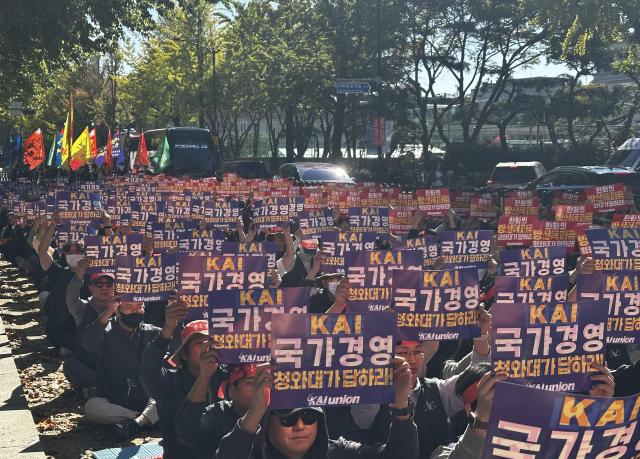
Lim said the union’s central concern is that Hanwha’s growing influence could erode KAI’s ability to choose its suppliers independently, particularly for fighter jet and export programs.
Hanwha already spans several defense segments, including aircraft engines, radar, avionics and weapons. KAI, for its part, is a major aircraft manufacturer and systems integrator.
Lim pointed to the KF-21 fighter program, which uses equipment from Hanwha, LIG D&A and other domestic and overseas manufacturers.
According to Lim, Hanwha supplies roughly 120 equipment items for the program and LIG D&A around 70. The figures were provided by the union and could not be independently verified.
“If Hanwha takes control of KAI, whose products would KAI choose? Hanwha’s products,” Lim said. He argued that rival suppliers could gradually lose out regardless of their technological merits.
He said procurement works differently for government-funded defense projects and for aircraft export contracts.
In domestic government programs, defense authorities set many equipment requirements and procurement arrangements. That limits KAI’s ability to replace designated components on its own.
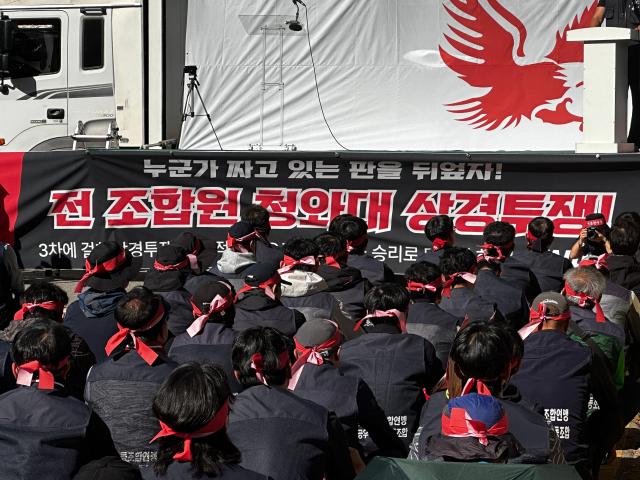
Lim offered a hypothetical: Hanwha equipment priced at 10 million won against an overseas alternative at 5 million won.
Under independent management, he said, KAI could pick the cheaper option or press Hanwha to cut its price or improve its product. His concern is that such choices could become harder if Hanwha gains control of KAI’s management.
The union argues that concentrating aircraft manufacturing and key component businesses under one conglomerate could weaken rival defense manufacturers and smaller suppliers. That, it says, could affect prices, delivery schedules and product quality.
Lim, who said he has worked at KAI for 16 years, said many of Wednesday’s demonstrators had been with the company and its predecessors for more than three decades.
“Everyone wants the company they work for to grow. But Hanwha isn’t the answer,” Lim said.
He also raised the prospect of restructuring, citing Hanwha’s past acquisitions of defense businesses, including Samsung Techwin, Samsung Thales and Doosan DST.
Lim questioned whether a future owner might sell off unprofitable divisions or transfer workers to other subsidiaries.
“There are certainly concerns that the business I have worked in could disappear, or that a colleague working next to me could be transferred to another business or company,” Lim said.
Those concerns remain hypothetical. No acquisition or restructuring plan for KAI has been formally announced.
The union also challenged a 1.8 billion-won ($1.25 million) consultancy project by the Export-Import Bank on strengthening the aerospace industry’s competitiveness.
According to the union, the study covers assessments of individual companies, plans to develop leading aerospace firms, implementation road maps and financing strategies.
The union said the bank told its representatives in May that the government was not considering a sale of KAI or any change to its ownership structure.
It questioned why the bank was pursuing such a study only months later, after Hanwha raised its stake and formally declared its intention to participate in management.
A union protest poster accused the bank of running a disguised consultancy in preparation for privatization. No government decision to privatize KAI has been announced.
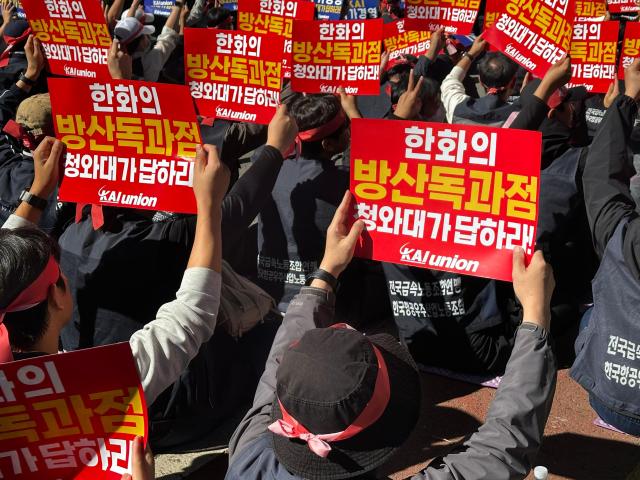
The rally drew support from the Federation of Korean Trade Unions, representatives of the LIG D&A labor union and civic groups from Sacheon, where KAI is headquartered.
Speakers warned that a change in KAI’s ownership could ripple beyond its employees. They said it could also affect research and development, local suppliers and the wider aerospace cluster around Sacheon.
KAI was established in 1999 under the Kim Dae-jung administration through a government-led consolidation of the aerospace industry. It has since played a central role in developing domestically produced aircraft, including the KF-21 fighter.
Kim urged President Lee Jae Myung to honor his earlier commitment to developing the aerospace industry around KAI and protecting the industrial base in South Gyeongsang Province.
Hanwha has said its expanded investment is intended to strengthen cooperation with KAI and improve South Korea’s global competitiveness in aerospace and defense. The conglomerate has not formally announced a plan to acquire KAI.

Copyright ⓒ Aju Press All rights reserved.
