

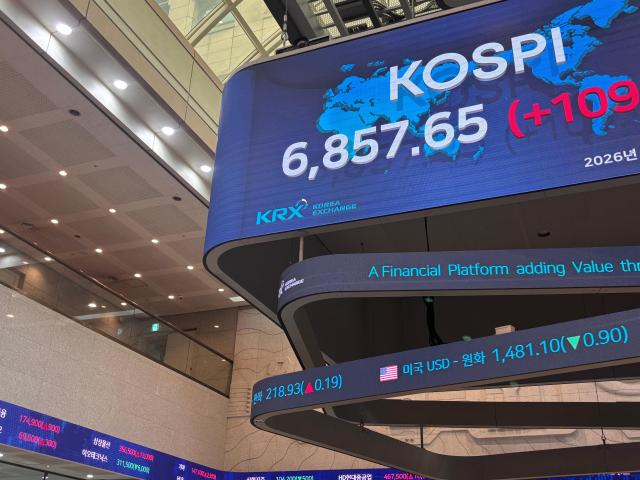
The KOSPI closed at 6,912.95, up 0.88 percent or 60.37 points from the previous session. It marked a second straight day of gains after the index surged 5.89 percent the previous day.
The index opened sharply lower at 6,759.95 and fell to as low as 6,742.44 before recovering. It later climbed to 6,954.12, marking an intraday swing of more than 210 points.
The reversal was largely driven by major chipmakers including Samsung Electronics. Investors were encouraged by expectations that Samsung Electronics could announce a large shareholder-return package, while SK hynix continued to attract buying after unveiling a record 40 trillion-won ($28 billion) share buyback plan earlier this week.
Samsung Electronics rose 3.87 percent to 281,500 won on expectations of a new shareholder-return package, a move that also lifted other Samsung affiliates. Samsung Life Insurance surged 10.61 percent to 328,500 won, while Samsung C&T jumped 5.75 percent to 395,500 won. SK hynix gained 2.31 percent, or 39,000 won, to 1.73 million won.
Those gains helped offset pressure from the weak overnight performance on Wall Street and another rise in U.S. Treasury yields, which had weighed on the market at the open.
The strength extended beyond chipmakers
By sector, insurers, telecommunications and semiconductor-related shares were among the strongest performers. Life insurers surged 8.88 percent, wireless telecommunications services rose 4.80 percent and non-life insurers gained 3.55 percent. Semiconductor and semiconductor equipment stocks advanced 2.97 percent, while banks climbed 2.36 percent.
Financials also advanced on expectations of stronger corporate value-up measures and shareholder returns. Hana Financial Group rose 3.17 percent to 130,900 won, Shinhan Financial Group climbed 2.97 percent to 104,100 won and KB Financial gained 2.69 percent to 164,300 won.
Other large caps were mixed. Samsung Electro-Mechanics fell 5.73 percent to 1,316,000 won and LG Energy Solution dropped 4.05 percent to 343,500 won. Samsung Biologics lost 1.46 percent to 1,551,000 won, while Hyundai Motor slipped 0.60 percent to 415,000 won and SK Square was unchanged at 1,123,000 won.
Samsung SDI also fell 4.30 percent to 478,000 won. After the market closed, the company said it would sell 13.09 million shares in Samsung Display back to the display maker for about 4.45 trillion won ($3.2 billion) to raise funds for future growth investments.
The shares represent about one-third of the company's 39.86 million-share holding in Samsung Display. Once the transaction is completed, its stake in the display maker will fall to 10.2 percent from 15.2 percent.
While the KOSPI was supported by gains in selected large-cap stocks, the KOSDAQ moved sharply in the opposite direction. Selling spread across growth stocks, with all 10 of its largest companies by market capitalization ending lower.
The junior index closed at 801.94, down 4.63 percent. It fell as low as 795.57 during the session before trimming some losses. Foreign investors sold a net 283.6 billion won of shares and institutions unloaded 346.4 billion won, while retail investors bought a net 623.8 billion won.
Biotechnology platform developer Alteogen fell 5.74 percent to 320,000 won. Battery materials holding company EcoPro dropped 7.26 percent to 81,700 won, while cathode-material maker EcoPro BM slid 7.45 percent to 105,600 won. Robot maker Rainbow Robotics lost 3.71 percent to 454,000 won.
Losses also spread to semiconductor-related names. Semiconductor, display and solar equipment maker Jusung Engineering fell 4.91 percent to 168,600 won, while semiconductor and display equipment maker Wonik IPS dropped 5.27 percent to 107,900 won. Semiconductor testing-component maker Leeno Industrial declined 5.47 percent to 65,700 won, and laser-based semiconductor equipment maker EO Technics lost 2.53 percent to 404,500 won.
Biotech shares were similarly weak, with HLB falling 3.13 percent to 38,650 won and bispecific-antibody developer ABL Bio tumbling 8.85 percent to 75,200 won.
The broad selloff stood in sharp contrast to the KOSPI, where buying remained concentrated in a relatively narrow group of large-cap stocks.
The session followed a broad retreat on Wall Street overnight. The Dow Jones Industrial Average fell 1.32 percent Thursday, while the S&P 500 lost 0.87 percent and the Nasdaq Composite dropped 1.00 percent.
Higher bond yields added to the pressure, with the benchmark 10-year U.S. Treasury yield climbing above 4.70 percent. That backdrop weighed more heavily on growth-sensitive KOSDAQ shares, while shareholder-return expectations helped insulate the KOSPI's largest chip and financial stocks.
The won strengthened to 1,385.20 per dollar, compared with 1,392.60 the previous day.
Across Asia, markets were mixed Friday as elevated U.S. Treasury yields and high oil prices kept investors cautious. Japan's Nikkei 225 fell 0.30 percent to 66,016.36 as rising global bond yields and oil prices weighed on sentiment. Japan's own bond yields also remained elevated, reinforcing expectations that the Bank of Japan could raise rates again as early as September.
China's Shanghai Composite was little changed, edging up 0.04 percent to 3,905.20. Mainland shares were relatively resilient despite pressure from global bond markets, while enthusiasm around domestic technology and strategic industries continued to provide some support.
Hong Kong outperformed the region, with the Hang Seng Index climbing 1.16 percent to 25,997.73.

Copyright ⓒ Aju Press All rights reserved.
