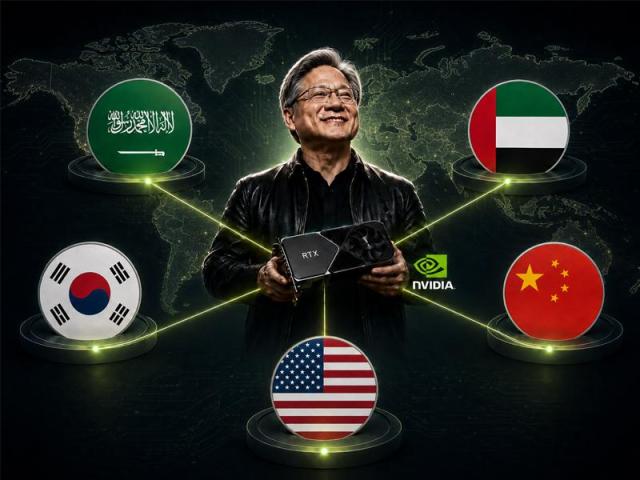
The government said on Aug. 18 that SK Telecom, LG AI Research and startup Upstage had cleared the second round of its sovereign AI foundation model contest. For the next stage, each team will receive access to roughly 1,000 Nvidia B200 graphics processing units, up from about 768 in the first half, at a combined six-month leasing cost of around 120 billion won ($86.7 million).
There is a revealing paradox in that arrangement.
South Korea is spending public money to reduce its dependence on foreign artificial intelligence. To do so, it is deepening its dependence on the American company that supplies the computing infrastructure on which much of the world's AI already runs.
Korea's predicament is increasingly a miniature of a global one.
From Seoul to Riyadh and Abu Dhabi, governments are pouring money into sovereign AI in an effort to keep national data, models and critical digital capabilities under greater domestic control.
Yet the harder countries race to establish AI sovereignty, the more infrastructure they are building around Nvidia.
The result is turning the sovereign AI boom into something Nvidia could scarcely have designed better for itself. Governments around the world financing an expansion of the ecosystem in which it already occupies the center.
Nvidia's dominance starts with chips.
About 92 percent of sovereign AI large-language-model projects tracked by Counterpoint Research use Nvidia chips. The Center for a New American Security finds Nvidia GPUs in 52 percent of the sovereign AI infrastructure projects in its database. Roughly 70 percent of sovereign AI projects tracked by CNAS involve at least one foreign partner, and four-fifths of those include an American company.
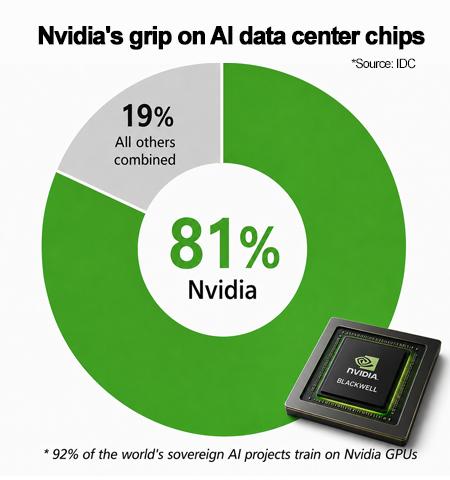
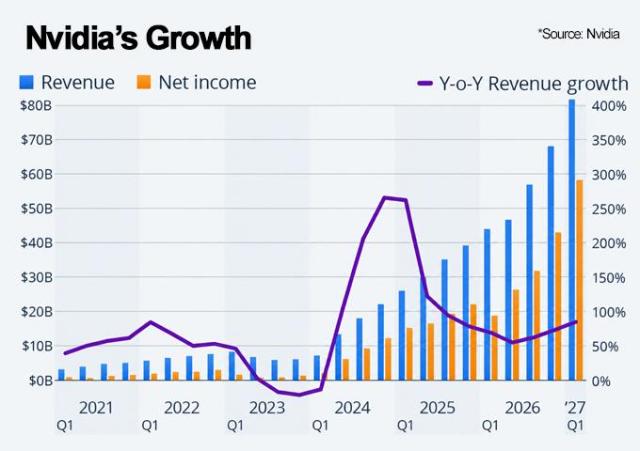
Nvidia reported $75.2 billion in data-center revenue for the quarter ended April 26, up 92 percent from a year earlier.
But the more consequential question is no longer simply how many GPUs Nvidia can sell.
It is how much of the architecture surrounding AI those GPUs can pull into Nvidia's orbit.
That is what makes the sovereign AI race different from an ordinary semiconductor boom.
A country buying thousands of Nvidia processors is not purchasing interchangeable pieces of silicon. Its researchers learn CUDA, Nvidia's software platform.
Its data centers are increasingly designed around Nvidia networking and rack-scale architectures. Models are trained and optimized in that environment. Engineers, cloud providers and startups acquire skills built around it.
The larger the installed base becomes, the higher the potential cost of moving away.
Sovereign AI can therefore create a peculiar form of path dependence. Governments seeking greater technological autonomy may simultaneously build domestic AI ecosystems whose most difficult component to replace remains foreign.
The paradox is sharpest where the money is deepest.
Saudi Arabia and the United Arab Emirates have committed tens of billions of dollars to becoming major AI powers and have deliberately spread some of that spending among alternatives including AMD, Qualcomm and Groq.
Saudi Arabia's Humain, for example, agreed with AMD on a multibillion-dollar infrastructure program partly as a way to avoid reliance on a single hardware vendor.
Yet Nvidia remains at the center of the kingdom's most ambitious training infrastructure.
Humain's Nvidia agreement calls for several hundred thousand of the company's advanced GPUs over five years, beginning with an 18,000-chip GB300 system. The UAE's Stargate project in Abu Dhabi similarly plans to use Nvidia's latest hardware for its initial buildout.
The diversification does not mean an escape from Nvidia.
What should draw greater attention is how aggressively Nvidia is widening the perimeter of that dependence. Its ambitions now reach above the chip into the model itself.
The company struck a $6 billion licensing agreement with AI startup Poolside that gives Nvidia access to technology and engineering talent as it builds more powerful open-weight models, positioning itself against Chinese systems such as DeepSeek as well as the closed models developed by companies including OpenAI and Anthropic.
Nvidia this month announced partnerships with Apollo, BlackRock, Blackstone, Brookfield, Goldman Sachs and KKR aimed at mobilizing more than $500 billion of third-party capital for AI infrastructure.
The proposition is unusual.
Nvidia wants lenders and infrastructure investors to treat compute itself as a long-lived, revenue-producing asset that can be financed, transferred between operators and redeployed for different workloads.
Its argument rests in part on the breadth of the Nvidia ecosystem.
Because GPUs supported by CUDA can serve many models and customers, the company argues, they retain economic usefulness beyond any single AI project.
Technical dominance gives Nvidia GPUs a large base of potential users. A large base improves their perceived redeployability. Greater redeployability can make lenders more comfortable financing them. Cheaper or more abundant financing can then make Nvidia infrastructure easier to buy.
The ecosystem reinforces the economics, and the economics reinforce the ecosystem.
"If GPUs have broad use cases on the back of the CUDA ecosystem and a large installed base, financial institutions have room to rate their residual value and redeployability highly," said Kang Jae-koo, an analyst at Hana Securities.
"If that translates into higher collateral value or lower capital costs than rivals, customers will come to prefer Nvidia by weighing not just GPU performance but the total financing cost of an entire AI factory," Kang said.
Nvidia's advantage is no longer limited to chip performance. Cheaper financing across its ecosystem could deepen its lead over competitors.
Korea offers an unusually revealing view of how far the orbit can extend.
The clearest example came this month when LG Chairman Koo Kwang-mo and Nvidia Chief Executive Jensen Huang signed a strategic cooperation agreement at Nvidia's Santa Clara headquarters spanning humanoid robots, AI factories and mobility.
LG brings manufacturing capability, actuators, sensors and batteries.
Nvidia increasingly supplies the intelligence layer.

"As our collaboration gains momentum, the tasks where the two companies can work together have become clearer in the field of AI factory, physical AI and mobility," Koo said.
The significance goes beyond one robot.
Nvidia's position in AI is spreading from systems that train language models into the machines, factories and vehicles that may eventually run them.
Even companies created partly as alternatives to Nvidia are being caught by that gravitational pull.
Huang recently met Rebellions co-founder and CEO Park Sung-hyun at Nvidia's headquarters, with the two companies in preliminary discussions that Bloomberg reported could range from technical cooperation or investment to a possible acquisition.
No transaction has been agreed, and Rebellions has confirmed the meeting but not the substance of the talks.
The symbolism is nevertheless striking.
Rebellions has spent years positioning its inference processors as part of a Korean answer to Nvidia's dominance. Park has publicly described his ultimate ambition as taking market share from the American chip giant.
Now even one of the companies built to challenge Nvidia may find strategic value in entering its orbit.
None of this means sovereign AI is futile, or that countries must manufacture every layer of the AI stack themselves.
Even with sufficient GPUs, countries lack equal access to frontier researchers, energy, data-center capacity, advanced networking and the capital required to keep upgrading systems as models become more compute-intensive.
Complete technological self-sufficiency would therefore be prohibitively expensive for all but a handful of countries — and probably inefficient even for them.
The more useful question is what a country must be able to control, substitute or keep operating when a critical foreign supplier becomes unavailable.
The Chey Institute for Advanced Studies argued in a report released Sunday that sovereign AI should move beyond ownership of a domestic model toward what it calls "access sovereignty" and "operational sovereignty."
A country, it argued, should retain reliable access to essential AI technology while possessing the ability to switch systems and maintain critical functions if a particular model or cloud service is cut off.
It also points toward the actual challenge posed by Nvidia.
Countries do not necessarily need to eliminate foreign technology to achieve AI sovereignty. They need enough alternatives, interoperability and domestic capability that using foreign technology does not leave essential national functions hostage to a single supplier.
The sovereign AI race may therefore be entering a second stage.
The first was about building national models.
The next will be about deciding which parts of the AI stack nations must control themselves, which they can safely source abroad and how much concentration they are willing to tolerate in the layers they do not own.
For now, that calculation keeps pointing toward Santa Clara.
Every national model trained on Nvidia hardware, every AI factory designed around its platform and every robot built on its software enlarges an ecosystem that becomes progressively harder to leave.
The world is racing for sovereign AI.
So far, the race is pulling it deeper into Nvidia's orbit.

Copyright ⓒ Aju Press All rights reserved.