

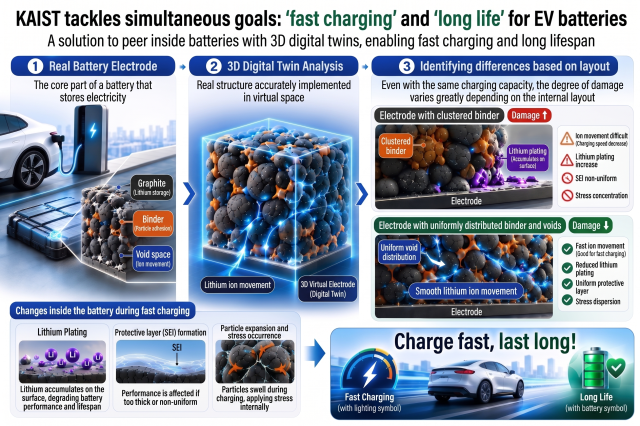
SEOUL, August 24 (AJP) - Fast charging can damage an electric vehicle battery in ways that standard capacity measurements do not reveal, researchers at the Korea Advanced Institute of Science and Technology said Monday, after building a three-dimensional virtual replica of the interior of a commercial lithium-ion cell.
In a graphite electrode 50 micrometers thick, slightly less than the width of a human hair, shifting the adhesive that binds the electrode together from an even spread to a concentration on one side altered total charging capacity by less than four percent. Lithium metal accumulating near one edge of that same electrode increased by more than 10 percent.
Charging capacity is the figure a battery test reports. The degradation the simulation identified was concentrated in a region that figure did not describe.
Lee Kang-taek's group in the mechanical engineering department at the Korea Advanced Institute of Science and Technology (KAIST) carried out the study with Cho Eun-ae's group in materials science and engineering.
A lithium-ion battery stores charge by moving lithium ions into the graphite particles that form its negative electrode. A polymer binder holds those particles in place. Pores, the empty channels running between them, carry the ions to the graphite.
During rapid charging, some ions fail to enter the graphite and settle on its surface as metallic lithium, a process known as lithium plating. The deposited lithium no longer carries charge, and repeated plating lowers both performance and battery life.
A protective film called the solid electrolyte interphase also forms on the graphite surface during charging. The film is necessary, but an excessively thick or uneven one degrades performance. Graphite particles swell as they absorb lithium, generating mechanical stress inside the electrode.
These processes occur simultaneously within a very small volume, which has made them difficult to isolate by experiment. Earlier computer models generally worked from average properties across the whole electrode and could not account for variation by position.
The researchers reconstructed the internal structure of a commercial graphite electrode in three dimensions, reproducing the graphite particles, the binder and the pores. They varied electrode thickness, pore volume and binder position, then simulated rapid charging while recording where lithium accumulated, where the protective film formed unevenly and where stress concentrated.
Binder concentrated on one side of the electrode reduced the pore space available for ion movement. Lithium plating near the current collector, the metal foil that carries current out of the cell, rose more than 10 percent above the level measured in an electrode with binder distributed evenly. Even distribution produced smoother ion movement and a more uniform protective film.
The effect grew with electrode thickness. At 83 micrometers, the capacity difference attributable to binder position widened to about 18 percent. KAIST said the result means electrodes built thicker to hold more energy require control over where materials sit inside them, not only over how much material is used.
Pore volume affected mechanical stress in the same way. Sufficient pore space absorbed the expansion of the graphite particles and dispersed the resulting force. Where pore space was insufficient, stress concentrated at particular points.
Binder gradients of this kind form during electrode manufacturing and drying rather than being introduced by design.
The numbers are computed, not measured. The team validated its model against a real electrode and against test data, but the percentages come out of the simulation. No batteries were cycled to failure, so nothing here shows a battery lasting longer. The work covers the graphite negative electrode alone, not the positive electrode and not a full cell. It names binder and pore distribution as design variables without showing how to control them on a production line.
KAIST said the approach allows a range of electrode structures to be examined in simulation before any of them are manufactured.
"If the binder and the empty space inside the electrode are placed appropriately, it should help in designing batteries that store a large amount of energy while charging quickly and lasting a long time," Lee said.
Kang Ye-jin, a doctoral candidate in mechanical engineering at KAIST, was first author on the paper, which was published in the journal InfoMat and selected as the back cover article on July 7.

Copyright ⓒ Aju Press All rights reserved.
