


SEOUL, August 27 (AJP) -South Korea is sending an emergency response team to Nepal after nine Korean workers at a hydropower construction site went missing in a catastrophic Himalayan flash flood that killed at least 160 people across Nepal and Tibet, with scientists pointing to a massive glacier collapse as the likely trigger.
Foreign Minister Cho Hyun convened an emergency task force meeting at 10:30 p.m. Wednesday after contact was lost with the nine employees of Korea South-East Power Co. (KOEN) and Doosan Enerbility working in Nepal's northern Rasuwa district.
The Foreign Ministry said officials from the Korean Embassy in Kathmandu, the National Police Agency, the Ministry of Land, Infrastructure and Transport and other agencies joined the meeting.
Cho ordered officials to mobilize all available resources for the search and rescue effort following an emergency directive from President Lee Jae Myung that the lives and safety of Korean citizens be given top priority.
"The ministry headquarters and our embassy should make every effort for the swift and safe search and rescue of our citizens while maintaining close communication with related agencies," Cho said, according to the ministry.
A joint rapid-response team made up of Foreign Ministry, police and fire officials is scheduled to leave Incheon International Airport at 1:40 p.m. Thursday and arrive in Kathmandu at 9:45 p.m. after transiting through Hong Kong.
The team will be led by Lim Sang-woo, the government's representative for overseas nationals' protection and consular affairs.
Cho also plans to speak with Nepal's foreign minister Thursday to request cooperation in the search. He instructed embassy officials to maintain close contact with the families of the missing workers and keep them informed of developments.
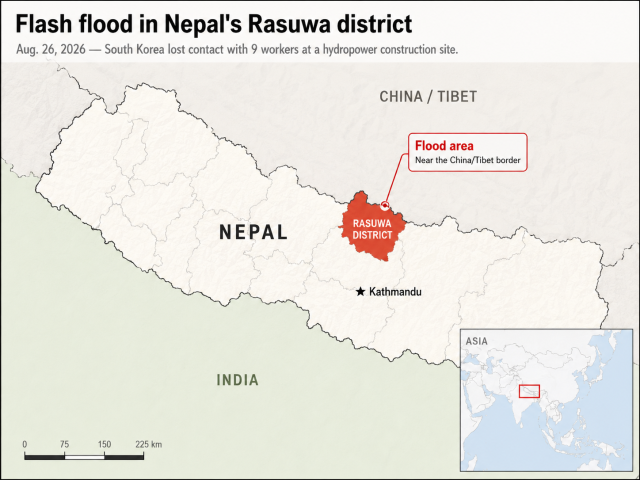
The Koreans were working on the Upper Trishuli-1 hydropower project, a 216-megawatt run-of-river power plant under construction in Rasuwa, roughly 70 kilometers north of Kathmandu.
KOEN is a major sponsor of the project and Doosan Enerbility is its engineering, procurement and construction contractor.
The plant, being developed by Nepal Water and Energy Development Company, is designed to generate electricity for Nepal's domestic grid. South Korea's embassy in Nepal described the project in May as a flagship example of energy cooperation involving Korean companies and international financial institutions. Commercial operation had been expected to begin next year.
The disaster struck around 9 a.m. Wednesday as a huge surge of water, mud, rocks and other debris swept through the Bhote Koshi and Trishuli river systems near Nepal's border with China's Tibet region.
Nepalese police reported at least 157 deaths by Thursday, while Chinese authorities said at least three people had died and 265 were missing in Tibet's neighboring Gyirong County. Hundreds of tourists, workers and residents were also unaccounted for in Nepal.
The flood destroyed villages, roads, bridges and power infrastructure across steep Himalayan valleys that serve as important trade, tourism and pilgrimage routes between Nepal and Tibet.
At least 19 bridges and nearly 40 kilometers of roads were swept away, complicating rescue operations in already difficult mountain terrain.
Hundreds of foreigners were among those reported missing, including visitors from India, the United States, Australia, Britain and Canada. Many were traveling toward Mount Kailash in Tibet, a major Hindu pilgrimage destination, or trekking around Nepal's Gosaikunda Lake area.
Scientists are increasingly focusing on the high mountains above the Lhende Khola, a tributary of the Bhote Koshi, for an explanation of how such a large flood developed so rapidly.
The Kathmandu-based International Centre for Integrated Mountain Development (ICIMOD) said preliminary evidence points to a large ice-rock avalanche from a high-altitude glacier.
A mass of ice and rock appears to have plunged into the Lhende Khola valley, possibly temporarily blocking the river before water and debris burst downstream. Hydrological measurements illustrate the extraordinary force of the resulting flood wave.
The Trishuli River at Galchhi rose by as much as nine meters in about 30 minutes, according to ICIMOD, while the water level at Malekhu climbed around seven meters over a similar period.
The precise reason for the collapse remains under investigation.
High temperatures and long-term ice loss are receiving particular scrutiny because Himalayan glaciers have been retreating rapidly as temperatures rise.
Nepal has lost nearly one-third of its glacier ice over the past three decades, with the rate of melting accelerating sharply during the past decade, and recent high temperatures may also have increased snow and ice melt before Wednesday's collapse.
Scientists caution, however, against attributing the individual disaster directly to climate change before the investigation is complete.
ICIMOD said warming is already altering glaciers, snow cover, permafrost and mountain slopes throughout the Hindu Kush Himalaya, increasing concern over so-called cryosphere hazards. But researchers said it remains too early to determine precisely how much climate change contributed to Wednesday's event.
A flash flood struck the same Nepal-China border region in July 2025 after a glacial lake in Tibet overflowed amid unusually high temperatures, killing nine people and damaging critical infrastructure, including the bridge linking the two countries.
Wednesday's disaster was far larger and again exposed the vulnerability of hydropower plants, roads and settlements built along narrow Himalayan river valleys.
- Nine South Korean workers are missing in Nepal's Rasuwa district after a massive Aug. 26 flash flood struck the construction area of the 216-MW Upper Trishuli-1 hydropower project involving KOEN and Doosan Enerbility.
- Seoul is dispatching a joint emergency team to Nepal, while Foreign Minister Cho Hyun plans to seek direct cooperation from Nepal's government in the search and rescue operation.
- At least 160 people have been reported dead across Nepal and Tibet, with hundreds more missing as floods destroyed roads, bridges, villages and power infrastructure near the China-Nepal border.

Copyright ⓒ Aju Press All rights reserved.
