

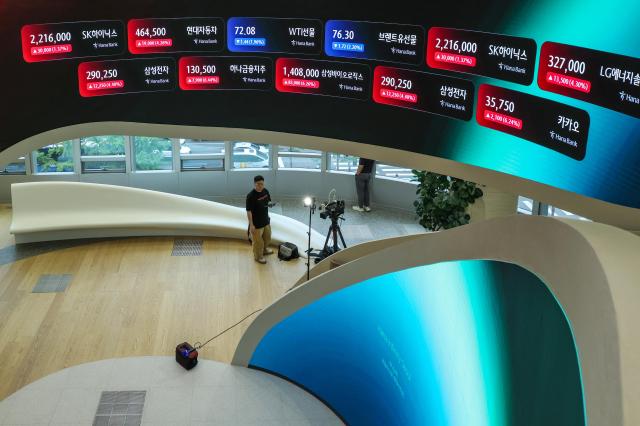
The KOSPI traded at 6,864.75 as of 10:20 a.m., up 0.84 percent, after jumping more than 2 percent earlier in the session on Nvidia's bullish outlook for artificial intelligence demand and warnings of increasingly scarce and expensive memory supply.
The BOK raised its benchmark rate by 25 basis points for a second straight month, bringing it to 3 percent for the first time since November 2024 despite a stronger won and the Federal Reserve's pause in tightening.
The decision caught much of the domestic bond market off guard. A Korea Financial Investment Association survey released ahead of the meeting showed 79 percent of bond-market professionals expected a hold, while 20 percent forecast an increase.
The central bank also sharply raised its growth forecast for this year to 3.3 percent from 2.6 percent and its 2027 estimate to 2.9 percent from 2.1 percent, reflecting confidence that the semiconductor boom will continue supporting exports and investment.
Retail investors turned heavy sellers as higher rates threatened to raise financing costs for leveraged stock bets.
Foreign investors remained net buyers of 63.2 billion won ($45.9 million), while institutions purchased a net 276.5 billion won. Retail investors sold a net 582.6 billion won.
Market breadth also weakened, with 330 stocks advancing against 518 decliners and 57 unchanged.
Chip shares nevertheless held onto sizable gains after Nvidia delivered another record quarter and signaled that the global AI infrastructure boom still has considerable room to run.
The U.S. chipmaker reported second-quarter revenue of $96.22 billion for fiscal 2027 and adjusted earnings per share of $2.22, beating Wall Street expectations.
Nvidia projected third-quarter revenue of about $108 billion, above analysts' estimate of around $104.2 billion, and gave a preliminary forecast for revenue to grow roughly 70 percent in fiscal 2028.
Samsung Electronics opened at 270,000 won and rose as high as 271,000 won before easing to 268,500 won as of 9:27 a.m., still up 2.68 percent.
SK hynix opened at 1,776,000 won and climbed as high as 1,788,000 won before trimming its gain to 4.32 percent at 1,761,000 won.
The gains reflected expectations that continued AI investment will sustain demand for advanced memory chips, including high-bandwidth memory (HBM), a key business for SK hynix and an increasingly important market for Samsung Electronics.
Nvidia on Wednesday admitted that even the AI chip giant cannot escape the cost squeeze from the boom it helped ignite, as soaring memory prices lift its production costs while benefiting Samsung Electronics and SK hynix from the supply crunch.
Nvidia's second-quarter revenue more than doubled from a year earlier, while data center revenue jumped 117 percent to $89 billion.
Yet the rapid expansion of AI infrastructure is increasingly straining the memory supply chain.
"We are experiencing extreme pricing conditions in memory," Nvidia Chief Financial Officer Colette Kress said during an earnings call Wednesday. "The magnitude of the price increase has exceeded our prior expectations and are headed even higher into next year."
Other technology and electronics shares also advanced.
SK Square climbed 4.54 percent to 1,106,000 won and Samsung Electro-Mechanics gained 4.89 percent to 1,395,000 won. LG Energy Solution rose 0.71 percent to 353,500 won.
Hyundai Motor edged down 0.12 percent to 407,500 won despite announcing a stronger shareholder-return plan a day earlier.
The automaker said it will cancel 2.51 million treasury shares worth about 789.1 billion won on Aug. 31, excluding shares set aside for employee compensation.
The cancellation will permanently reduce shares outstanding. Hyundai Motor also reaffirmed plans to maintain a total payout ratio of at least 35 percent and an annual dividend of at least 10,000 won per share.
Among industrial and defense shares, Hanwha Aerospace rose 1.84 percent to 1,107,000 won and Kia gained 0.53 percent to 132,100 won. Doosan Enerbility fell 2.56 percent to 83,600 won.
Financial shares were mostly higher. KB Financial rose 0.42 percent to 167,300 won and Shinhan Financial gained 1.12 percent to 108,600 won, while Samsung Life was unchanged at 309,500 won.
Samsung C&T gained 0.90 percent to 391,000 won, while Samsung Biologics slipped 0.19 percent to 1,596,000 won.
The junior KOSDAQ opened 0.58 percent higher at 831.64, with gains across biotech, battery-material and semiconductor-equipment shares.
Alteogen rose 0.32 percent to 312,500 won. EcoPro gained 2.76 percent to 89,400 won and cathode-material maker EcoPro BM advanced 2.33 percent to 114,100 won.
Robot maker Rainbow Robotics climbed 1.44 percent to 457,000 won.
Semiconductor-equipment shares were also higher. Jusung Engineering rose 0.98 percent to 175,100 won, Wonik IPS gained 0.91 percent to 110,300 won and LEENO Industrial added 0.60 percent to 66,800 won. EO Technics climbed 1.62 percent to 407,000 won.
Investor attention now turns to Federal Reserve Chairman Kevin Warsh's first keynote address at the Jackson Hole Economic Policy Symposium on Friday for clues on whether the U.S. central bank could resume tightening after keeping its policy rate at 3.50 percent to 3.75 percent since December.
Meanwhile, Japan's Nikkei 225 fell 0.65 percent to 65,833.96.
The Korean won strengthened to 1,378.90 per dollar as of 10:23 a.m., up about 0.5 percent from the previous session's reference rate of 1,386.00.
AJP Takeaways
• The KOSPI pared an early gain of more than 2 percent to 0.84 percent after the BOK delivered a second straight rate hike to 3 percent.
• Samsung Electronics and SK hynix remained sharply higher after Nvidia signaled continued AI demand and extreme memory pricing conditions.
• The BOK raised its 2026 growth forecast to 3.3 percent and its 2027 outlook to 2.9 percent, strengthening expectations that Korea's chip-driven expansion has further to run.
• Attention shifts to Fed Chairman Kevin Warsh at Jackson Hole on Friday for clues on the next move in U.S. monetary policy.

Copyright ⓒ Aju Press All rights reserved.
