

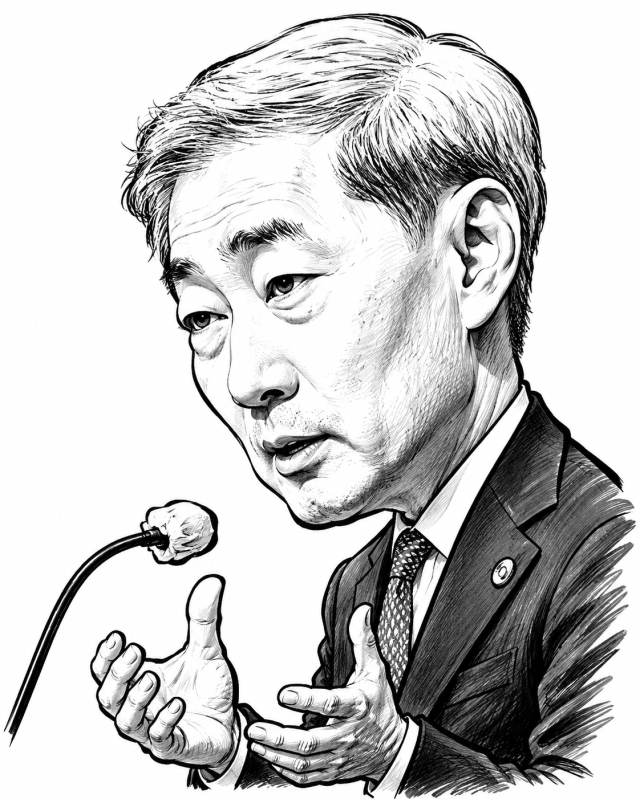
South Korea's central bank on Thursday sent an unequivocal message to markets and borrowers through back-to-back rate hikes rarely seen outside extraordinary conditions.
The diagnosis is that the artificial intelligence boom has given new traction to a Korean economy that had underperformed its potential growth rate of around 2 percent for nearly a decade - except during the post-pandemic rebound - and that deleveraging must begin as inflation and interest rates are unlikely to come down anytime soon.
The Bank of Korea (BOK) raised its benchmark rate by another 25 basis points to 3.00 percent, following July's increase from 2.50 percent. The rate is now at its highest since January 2025. Six of the seven Monetary Policy Board members backed the move.
Governor Shin Hyun-song made clear that the unusual sequence was intentional.
The consecutive increases were a departure from convention and were designed to send a "strong signal" to the market, Shin said after the meeting.
Invoking the Korean proverb about stopping a problem with a small hoe before needing a much larger spade, he argued that early action could ultimately reduce the severity and duration of tightening.
The AI boom has changed the arithmetic of the Korean economy with extraordinary speed.
The BOK raised its 2026 growth forecast to 3.3 percent from 2.6 percent in May and its 2027 estimate to 2.9 percent from 2.1 percent. The turnaround is especially striking after the economy managed growth of just 1.1 percent last year and amid a broader national debate over a potential growth rate that has fallen below 2 percent.
Korea happens to possess one of the most valuable assets of the AI age — dominance in memory chips, the brain behind every big and small AI machine.
Exports reached a record $496.7 billion in the first half, up 48.4 percent from a year earlier. Semiconductors alone accounted for $192.4 billion, or nearly 39 percent, after surging 162.6 percent. Even non-semiconductor exports rose a healthy 16 percent.
The earnings scale is harder still to comprehend. Brokerage consensus compiled by FnGuide puts Samsung Electronics' 2026 operating profit at 391.8 trillion won ($284 billion) and SK hynix's at 266.6 trillion won. Their combined 658.4 trillion won would equal more than four-fifths of the 800-trillion-won-plus national budget the government is preparing for 2027.
And the boom may have further to run. Gartner forecasts global memory revenue at $837.3 billion this year, nearly four times 2025's $220.1 billion, before topping $1 trillion at $1.08 trillion in 2027. Memory's share of worldwide semiconductor revenue is expected to double to 54 percent this year from 27 percent last year.

The BOK clearly is not imagining the spillover. Corporate income is rising, tax revenue is swelling and the government is preparing its biggest budget ever.
Companies are boosting wages, bonuses and shareholder returns. The KOSPI, despite its violent correction from the June peak, remained 64 percent above its end-2025 level as of Aug. 21 after soaring 75.6 percent last year.
Such a boom inevitably feeds demand. Headline consumer inflation eased to 2.8 percent in July, but core inflation accelerated to 2.6 percent. The BOK expects consumer inflation of 2.7 percent this year and 2.3 percent next year, while predicting core inflation of 2.5 percent in both years.
The central bank expects price gains to remain above its 2 percent target for a "considerable period." Supply-side cost pressures are being joined by stronger demand as incomes rise and wage increases spread.
Shin's instinct to act before inflation expectations become entrenched is therefore defensible.
Everyday Koreans remain uninvited to the AI party
The problem is that an aggregate economy can look much healthier than many of the people living inside it.
Korea increasingly resembles a two-speed economy - spectacular profits, exports and asset wealth at the top and borrowers and young workers who are receiving much less of the AI dividend are left well behind.
Paychecks tell the same story. Wages adjusted for inflation have stagnated, with real wages falling for three consecutive months through June.
Real wages fell 0.1 percent from a year earlier in June, marking a third consecutive monthly decline and the longest losing streak since 2023, according to the Ministry of Employment and Labor on Thursday.
In the second quarter, real wages dropped 0.8 percent even as nominal wages rose 2.1 percent, because consumer prices increased at a faster 3.0 percent pace. For ordinary workers, the celebrated AI boom has yet to translate into greater purchasing power.
Household credit meanwhile reached a record 2,019.8 trillion won at the end of June after jumping 25.9 trillion won in just three months. That acceleration is one reason for the BOK to tighten. It is also precisely why Korea is unusually sensitive to higher rates.
The medicine falls even bitter on the self-employed. Outstanding loans to self-employed borrowers reached a record 1,095.5 trillion won at the end of March. Delinquent debt climbed to 22.3 trillion won and the delinquency rate to 2.04 percent, the highest in nearly 11 years.
The weakest borrowers are in a different league altogether. The delinquency rate among vulnerable self-employed borrowers — low-income or low-credit people indebted to multiple financial institutions — reached 12.6 percent in the first quarter and has remained in double digits for 10 consecutive quarters. Some 342,500 such borrowers owed 117.2 trillion won.
The BOK has estimated that a 25-basis-point increase in lending rates would add about 1.8 trillion won to the self-employed sector's annual interest bill.
These are not borrowers benefiting directly from soaring HBM prices or trillion-dollar AI data centers.
The generational divide is equally uncomfortable. The employment rate for Koreans aged 15 to 29 fell 1.6 percentage points from a year earlier to 44.2 percent in July, marking its 27th consecutive month of decline. The number of employed young people fell by 191,000, extending a losing streak to 45 months, while youth unemployment climbed to 6.8 percent.
Manufacturing employment fell by another 68,000 and has now declined for 25 consecutive months.
The irony is that the same AI revolution giving the BOK confidence to raise rates may be aggravating the labor-market weakness.
The central bank's own researchers found that youth employment declined by 285,000 jobs over the past four years.
Some 268,000 of those losses — 94 percent — occurred in industries with high exposure to AI, including information services, publishing, computer programming and professional services. Older workers in many of the same sectors fared better.
AI is creating unprecedented corporate wealth while simultaneously removing some of the first rungs from the career ladder.
None of this means the BOK should ignore inflation, household leverage or Seoul property prices. Allowing another debt-and-property bubble to form while corporate profits and government spending surge would carry its own enormous cost.
But interest rates are a blunt instrument.
One policy rate is now being asked to contain inflation, cool metropolitan housing, restrain household borrowing, anchor the currency and temper speculative financial markets.
The same rate simultaneously sets the financing cost for restaurants, small manufacturers, young homebuyers and companies far removed from the semiconductor supercycle.
That is too much work for one instrument.
After two consecutive hikes, the better course is to give the medicine time to circulate.
Shin himself indicated that future increases should be gradual, with policymakers' six-month projections pointing to another move toward 3.25 percent rather than an urgent tightening cycle.
Housing leverage should increasingly be dealt with through targeted macroprudential measures. Lending rules can be tightened where property speculation is concentrated without raising financing costs for every borrower nationwide.
Fiscal and financial policy can do what the base rate cannot: restructure distressed self-employed debt, support viable small businesses while helping unviable ones exit, and invest the chip tax windfall in retraining and employment pathways for young people displaced by AI.
The government's planned Future Response Fund, financed by exceptional chip-driven tax revenue, is explicitly intended to direct resources toward youth, education, regional development and future industries. That is the sort of targeted counterpart a tighter monetary policy requires.
The BOK has already achieved one important goal. Nobody in the market can now mistake its resolve.
Shin's hoe-and-spade proverb is apt, but it cuts both ways. Acting early can prevent a much more painful cure later. An excessive dose, however, can weaken the patients least responsible for the fever.
The BOK has delivered its strong signal. It should now give the medicine time to work before reaching for another dose.
*The author is the managing editor of AJP.
Copyright ⓒ Aju Press All rights reserved.
