SEOUL, August 27 (AJP) - A coating material built from discarded plastic bottles and carbon dioxide can be made soft and rubbery or firm and glassy by changing one setting in the reactor, researchers at Sookmyung Women's University found. The team traced how the molecular structure of the starting material shapes the behavior of the finished film, turning a single laboratory result into something closer to a recipe with dials.
The range they measured is wide. Glass transition temperature, the point at which a plastic shifts from stiff and glassy to soft and rubbery, moved from minus 36.4 degrees Celsius to 17.5 degrees Celsius depending on how the material was made. Tensile strength, a measure of how hard a film can be pulled before it tears, reached 13.6 megapascals, roughly the range of the flexible plastic films used in packaging. Because that temperature span crosses ordinary room temperature, the same feedstock can yield a film that behaves like rubber on a desk or one that behaves like a hard shell.
The material belongs to a family called UV-curable coatings, which harden in seconds under an ultraviolet lamp rather than being baked or left to dry with solvents. They appear on phone screens, wood flooring, furniture, printing inks and optical film. Most of them start from polyols, a class of liquid building blocks that the chemical industry draws almost entirely from petroleum.
The Sookmyung work replaces part of that petroleum input with two things normally treated as waste. Polyethylene terephthalate, the plastic used in beverage bottles and better known as PET, supplies one half. Carbon dioxide supplies the other.
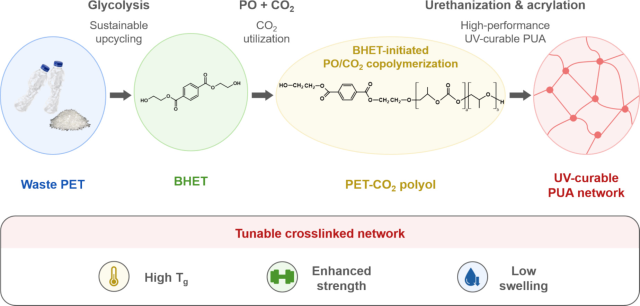
The team broke down waste PET chemically to recover an intermediate compound called BHET, reacted that compound with carbon dioxide to build a polyol, then converted the polyol into a polyurethane acrylate, the UV-curable material tested in the study.
Control came from two variables. By changing the pressure at which carbon dioxide was fed into the reaction and by changing the proportions of the starting materials, the researchers adjusted how much carbonate structure derived from CO2 and how much aromatic structure derived from PET ended up in the polyol. Those two features then shaped the crosslinked network that forms when the material cures, and the network determined the thermal and mechanical properties of the film.
The aromatic rings inherited from the bottle plastic did most of the stiffening. They restricted the movement of the polymer chains, raising the rigidity and the mechanical performance of the material.
The university said the significance lies in connecting the molecular structure of the raw material to the network formed during curing and then to the properties of the finished product, a relationship it calls structure, network and property. The team expects the material to find use in coatings, films and adhesives.
The paper extends work the same group published earlier, in which PET-derived feedstock and carbon dioxide were combined into polyols and used to make flexible polyurethane foam. The new study carries that chemistry into UV-cured materials, which cure differently and go into different products.
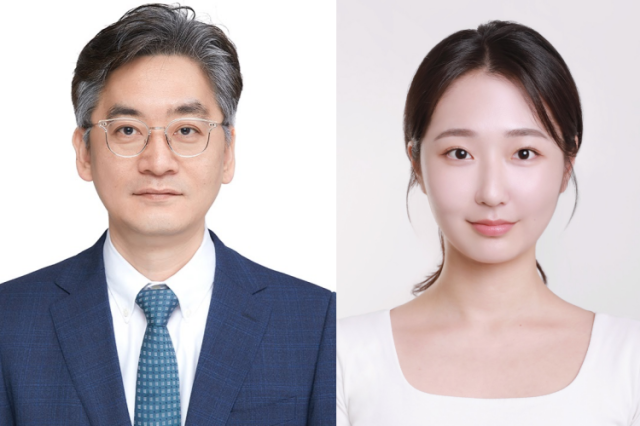
The findings appeared in Chemical Engineering Journal, volume 547. Chae Ji-young was the first author, Kim Ye-in, Lee Da-young, and Kim Ha-rin were co-authors, and Sookmyung's Baik Joon-hyun was the corresponding author.
"We plan to expand the research toward developing high-value materials that use waste plastic and carbon dioxide," Baik said.
[Reference Information]
Journal/Source: Chemical Engineering Journal (IF: 12.5, JCR top 4.5%)
Title: Integrated upcycling of waste PET and CO2 into UV-curable polyurethane acrylates via CO2-based polyols
Link/DOI: https://doi.org/10.1016/j.cej.2026.180657
Copyright ⓒ Aju Press All rights reserved.