
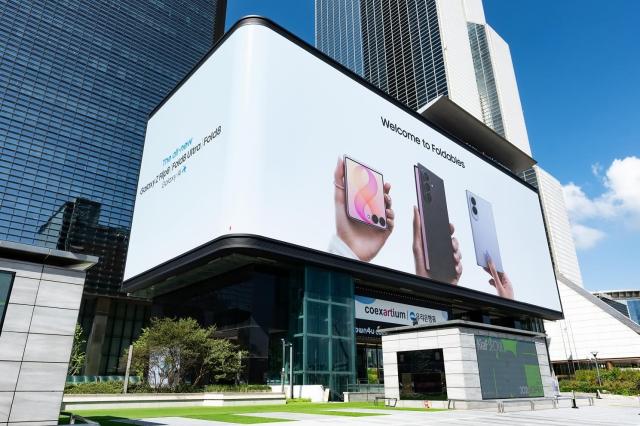
SEOUL, October 16 (AJP) - Samsung ranked as Asia's most valuable corporate brand for a third straight year, holding off Apple and Nike in Nikkei Research's latest regional survey.
Samsung placed first among 200 brands assessed across eight Asian markets, while Apple rose to second from fourth and Nike held third place. Adidas slipped to fourth, while Toyota climbed three spots to fifth.
The Asia ranking covers China, Taiwan, Thailand, India, Viet Nam, Indonesia, Malaysia and the Philippines. Nikkei Research said the survey measures brand strength and how much a brand influences purchasing and other decisions.
Samsung ranked first in Thailand and Malaysia this year and second in India, Viet Nam and Indonesia. Its number of No. 1 markets fell from five last year.
Other South Korean brands also placed in the top 100. LG ranked 18th, Hyundai 29th and Lotte 65th.
Toyota was the highest-ranked Japanese brand at No. 5, followed by Honda at No. 6 and Sony at No. 7. Other named brands such as Microsoft, Mercedes-Benz and BMW completed the top 10.
Nikkei Research launched the Global Brand Survey in 2024 and evaluates corporate brands using measures including awareness, engagement and a brand's contribution to consumer decision-making.
Joonha Yoo
Joonha Yoo is a bilingual journalist at AJU Press (AJP), covering music, culture, entertainment and Korea’s automotive industry.
Raised in Fort Collins, Colorado, he often writes from the scene, bringing firsthand detail to stories ranging
from BTS comeback concerts to unique cultural events that catch the world's eye.
Copyright ⓒ Aju Press All rights reserved.
Related News
-
 Samsung Electronics Accelerates Digital Transformation in Vietnamese Manufacturing
Samsung Electronics is showing improvements in production efficiency through its smart factory support program aimed at local manufacturing companies in Vietnam. Companies receiving technical and operational consulting from Samsung have been accelerating their digital transformation by shortening production times and integrating process data, thereby expanding their participation in the global supply chain. According to local media outlet Tien Phong on November 19, Samsung Vietnam has supported improvements in the production management systems of local companies through the '2026 Smart Factory Development Support Project' in collaboration with the Ministry of Industry and Trade of Vietnam. This year, a total of 14 companies completed the program, with Viet Uc Plastic Mechanical, located in Dong Nai Province, highlighted as a key success story. Production Time Reduced from 5 Days to 3 Days... Smart Factory Level Increased from 1.0 to 2.5 Viet Uc Plastic Mechanical improved its production processes and data management systems with Samsung's support. Previously, employees had to call multiple departments to check the production status for each order, but after integrating the system, the sales department and management can now remotely monitor production status. Nguyen Duc Hoang Jui, chairman of Viet Uc Plastic Mechanical, explained that after consulting with Samsung experts, the production time was reduced from the previous 4-5 days to 3 days. The time spent on paperwork and data retrieval has decreased, streamlining the order processing. Chairman Jui noted that before pursuing digital transformation, it was challenging to determine the scale of investment and the order of implementation. However, with Samsung experts conducting on-site diagnostics to analyze the company's strengths and areas for improvement, they were able to clarify the business direction and develop a phased implementation plan for the software to be introduced. During the smart factory construction process, employees' technical capabilities have also improved. Samsung experts provided training that went beyond simply automating production equipment, teaching how to connect equipment and processes to a central system and quickly collect and manage data. As a result, internal personnel have gained the ability to perform tasks such as data analysis, process standardization, and risk management. Tran Thi Chang, head of the integrated systems management department at Viet Uc Plastic Mechanical, stated, "What we are most proud of is not just the system we built, but that Viet Uc employees have gained the confidence to develop technology and operate it themselves." In fact, evaluations from Samsung experts indicated that the smart factory level of Viet Uc Plastic Mechanical increased from the previous 1.0 to 2.5. Samsung applied a five-level evaluation system, and the company plans to enhance its smart factory operational capabilities to level 3.0 and eventually to level 4.0. Chairman Jui remarked, "After completing the project, Viet Uc clearly understands the direction it needs to take to establish a smart factory," adding that the support from Samsung experts has instilled confidence in employees to continue tackling the remaining challenges. Support for 96 Vietnamese Companies... Expanding the Foundation for Global Supply Chain Entry Samsung's smart factory support program is expanding across the Vietnamese manufacturing sector. Since 2022, Samsung has been operating a smart factory development project in collaboration with the Ministry of Industry and Trade to enhance the production capabilities and management levels of local industrial companies. To date, Samsung has completed smart factory construction consulting for 96 Vietnamese companies and trained over 240 experts in related fields. This year, 14 companies, including Viet Uc Plastic Mechanical, completed the program. Samsung emphasizes not only the introduction of equipment or software in this initiative but also training local employees to manage and improve the systems themselves. This approach helps build internal technical operational capabilities so that productivity and quality can continue to improve even after external expert support ends. Cha Ji-ho, head of Samsung Vietnam's purchasing center, stated, "The key goal of the smart factory model is to support local personnel in operating the systems directly and identifying and resolving issues more quickly," emphasizing the importance of developing into an organization that can continuously pursue self-improvement. Samsung believes that activities to enhance the technological and quality management capabilities of local companies will also help expand opportunities for participation in the global supply chain for Vietnamese manufacturing. In particular, the plan is to strengthen Vietnam's industrial ecosystem through the sharing of technology and management know-how between foreign direct investment (FDI) companies and local manufacturers. Head Cha emphasized, "Samsung Vietnam believes that a strong supporting industrial ecosystem is formed based on trust, cooperation, and mutual development," adding that as Vietnamese companies improve their management capabilities, technology, and quality, they will enhance their competitiveness and secure deeper opportunities for participation in the global supply chain.* This article has been translated by AI.
-
Samsung and SK Hynix to Occupy Semiconductor Cluster in Gwangju
Gwangju's military airport site will host a semiconductor cluster, with Samsung Electronics utilizing the southern portion and SK Hynix the northern section. This agreement on land allocation between the two companies comes four months after the site was designated as a candidate for a national industrial complex last July. The two companies are expected to sign a land lease agreement by the end of this year. According to the government and Gwangju city on the 19th, after discussions, it was decided that Samsung Electronics will use 1.2 million pyeong of the 2.5 million pyeong area around the Gwangju military airport, while SK Hynix will occupy 1 million pyeong. The remaining 300,000 pyeong will be used for internal roads and shared infrastructure. Both companies plan to construct a total of four semiconductor production facilities (fabs), with each building two. The delay in land allocation was reportedly due to both companies preferring the northern section. The northern area is closer to the Gwangju Songjeong Station of the Honam High-Speed Railway and the city center, and it has been evaluated as having relatively favorable ground conditions for factory construction and logistics operations. The government is said to have proceeded with discussions to allocate advantageous locations to companies that can quickly promote factory construction. Furthermore, it has been decided to prioritize the development of 630,000 pyeong of the total 2.5 million pyeong, including the planned relocation site for ammunition depots, which has minimal impact on military operations. If all goes according to plan, site preparation work could begin in the first half of next year, with the first phase of the factory expected to be completed by 2029 and the first semiconductor production slated for June 2030. A key factor is the relocation of the military airport. The Ministry of National Defense plans to temporarily relocate the functions of the 1st Fighter Wing of the Gwangju Air Force Base to Yecheon, Seosan, and Jungwon by mid-2028 to secure the semiconductor industrial complex site. The National Assembly's Defense Committee also approved a revised budget plan on the 16th to advance the project cost of 103.12 billion won (KRW) for the temporary deployment of the Gwangju military airport to next year's budget.* This article has been translated by AI.
-
Memory Semiconductor Boom Expected to Shift in 2028 as Samsung and SK Keep Watch
The boom in memory semiconductors driven by artificial intelligence (AI) demand is expected to reach a turning point around 2028. Samsung Electronics and SK Hynix are anticipated to continue their strong performance in high-bandwidth memory (HBM) and general-purpose DRAM until next year. However, analysts suggest that the combination of new global factory operations and aggressive expansions in China may lead to a decline in price strength due to reduced supply shortages.At the TrendForce Roadshow Korea 2026 held on November 18 at the Oakwood Premier Coex Center in Gangnam, Seoul, Ellie Wang, a senior analyst at TrendForce, presented on the topic of "Balancing Performance and Cost: Next-Generation Growth Drivers for DRAM and HBM," indicating that a turning point for memory prices could occur in mid-2028.Wang stated, "Since mid-2023, we have projected that a turning point for memory prices could appear in mid-2028. While investment plans for data centers are largely confirmed until 2027, we expect risk factors to emerge after 2028."In the immediate term, memory price strength is expected to persist until next year. TrendForce forecasts that the contract price for general-purpose DRAM will rise by 5-10% in the first quarter of 2027 compared to the previous quarter. In the second quarter, it is projected to increase by 3-8%, and by 0-5% in the third and fourth quarters. Although the rate of price increase may slow, supply shortages in memory are expected to continue.The expansion of AI infrastructure investment is supporting demand. TrendForce anticipates that the capital expenditures of major global cloud service providers (CSPs) will increase by 104% this year, followed by a further 60% increase next year. The investment scale for next year is expected to reach approximately 15.158 trillion won.The expansion of HBM production is also constraining the supply of general-purpose DRAM. Next year, HBM supply bits are expected to increase by 65.7% year-on-year, while DRAM for PCs is projected to decrease by 7.9%. It is estimated that server-related products will account for 67% of the total DRAM supply bits.Wang explained, "Producing HBM4 requires 3-4 times more wafers than general-purpose DRAM. Therefore, it seems unlikely that DRAM prices will turn downward even in 2027."However, the supply environment may change starting in 2028. New production facilities being pursued by Samsung Electronics, SK Hynix, and Micron are expected to come online between 2028 and 2030, leading to increased production capacity. If the growth rate of AI investment slows, there is a possibility that the increased supply may not be fully absorbed by demand.In particular, China's aggressive expansion has emerged as a variable. TrendForce projects that the DRAM production capacity of China's CXMT will increase by 20% from 300,000 wafers per month at the end of this year to 360,000 wafers per month by the end of next year. During the same period, Samsung is expected to expand from 750,000 to 845,000 wafers per month, while SK Hynix is projected to grow from 615,000 to 695,000 wafers per month, marking a 13% increase for both. China's expansion rate is outpacing that of domestic companies.Additionally, changes in the growth rate of the HBM market are anticipated. Ellie Wang raised the possibility that the HBM shipment growth rate could slow from approximately 50% in 2027 to around 10% in 2028. However, she noted that the 2028 figure is still under review. As the growth rate of HBM adoption in AI semiconductors moderates, the supply and demand environment may change with the continued expansion of production capacity among major memory companies.Wang concluded, "Until 2027, the robust demand for memory driven by increased AI investment and HBM production will continue. However, with new factories from major semiconductor companies coming online starting in 2028, the subsequent balance of demand growth and supply expansion will determine the direction of the memory market."* This article has been translated by AI.