SEOUL, August 31 (AJP) -South Korea's factory output growth sharply eased on a pullback from chip shipments while a key gauge of household consumption fell back in July, suggesting the economy's heavy reliance on chip activity and restricted trickle-down effect of the chip boom on the the broader economy, government data showed Monday.
Mining and manufacturing output edged up 0.2 percent in July from the previous month, sharply losing steam from a 6.7 percent surge in June. Growth from a year earlier also slowed to 3.6 percent from 6 percent, according to the Ministry of Data and Statistics.
The domestic front was dimmer, with retail sales falling 2.4 percent on month after a 2.7 percent rebound in June. Construction activity also declined 1.1 percent from the previous month and 3.2 percent from a year earlier.
Services output dropped 1.3 percent on month, leaving overall industrial production flat after a 2.4 percent increase in June. From a year earlier, total industrial output was still up 3.1 percent.
Capital investment remained the sole bright spot, supported by aggressive spending on machinery including semiconductor manufacturing equipment. Facility investment jumped 7.5 percent from June and 24.9 percent from a year earlier, accelerating from respective gains of 6.9 percent and 22.5 percent in June.
Investment in machinery rose 4.2 percent on month, while transport equipment investment climbed 15.4 percent on increased spending on ships and aircraft. From a year earlier, machinery investment surged 21.3 percent and transport equipment 32.7 percent.
Domestic machinery orders, another gauge of future corporate investment, increased 25.4 percent from a year earlier. Private-sector orders jumped 27 percent, including a 47.9 percent surge among manufacturers, although the pace slowed from June's exceptionally strong 52.4 percent overall increase.
The production data were more mixed inside manufacturing.
Manufacturing output rose just 0.2 percent from June. Electronic components surged 20.7 percent and primary metals gained 4.2 percent, offsetting declines of 4.5 percent in automobiles and 5 percent in other transport equipment.
Semiconductor production itself edged up only 0.5 percent on month and 0.8 percent from a year earlier.
Semiconductor shipments fell 7.3 percent from June and 3.4 percent from a year earlier, while inventories rose 10 percent on year.
The broader manufacturing picture was somewhat stronger outside the monthly volatility. Factory output excluding electronics and communications products was up 4.5 percent from a year earlier, while machinery production climbed 9.6 percent and automobile production 10.6 percent.
Average factory utilization edged up 0.2 percentage point to 74.9 percent.
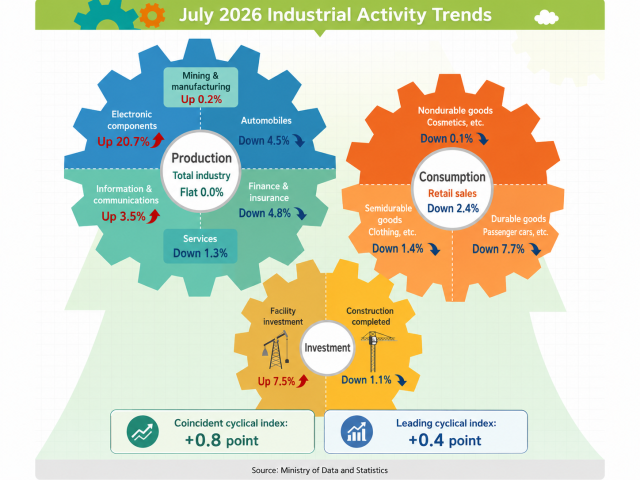
Department-store sales remained 9 percent higher than a year earlier and duty-free sales jumped 13.4 percent, but sales at large discount stores dropped 7.4 percent and specialty retailers fell 3.5 percent.
Services also lost momentum after three straight monthly gains. Financial and insurance services fell 4.8 percent from June in line with the sharp cooling in the stock market, professional, scientific and technical services declined 2.7 percent and wholesale and retail services slipped 1.1 percent.
Accommodation and food services fell 1.1 percent on month and 1 percent from a year earlier, pointing to continued weakness in spending closely tied to household demand.
Construction remained another soft spot. Building activity tumbled 7.4 percent from June, outweighing an 18.5 percent rise in civil engineering work. New construction orders plunged 34 percent from a year earlier, including a 33.7 percent fall in housing orders.
Still, broader business-cycle indicators continued to point upward. The coincident composite index's cyclical component, which measures current economic conditions, rose 0.8 point in July, while the leading index's cyclical component gained 0.4 point.
AJP Takeaways
○ South Korea's industrial recovery lost momentum in July: mining and manufacturing output rose just 0.2 percent on month after June's 6.7 percent surge, while overall industrial production was flat.
○ Domestic demand stayed weak: retail sales fell 2.4 percent, services output dropped 1.3 percent and construction activity declined 1.1 percent from June.
○ Corporate investment remained the standout: facility investment jumped 7.5 percent on month and 24.9 percent on year, supported by semiconductor manufacturing machinery and transport equipment.

Copyright ⓒ Aju Press All rights reserved.