

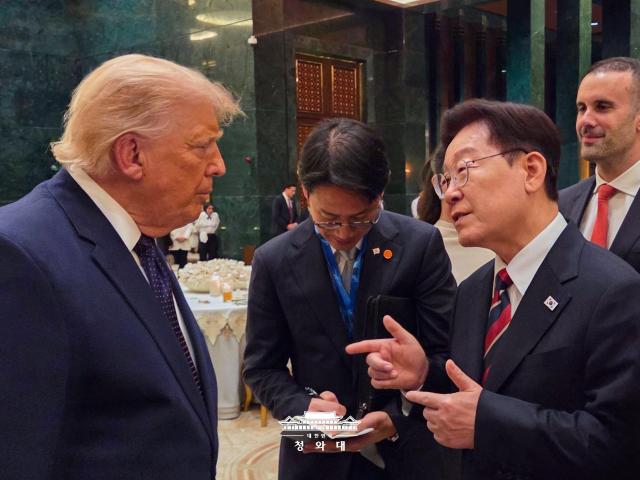
SEOUL, September 03 (AJP) - U.S. President Donald Trump renewed pressure on South Korea and Japan on Wednesday (local time) to participate in Alaska energy development, again speaking as though the two Asian allies were already moving toward involvement in one of his administration’s signature energy projects.
“You have Japan, you have South Korea, you have all these people now going to Alaska to load up with fuel, load up with oil, build pipelines, everything else,” Trump said at the White House on Sept. 2 while discussing Alaska and Republican Sen. Dan Sullivan, whom he plans to campaign for ahead of the November midterm elections.
Although Trump did not explicitly name the Alaska LNG project in those remarks, they came against the backdrop of his administration’s sustained push for South Korea and Japan to invest in, supply equipment for and purchase gas from the massive project.
The Alaska LNG project is designed to bring natural gas from Alaska’s North Slope across the state to Nikiski on the Kenai Peninsula, where it would be liquefied and shipped primarily to Asian markets.
The roughly $44 billion project includes a pipeline running about 800 miles, or 1,300 kilometers, across Alaska and an LNG export terminal with planned capacity of 20 million metric tons a year. Glenfarne Group, which owns a 75 percent stake in the project, has targeted a final investment decision on the pipeline in 2026 and another on the export terminal in early 2027, with LNG exports expected to begin in 2031.
The project has gained new momentum amid disruptions to Middle Eastern energy supplies. Glenfarne said in March that it had lined up preliminary commitments covering about 13 million tons of LNG annually and needed agreements for another 3 million tons before reaching the 16-million-ton threshold — 80 percent of capacity — it wants covered by binding contracts to support financing.
Japan’s JERA and Tokyo Gas have reached preliminary agreements to buy a combined 2 million tons of LNG annually, while Glenfarne has said buyers in South Korea, Japan, Taiwan and Thailand have all signed up for volumes.
Trump’s latest comments marked his second public reference in 2026 linking both South Korea and Japan to the Alaska project.
At a White House briefing marking the first anniversary of his second term on Jan. 20, Trump touted the Alaska pipeline as a project aimed at exporting natural gas to Asia and said trade agreements with South Korea and Japan had provided unprecedented levels of funding. Alaska Gov. Mike Dunleavy subsequently highlighted Trump’s claim that South Korea and Japan would provide funding as he promoted progress on the project.
But the January remarks were not Trump’s first-ever attempt to draw the two Asian allies into the project.
“My administration is also working on a gigantic natural gas pipeline in Alaska,” Trump told a joint session of Congress on March 4, 2025, adding that “Japan, South Korea and other nations want to be our partner.” He claimed at the time that the countries would make investments worth “trillions of dollars each.”
Trump continued to raise the idea in the months that followed. In April 2025, after speaking by phone with then-South Korean acting President Han Duck-soo, Trump said the two sides had discussed a “large-scale purchase of U.S. LNG” and South Korea’s proposed joint venture with Japan in an Alaska pipeline.
He returned to the subject during South Korean President Lee Jae Myung’s White House visit on Aug. 25, 2025.
“We’re dealing with South Korea, as you know, in Alaska, and we’re going to be making a deal, a joint venture with South Korea,” Trump said, adding that Japan was “also very strongly involved.”
South Korean experts said Seoul should exercise caution in participating in the project.
"Given the time frame and costs involved, the Alaska LNG project falls considerably short in terms of commercial viability," said Kang In Soo, a trade expert and professor of economics at Sookmyung Women's University.
"It would not be desirable for Seoul to participate in the project simply because it is being pressured by Washington," Kang said. "A detailed feasibility study should come first."
"South Korea should not participate in this project," said Rep. Kim Joon-hyung of the Rebuilding Korea Party.
"The project would not yield significant benefits for South Korea and also lacks commercial viability," Kim said.
"For the project to become commercially viable, substantial infrastructure investment from the U.S. side will also be necessary, so I hope companies and governments in South Korea, the United States and Japan will engage in close consultations and produce productive results," said Rep. Kim Gunn of the People Power Party.
"At a time when energy security is increasingly important, I understand that South Korean companies are also showing interest in the project," Kim added.
AJP Takeaways
-
U.S. President Donald Trump renewed pressure on South Korea and Japan to participate in Alaska energy development, again suggesting on Sept. 2 that the two Asian allies were moving toward involvement in the Alaska LNG project.
-
The $44 billion Alaska LNG project would transport North Slope gas through an 800-mile pipeline to an export terminal in Nikiski, with Glenfarne targeting LNG shipments to Asian markets from 2031.
-
South Korean experts and lawmakers remain divided over participation, with critics questioning the project’s commercial viability while others say closer U.S.-South Korea-Japan cooperation could strengthen energy security.
Copyright ⓒ Aju Press All rights reserved.
