SEOUL, September 07 (AJP) -South Korea’s base rate has yanked up to 3.00 percent from 2.50 percent through two consecutive hikes after staying unchanged for more than a year and may rise further given the central bank’s inflation-focused bias, raising delinquency risks for highly leveraged mortgage households, a Bank of Korea (BOK) study showed Monday.
A 1 percentage point increase in rates would raise the probability of delinquency among heavily indebted homebuying households by 0.81 percentage point within 12 months, according to an empirical study published in the latest BOK Issue Note.
The study focused on households that bought homes between 2023 and 2025 and ranked in the top 10 percent for increases in principal and interest payments relative to income after the purchase, making them most vulnerable to higher interest rates.
The BOK said delinquency risks among borrowing households overall would remain broadly stable under current rates, but some heavily indebted groups could be vulnerable to larger rate shocks.
Financial stress could also spread between members of the same household.
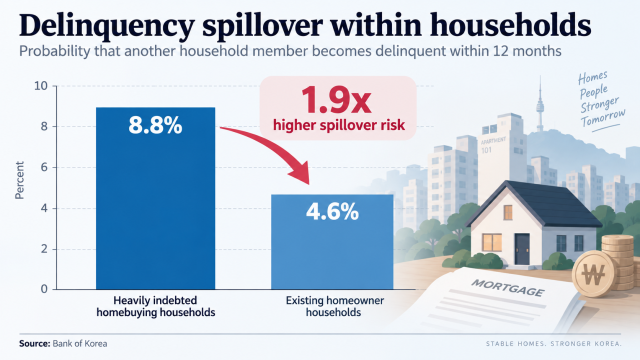
Among heavily indebted homebuying households, the probability that another member would become delinquent within 12 months after one member fell behind on payments was 8.8 percent.
That was 1.9 times the 4.6 percent rate among households that already owned homes.
The BOK built the database because traditional household debt analysis largely focuses on individual borrowers, even though families often make borrowing and saving decisions together.
Looking at spouses and other family members together could therefore provide a clearer picture of a household's ability to repay its debts, the central bank said.
Heavy repayment burdens were also found to squeeze consumption.
The BOK estimated that household spending began to decline when the debt service ratio (DSR), which measures annual principal and interest payments relative to income, exceeded 46 percent.
About 11.1 percent of indebted households were above that threshold in 2025.
Among households in the lowest income quintile, the share rose to 14.5 percent in 2025 from 11.4 percent in 2021, pointing to increasing pressure on lower-income borrowers, according to the BOK.
The study was released less than two weeks after the BOK raised its Base Rate by 25 basis points to 3.00 percent from 2.75 percent.
The central bank said it was seeking to contain persistent inflation while remaining alert to financial stability risks.
At its Aug. 27 policy meeting, the central bank said home prices in the Seoul metropolitan area continued to rise rapidly while household lending increased substantially.
Bank household loans rose by 5.4 trillion won (about $4.0 billion) in July to 1,194.8 trillion won, according to BOK data released last month.
Mortgage loans accounted for 3.4 trillion won of the increase as the effects of earlier growth in housing transactions around the capital region continued to feed into lending.
The monthly increase in overall bank household lending had slowed from June but was still twice as large as a year earlier.
The study also suggested that the headline size of household debt alone may not capture where financial vulnerabilities are concentrated.
The BOK said monitoring should pay particular attention to heavily indebted homebuyers, the transmission of credit risk between household members and high repayment burdens among lower-income families.
AJP Takeaways
- Bank of Korea analysis found that families taking on large debts to buy homes were especially vulnerable to large interest rate increases.
- South Korean households with heavy home loans showed a much higher risk of financial trouble spreading from one family member to another.
- Bank of Korea findings were released after a Base Rate increase and during a period of rising household and mortgage lending.
Copyright ⓒ Aju Press All rights reserved.