SEOUL, September 10 (AJP) - Environmental protection was written into the package of agreements that lifted relations between Uzbekistan and Serbia to a strategic partnership this week, giving formal shape to environmental contacts that had been building since last year.
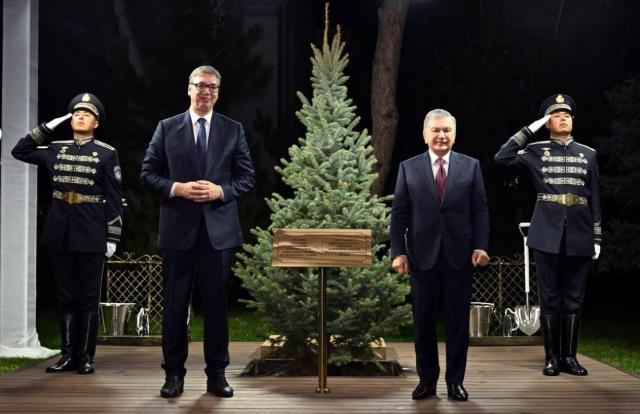
Shavkat Mirziyoyev and Aleksandar Vucic signed a joint declaration establishing the partnership in Belgrade on Tuesday, at the close of the Uzbek president's first official visit to Serbia. The two sides exchanged 20 bilateral documents covering transport, renewable energy, agriculture, digitalization, labor migration and environmental protection.
Bilateral trade reached $41.9 million last year, a record, up 27 percent from $32.9 million in 2024, according to the Serbian Chamber of Commerce. Serbian exports of agricultural and food products to Uzbekistan rose 54.1 percent in the first seven months of this year.
The Embassy of Uzbekistan in the Republic of Korea said the environmental track centers on three areas, which are sustainable forest management, biodiversity conservation and cooperation between universities working on climate and environmental science.
Forestry is where Serbia has the most to offer. Its Second National Forest Inventory, carried out between 2018 and 2023, put the country's forests and forest land at 3,025,471 hectares, or 39 percent of its territory, an increase of about 5 percentage points over the inventory published in 2009. A large share of that land is privately held, and Serbian forestry authorities have spent years building management arrangements between the state and private owners.
Uzbekistan is trying to expand its own tree cover under Yashil Makon, a national planting campaign launched in 2021 with a target of 200 million saplings a year. The government says more than 266 million were planted in 2025.
Serbia has granted protected status to 460 natural sites. They include five national parks, 17 nature parks, 20 landscapes of outstanding features, 68 nature reserves, 309 natural monuments and three protected habitats, together covering 583,183 hectares, or about 6.6 percent of the country, according to the International Commission for the Protection of the Danube River.
The academic component centers on the Central Asian University of Environmental and Climate Change Studies, known as Green University, which Tashkent has positioned as the region's flagship environmental institution. It was created by presidential decree on May 31, 2023, and opened in Tashkent Region in February 2024, with instruction conducted in English.
The opening drew the director general of the International Union for Conservation of Nature, Grethel Aguilar, along with the environment ministers of all five Central Asian states.
Uzbekistan wants to link the university with the University of Belgrade and the University of Novi Sad through joint degree programs, research projects and exchanges of students and faculty.
The groundwork was laid in Samarkand in early June. Serbia sent a delegation led by Sara Pavkov, who became environment minister in April 2025, to the Eighth Assembly of the Global Environment Facility, held from May 30 to June 6, and to the Eco Expo Central Asia environmental technology exhibition that ran alongside it. Serbian officials took part in a high-level plenary session on green investment and innovation, the embassy said.
The exhibition opened on June 2 at the Silk Road Samarkand complex and drew close to 10,000 participants. Its first edition, held in Tashkent in 2025, attracted about 7,500 and launched more than 130 environmental projects with international partners.
Uzbekistan has invited Serbia to the next edition, scheduled for June 15 to 17 next year at the CAEx Uzbekistan exhibition center in Tashkent.
Both events sit inside an environmental apparatus that Uzbekistan rebuilt last November, when Mirziyoyev removed the Ministry of Ecology, Environmental Protection and Climate Change from the Cabinet of Ministers and reconstituted it as the National Committee on Ecology and Climate Change, reporting directly to the president. Aziz Abdukhakimov, who had been ecology minister, chairs the committee and serves as presidential adviser on the environment. He chaired the Samarkand assembly.
Serbia has a platform of its own next year. The United Nations Environment Programme has selected it to host World Environment Day 2027, an event Belgrade intends to run in coordination with Expo 2027. Uzbekistan has confirmed it will take part in that exposition with a national pavilion.
Copyright ⓒ Aju Press All rights reserved.