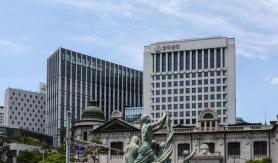
The Bank of Korea (BOK) and the Korean Statistical Society opened a joint forum Friday to discuss how artificial intelligence, machine learning and new data techniques can improve the accuracy and timeliness of economic statistics.
BOK Senior Deputy Governor Kwon Min-soo said rapid advances in AI and changes in the data environment are reshaping how statistics are produced and analyzed, increasing the need to use new types of data to capture economic developments more quickly.
Kwon said maintaining statistical reliability as the distribution and structure of underlying data change has also emerged as an important challenge.
The forum, titled “AI, Data and Economic Statistics: A Changing Environment and New Approaches,” brings together central bank officials, academics and statistical practitioners for three sessions on statistical methods, adaptive AI and distributional statistics.

The first session examines how traditional statistical techniques such as data integration and adjustment can be combined with machine-learning methods using high-frequency indicators including card sales and search trends.
Korea University professor Park Min-gyu will present applications of transfer learning to economic nowcasting and cross-country growth forecasts, along with a statistical verification framework for safely applying machine learning to official statistics.
Transfer learning allows models trained on one set of data or tasks to reuse that knowledge for new applications, reducing the amount of data and computing resources required.
The second session focuses on maintaining model reliability when underlying data patterns change.
Hongik University professor Park Se-ho will examine discrepancies between micro-level data and macroeconomic statistics through “distribution shift,” proposing a process to detect and correct changes in data distributions.
Yonsei University professor Song Kyung-woo will discuss self-evolving AI agents designed to adapt to changing environments and tasks, including statistical methods to control hallucinations and uncertainty in AI-generated responses.
The final session turns to practical applications being tested by the BOK.
BOK researcher Kim So-jung will present AI agents developed to interpret changes in economic statistics and simulate policy judgments, while stressing the need to identify and control biases in their responses.
Another BOK researcher, Park Jin, will present measures to reconcile gaps between microeconomic and macroeconomic data in household distributional accounts.
The BOK said the revisions improved coverage ratios between the two data sets and the treatment of movements across income groups.
Kwon said such practical efforts, including the use of AI agents and improvements to household distributional accounts, could enhance the explanatory power and usefulness of economic statistics.
He added that the forum was intended to bring together academic theory and practical experience to help further improve the quality of Korea's statistics.
The forum runs from 9 a.m. to 3 p.m. at the BOK's conference hall in Seoul, following opening remarks by Korean Statistical Society President Kang Ki-hoon and a welcome address by Kwon.
AJP Takeaways
- The BOK is testing AI agents that can interpret changes in economic statistics and simulate policy judgments.
- BOK Senior Deputy Governor Kwon Min-soo said maintaining statistical reliability as data distributions and structures change has become an important challenge.
- Researchers are examining how machine learning and high-frequency data can be combined with traditional statistical methods while controlling model errors.
- The forum also addresses AI hallucinations, changing data distributions and inconsistencies between microeconomic and macroeconomic statistics.
Copyright ⓒ Aju Press All rights reserved.