SEOUL, September 14 (AJP) - Two South Korean technology firms agreed this month to build a digital model of Alatau City, a Kazakh new town that remains largely empty land, in the latest of a series of Korean commitments to the project ahead of Wednesday's first summit between South Korea and five Central Asian countries.
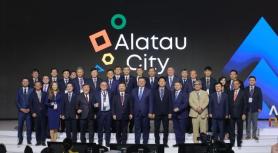
The agreement was signed on September 9 at the World Smart City Expo in Busan by AST Holdings, ILJOO GnS and the Alatau City Authority. The following day, in the same convention center, Korea Overseas Infrastructure and Urban Development Corporation briefed Korean firms on a 330-hectare district it intends to develop at the site.
President Lee Jae Myung meets the Kazakh president on Tuesday afternoon during three days of bilateral talks, then hosts the leaders of Kazakhstan, Kyrgyzstan, Tajikistan, Turkmenistan and Uzbekistan in Seoul on Wednesday for the first Korea-Central Asia Summit 2026. A business summit drawing about 500 government and corporate officials follows.
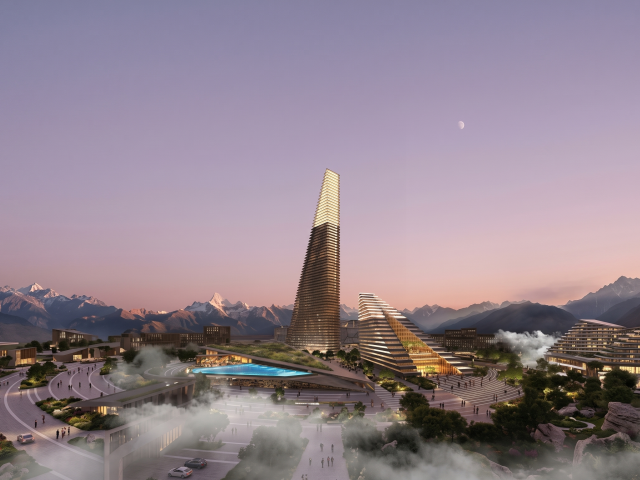
Alatau City lies 47 kilometers from Almaty and covers 88,000 hectares. The Alatau City Authority (ACA) says it will eventually house 1.87 million residents, a projection that runs a quarter century out.
Five anchor plants are operating there now, among them the food manufacturer Mareven Food, the German building materials maker Knauf and the Almaty Fan Plant. PepsiCo is building a $360 million facility expected to employ up to 900 people, and work has started on a Mars Petcare plant.
ACA puts the full investment portfolio at 67 projects worth $6.9 billion with the potential to create 55,000 jobs.
What has drawn Korean interest, however, is less the construction schedule than the legal regime written around it.
Kazakh President Kassym-Jomart Tokayev signed the Constitutional Law on the Special Legal Regime of Alatau City on May 8. It took effect on July 1, with the remaining provisions phasing in through January and July of next year.
The law designates Alatau as the country's first city of accelerated development, granting qualifying investors a single-window approval process and tax incentives of up to 30 years. Special economic zone and free customs zone treatment applies for 50 years from January 1, and work permits for foreign specialists are eased.
It also allows the city administration to write regulations on the principles and precedents of English and Welsh law, which Kazakh officials say should make the system read as predictable to foreign investors. And it converted ACA, created last year by presidential decree as a state fund, into a government body.
The law further permits companies to run artificial intelligence systems, unmanned aircraft, robotics and connected devices inside Alatau under rules that apply nowhere else in Kazakhstan.
That provision matters to a sector with almost nowhere to operate. Urban air mobility, the industry built around small electric aircraft carrying passengers across cities, cannot launch on aircraft alone. It needs certification rules, reserved airspace, low-altitude traffic management and landing infrastructure, almost none of which exists in any country.
ACA said it is exploring cooperation with Korea Airports Corporation on that set of problems, and that Kazakhstan and South Korea have agreed to keep consulting on company participation in the sector.
Only one Korean-linked project at the site has broken ground. A cultural and industrial complex branded K-Park began construction in September last year, led by Kazakhstan's investment agency and the Kazakh conglomerate Caspian Group, which called it the first execution model of the wider city project.
The rest remain memoranda, concepts or pilots.
The digital twin signed on September 9 is among them. A digital twin is a live software model of a physical place, fed by sensors, used to run utilities and traffic from a single system.
In an established metropolis, building one means stitching together decades of incompatible legacy systems. In Alatau the data architecture can be designed alongside the pipes and the roads.
AST Holdings chief executive Lee Dong-woo said the city allows digital technology to be built into urban design and operation from the outset, Edaily reported. The three parties have not yet fixed the pilot area or the technical scope and plan to settle both in joint working sessions, with artificial intelligence tools for city operations to follow in stages.
Neither firm is large. ACA put AST Holdings' revenue last year at 13.83 billion won ($10.3 million) and ILJOO GnS at 15.65 billion won.
AST Holdings has built digital twin platforms for Korea Land and Geospatial Informatix Corporation and worked on the government's Digital Twin National Land program, and it is developing digital twins for five Saudi cities with Naver Cloud. ILJOO GnS has worked on Busan Eco Delta City and on digital manufacturing systems for Hyundai plants.
The heavier commitment belongs to Korea Overseas Infrastructure and Urban Development Corporation (KIND), the state body created to move Korean construction and urban development firms into overseas markets.
KIND signed a memorandum in Astana on December 11 with Kazakhstan's Ministry of Industry and Construction and ACA, with Deputy Prime Minister Kanat Bozumbayev present.
In remarks released by KIND, Bozumbayev called Alatau a national project concentrating demand for energy, water, sewerage and waste treatment as well as housing and industrial estates, and said Kazakhstan welcomed "the active participation of Korean companies with extensive infrastructure experience and technology."
KIND's planned district, K-Smart Town, covers 330 hectares and provides for 5.3 million square meters of real estate. A development concept has been prepared.
KIND presented the work on September 10 at its K-City Network Global Smart City Partnership Forum at BEXCO, alongside a satellite city planned for Tashkent's new airport and a smart city master plan in Lublin, Poland. The stated purpose was to identify Korean companies willing to join demonstration and investment projects.
Questions from the floor ran to local incentives, the point at which smaller firms could enter, and how any of it would be financed.
One frequently cited Korean link is less settled than it appears. ACA counts the Qazaqstan Advanced Institute of Science and Technology, a research university modeled on the Korea Advanced Institute of Science and Technology, among Alatau's partnerships, citing an October 2025 agreement involving Kazakhstan's Ministry of Science and Higher Education, KAIST and Alatau City Bank.
The project itself dates to 2020 and was formalized by a science and technology memorandum between the two governments in June 2024. Kazakh officials said last year the institute would open in Almaty, with the exact site to be determined by its feasibility study.
That study was presented in Astana on July 31, covering the academic model, faculty structure, research priorities and project risks.
Two more Korean names appear in ACA's account at the level of intention rather than contract. Doosan Enerbility is under consideration as a partner in Alatau's power infrastructure, with no parameters announced.
An agreement to develop a Hyundai Green Food production and logistics complex was announced by the Kazakh government in August. Hyundai Green Food is the catering and food distribution arm of Hyundai Department Store Group and is not part of Hyundai Motor Group.
South Korea is not the only country making this argument to Kazakhstan, and it is arriving with smaller numbers attached.
The United States signed and announced more than $25 billion in commercial deals at a dealmaking session tied to last year's C5+1 summit, the European Union has put forward an investment package worth 12 billion euros, and Japan has set a target of 3 trillion yen in private-sector projects over five years, Digital Times reported.
South Korea's cumulative investment in Kazakhstan through last year stood at $4.38 billion on a declared basis, according to the Ministry of Foreign Affairs. ACA puts the figure far higher, at $11.8 billion since 2005, and says more than 1,000 companies with Korean participation are registered in the country.
Two-way trade reached $3.17 billion last year by ACA's count, with Kazakh exports to South Korea still dominated by minerals and metals, the pattern both governments say they want to break.
In August, the South Korean government named three priorities for Central Asia: critical minerals and energy supply chains, emerging industries including artificial intelligence and biotechnology, and transport, logistics and human capital.
Alatau touches all three, which makes it one place to measure whether Wednesday's summit produces more than signatures. The two sides have met at ministerial level every year since 2007, and Wednesday is the first time their leaders have sat down together.
The master plan and feasibility study for K-Smart Town's 330 hectares are due to be completed by the end of this year.
Copyright ⓒ Aju Press All rights reserved.