

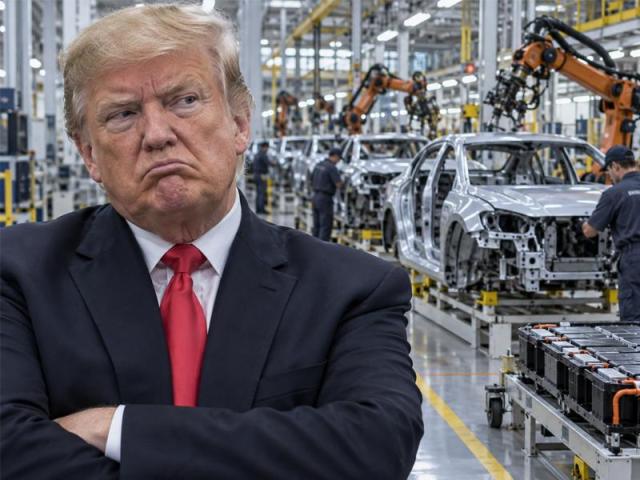
Now, some are finding one in the power-hungry data-center boom.
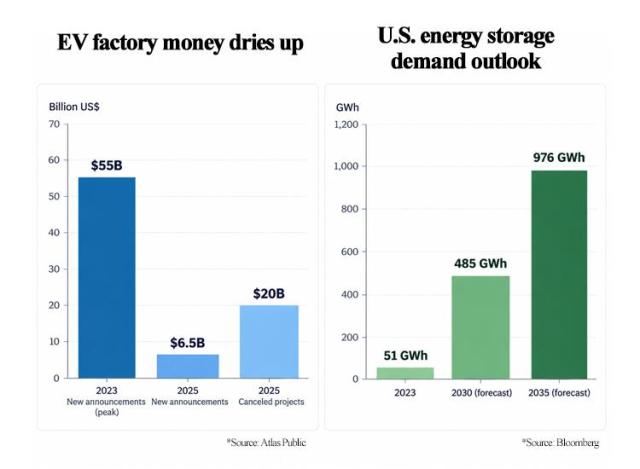
Canceled U.S. EV and battery projects between January 2025 and August this year had promised about 27,000 jobs, according to a Reuters analysis of Atlas Public Policy data. About four-fifths of the canceled investment was in Republican-leaning states.
The reversal has hit a string of multibillion-dollar ventures involving LG Energy Solution, SK On and Samsung SDI.
Ultium Cells, the $2.3 billion battery plant in Lordstown, Ohio, owned by General Motors and LG Energy Solution, halted production in January after weakening EV demand and initially placed about 480 workers on indefinite layoff.
Cell production resumed in mid-August, bringing back about 700 workers, but roughly 600 remained on indefinite layoff, the company told Reuters.
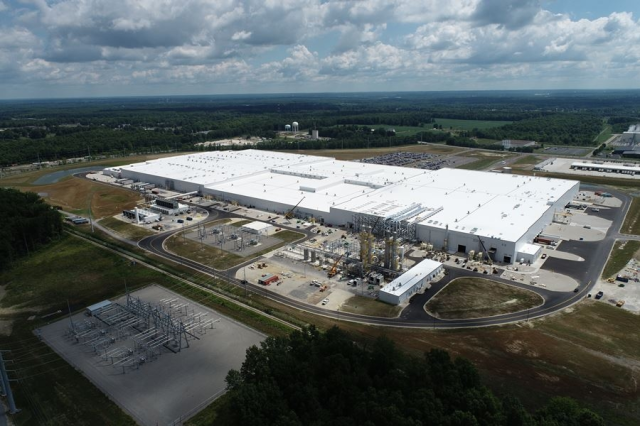
In Glendale, Kentucky, about 1,500 workers were laid off in December at the $5.8 billion battery complex originally built by Ford and SK On. The project had once been pitched as creating about 5,000 jobs.
Part of the roughly $6 billion, 2,800-job battery complex planned by Stellantis and Samsung SDI in Kokomo, Indiana, has also stalled.
The retrenchment accelerated after the $7,500 federal EV purchase tax credit expired on Sept. 30, 2025, following legislation backed by Trump and congressional Republicans.
The administration also eased vehicle-emissions rules and other policies that had supported EV adoption. Automakers have cited those policy changes, together with softer-than-expected consumer demand, in reassessing EV investment.
U.S. EV sales fell 20.5 percent from a year earlier to 247,226 vehicles in the second quarter, according to Cox Automotive. EVs accounted for about 5.8 percent of total new-vehicle sales, down sharply from a record 10.6 percent in the third quarter of 2025, when buyers rushed to qualify for expiring incentives.
Ford has been among the most aggressive in resetting its EV ambitions.
The automaker booked a $19.5 billion writedown in December, ended plans for several electric models and dissolved its battery joint venture with SK On. Ford also terminated a large battery-supply agreement with LG Energy Solution as it shifted capital away from some EV programs.
Its unopened Tennessee assembly plant, once intended to build electric pickups, is being redirected toward gasoline-powered trucks.
But the battery factories built to power cars are not necessarily being abandoned. Increasingly, they are being retooled to power something else: artificial intelligence.
The explosive construction of data centers is creating a new market for energy-storage systems, or ESS, which absorb electricity and release it when grids or facilities need additional power.
Ford plans to hire about 2,100 workers at its Glendale battery complex from late 2027 to produce energy-storage batteries — less than half the workforce originally projected for the site when it was built around EV demand.
LG Energy Solution is making a similar pivot.
The company is expanding lithium iron phosphate, or LFP, battery production for stationary storage and aims to have more than 50 gigawatt-hours of ESS production capacity across North America by the end of this year. Its North American network includes plants in Michigan and Ontario as well as joint-venture facilities in Ohio and Tennessee.
Samsung SDI is also pushing deeper into storage.
Its StarPlus Energy venture in Indiana is producing batteries for U.S. ESS contracts, and the company has signed large supply deals aimed at the North American market. Samsung SDI said in August that another Indiana plant would also be used for energy-storage batteries as market demand changes.
The shift toward storage is already showing up in Korean battery makers' earnings.
All three major Korean battery companies returned to operating profit in the second quarter, though for different reasons. Samsung SDI posted a 203.8 billion won operating profit, its first in seven quarters, with demand for batteries used in energy storage and AI-related backup-power applications helping the rebound. LG Energy Solution posted a 113.3 billion won operating profit as ESS revenue surged.
LG Energy Solution’s underlying business, however, remained in the red. Excluding 241 billion won in U.S. production tax credits, it recorded an operating loss of about 127.7 billion won.
SK On also returned to profit after seven quarters, helped by increased Asian battery sales, customer compensation and U.S. production incentives rather than storage alone.
The new market offers relief, but not a full replacement for the EV boom the plants were designed to serve.
Converting battery lines can take months or years because stationary-storage batteries often use different chemistries and specifications.
Storage demand is also not expected to absorb all of the EV capacity now sitting idle or underused.
For Korean battery makers, the U.S. bet has therefore changed more quickly than the factories themselves.
Plants built to ride America's EV transition are being forced to chase its next power-hungry growth engine — the data centers feeding the artificial-intelligence boom.
"Because subsidies expired on Sept. 30, 2025, pull-forward demand concentrated sales between July and September, meaning this year's third quarter will face a much steeper year-on-year comparison," said Kim Hyun-soo, an analyst at Hana Securities.
"From October, the base effect eases, making a return to year-on-year growth likely."
AJP Takeaways
- Canceled U.S. EV and battery projects between January 2025 and August 2026 had promised about 27,000 jobs, according to a Reuters analysis of Atlas Public Policy data. About four-fifths of canceled investment was in Republican-leaning states.
- U.S. facilities involving LG Energy Solution, SK On and Samsung SDI have been idled, scaled back or reworked as EV demand weakened following the expiry of the $7,500 federal tax credit.
- Korean battery makers are increasingly redirecting U.S. capacity toward energy-storage batteries serving utilities and the fast-growing AI and data-center market. Ford plans to hire 2,100 workers for storage-battery production at its Glendale, Kentucky, complex from late 2027.

Copyright ⓒ Aju Press All rights reserved.
