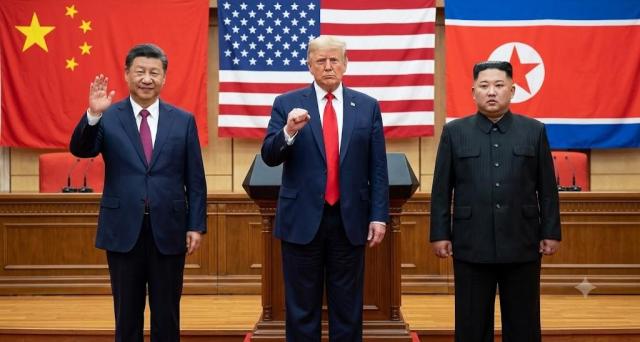
In New York, the U.N. General Assembly will bring world leaders together as conflicts in the Middle East and Ukraine continue to grind on, adding to a growing sense of fragility in the international order. In Washington, President Donald Trump will meet Chinese President Xi Jinping, with their talks expected to focus on artificial intelligence (AI), trade, tariffs and rare earths amid the broader rivalry between the world's two largest powers.
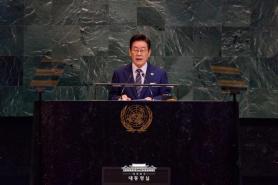
South Korea will not be at the center of either gathering, but it will not be left out, with President Lee Jae Myung delivering an address at the U.N. in New York on Tuesday. He is expected to outline his administration's vision for peace on the Korean Peninsula through engagement with North Korea, as well as proposals for U.N. reform and South Korea's role in addressing global challenges.
Trump has repeatedly expressed that he remains interested in meeting North Korean leader Kim Jong-un. But despite his overtures to look for any breakthrough amid declining support ahead of the U.S. midterm elections in November, the main obstacle that turned earlier talks into mere photo-ops remains. Pyongyang appears even less willing than before to give up its nuclear weapons, as it increasingly views them as essential to its security.
Another meeting between Trump and Kim, if it happens, may be easier to arrange than to make meaningful. The question is no longer simply whether the two leaders can meet. It is whether they can find enough common ground to achieve something more than another summit. The answer may depend partly on what happens at the upcoming meeting between Trump and Xi slated for Thursday.
China probably wants to maintain the status quo on the Korean Peninsula because it does not want a war or a sudden collapse of North Korea on its border.
But Beijing's strategic interests do not always coincide with Washington's. China is also increasingly engaged in a broader contest with the United States over technology, trade and regional influence. But Beijing's strategic interests do not always coincide with Washington's. China is also increasingly engaged in a broader rivalry with the U.S. over advanced technology, trade and regional influence.
That puts North Korea squarely in the middle of tensions between the U.S. and China. Washington wants Beijing to use its influence over Pyongyang. Beijing, meanwhile, has little reason to help Washington strengthen its strategic position in East Asia at a time when the two countries are already competing across so many fronts.
That is why Trump's meeting with Xi could have important implications for South Korea, even if North Korea is not a main topic of their talks.
The immediate discussions between them will be mainly economy-related ones. The two sides are trying to manage their trade tensions including tariffs, Chinese purchases of U.S. goods and restrictions on critical minerals. AI-related topics add another important issue, as both countries recognize that technology is becoming increasingly inseparable from national security.
None of this guarantees a breakthrough. A temporary easing of U.S. China tensions should not be seen as a settlement of their deeper strategic rivalry. But even some improvement in their relationship could create more room for dealing with North Korea.
At the U.N., Trump may make clear what he wants from North Korea. If he shows that he is serious about resuming talks with Kim, Pyongyang will be watching closely. So will Seoul.
The real test will be whether diplomacy can reduce military tensions and establish a practical framework for ending North Korea's nuclear weapons program and achieving denuclearization of the Korean Peninsula. That will require more than personal "good chemistry" between the leaders.
For all the attention this week's global gatherings will draw, the most important signals may come not from podiums, photo-ops or the usual rhetoric, but from what the major powers are sincerely willing to do.
Copyright ⓒ Aju Press All rights reserved.