

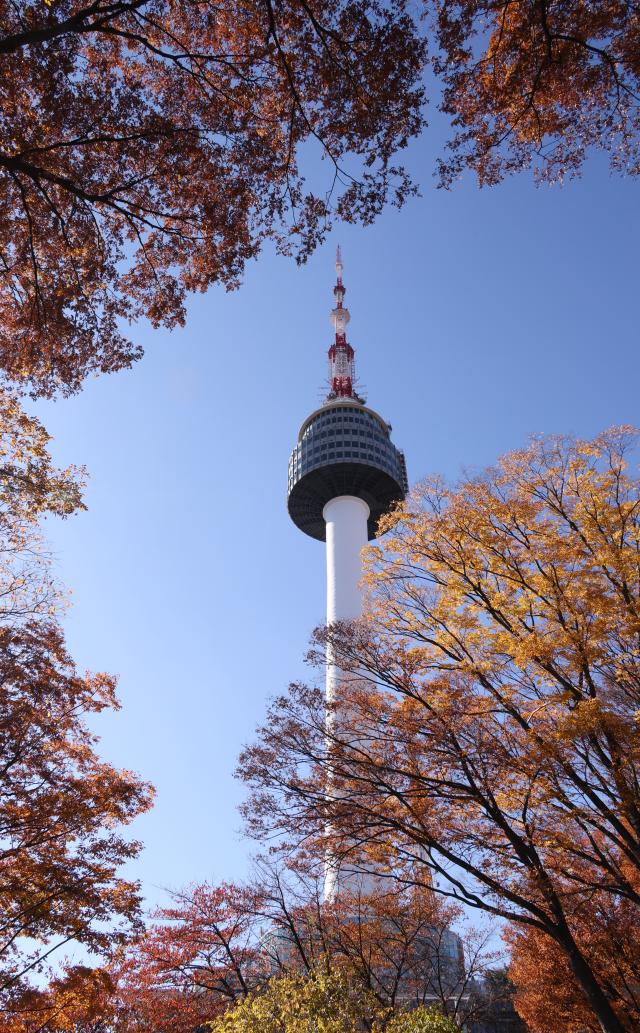
This is a hiking guide in which no hiking takes place.
Namsan, the 265-meter peak in the middle of Seoul, is on every visitor's list, and in crisp late autumn it fully deserves its place. But you don't need boots, a training plan or a single conversation with a stranger to reach the top. You need a transit card, a bus that comes every five minutes and, ideally, snacks.
AJP took the easy way up, step by step, so first-timers can follow along.
Stop 1: Coffee near Chungmuro
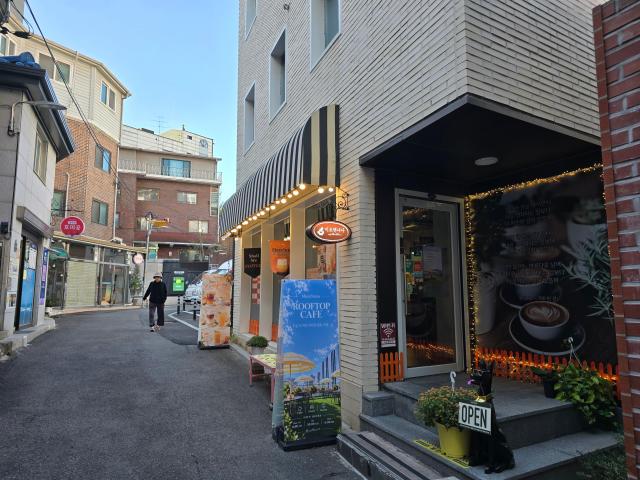
Naver Weather had called it clear: a touch cooler than the day before, little wind, no rain, about 8 C in the morning and warming through the day. Ideal walking weather. Not that I planned to do much walking.
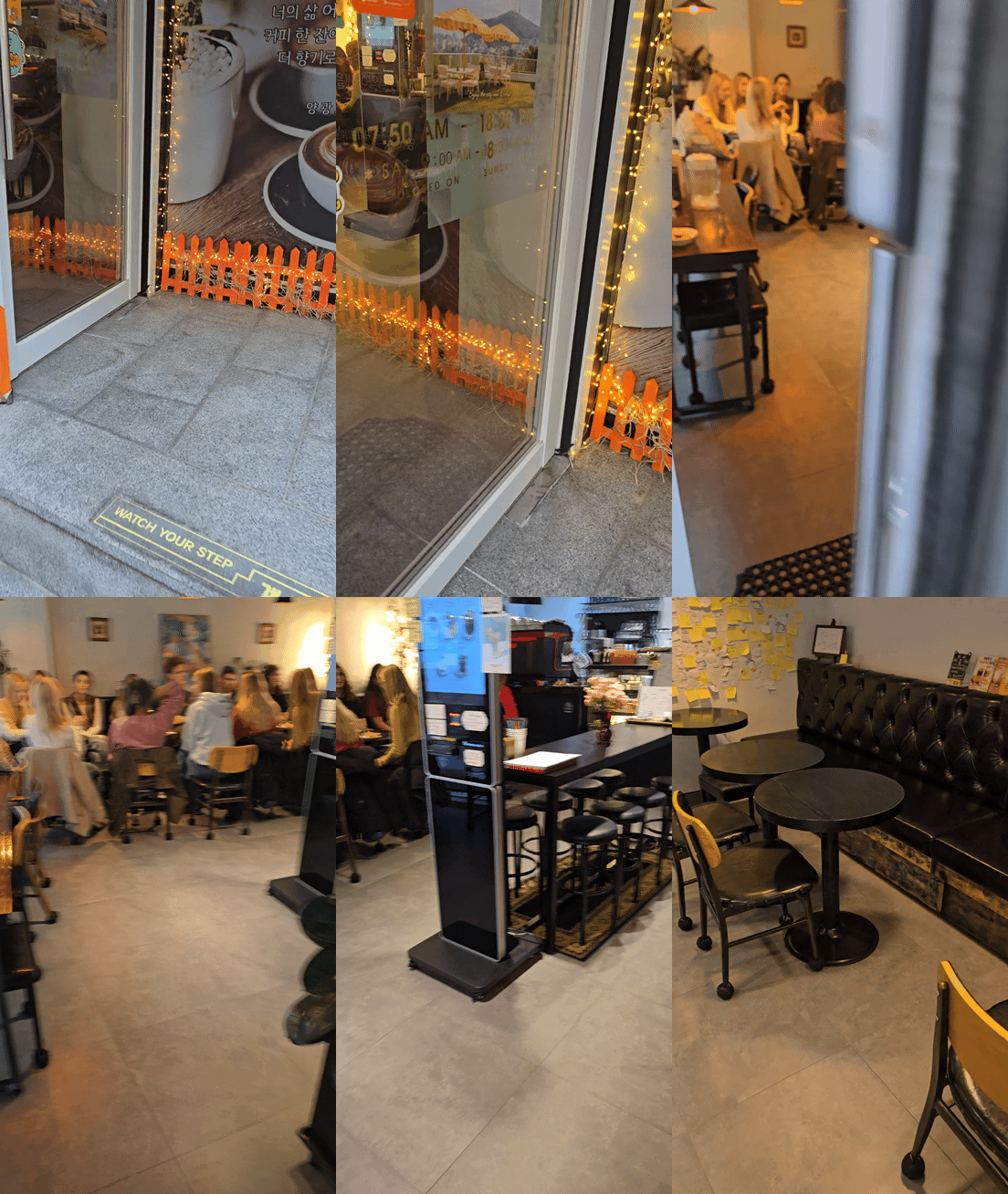
A few steps up the slope sat a small cafe, Mio & Nana. The door opened onto the smell of butter and almond flour from a tray of financiers. It's a cafe by day and a bar by night, and about 20 tourists had already claimed tables over lattes and the house signature, an einspanner.
Maybe they had come up from the hanok village down the street.
I ordered an apple-mint mojito for 6,300 won. The financiers called my name. I ignored them. Heroically.
Yes, I'm counting. You'll see.
Tip: If you have a bus to catch, order early. A full cafe means a wait.
Stop 2: Seoul's most introvert-friendly bus stop
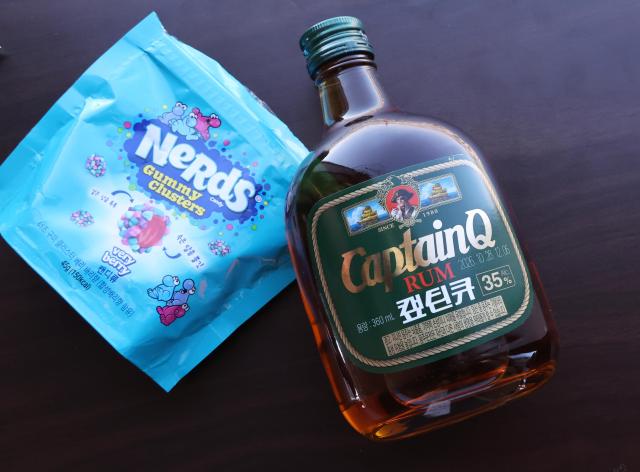
On the way, I picked up a bottle of Captain Q rum at a convenience store for 9,900 won. I drink Kavalan and Johnnie Walker without much ceremony, but Captain Q is folklore. Lotte Chilsung launched it in 1980 as a cheap stand-in for imported liquor and pulled it in 2015. Korean drinkers still joke that it's the bottle that makes you wake up two days later: no hangover whatsoever, just time cut out.
Lotte brought it back last month, 11 years on, this time as a real Caribbean rum aged in casks, 360 milliliters at 35 percent. I had never seen one in the wild. I did not open it. It was 10 a.m.
The ground overhead has had a heavy few centuries.
In the Joseon era, the slope was Yejang, a training ground where soldiers practiced martial arts. Under Japanese rule, it held Japan's Residency-General, set up in 1907, along with the resident-general's official residence and a Japanese settlement.
After the 1961 coup, the Korean Central Intelligence Agency moved in, and its 6th Bureau, which spied on college campuses, became notorious for torture during interrogations.
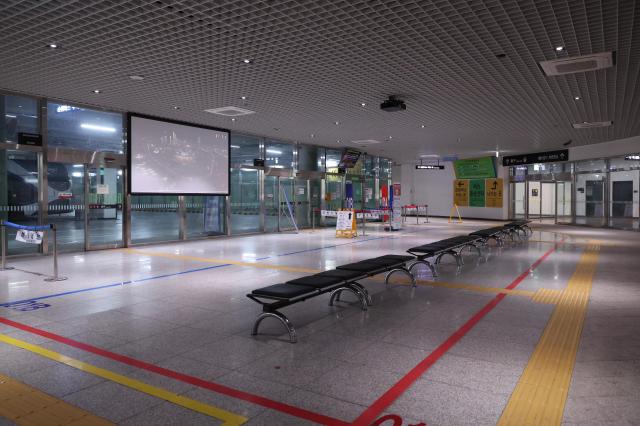
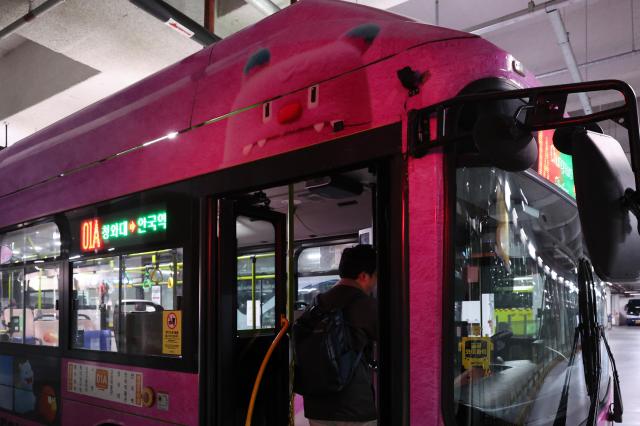
Tip: Buses 01A and 01B both go to the tower. The fare is 1,400 won with a transit card. The 01A runs every 6 to 9 minutes and the shorter 01B loop every 15 to 18, so together you'll see a bus about every five minutes. No need to sprint.
Stop 3: The ride up
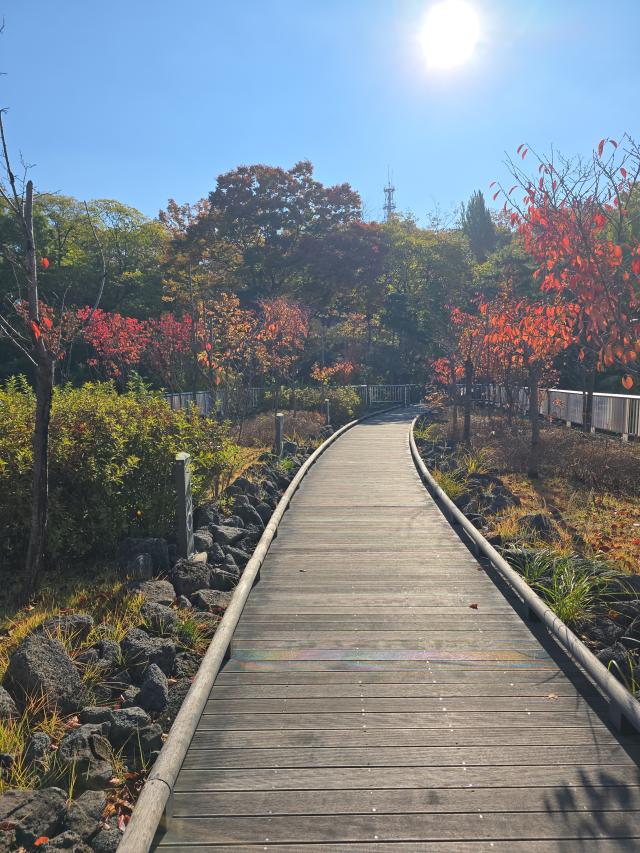
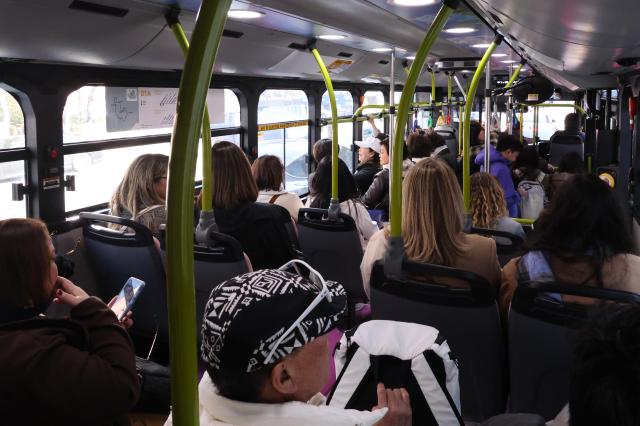
The road is steep and bumpy enough that, warm as the bus was, there was no dozing off. We passed the National Theater of Korea and stretches of Hanyangdoseong, the Joseon-era city wall that still runs along Namsan's ridge.
Naver Map says the same climb on foot from Jangchung Gymnasium takes an hour and 10 minutes and gains 230 meters. At the rate my legs burn, that's roughly 250 kcal.
Not today.
Stop 4: Snacks with a view
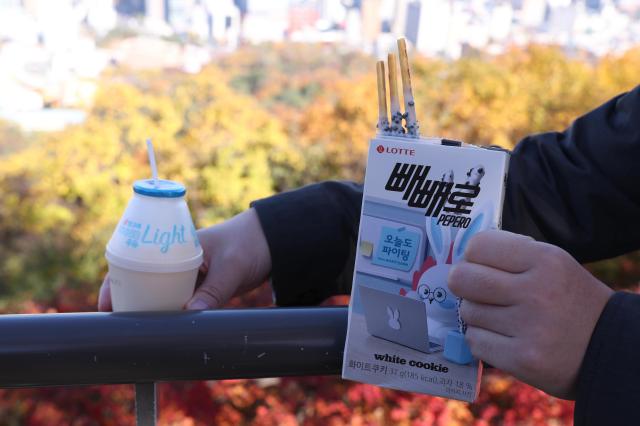
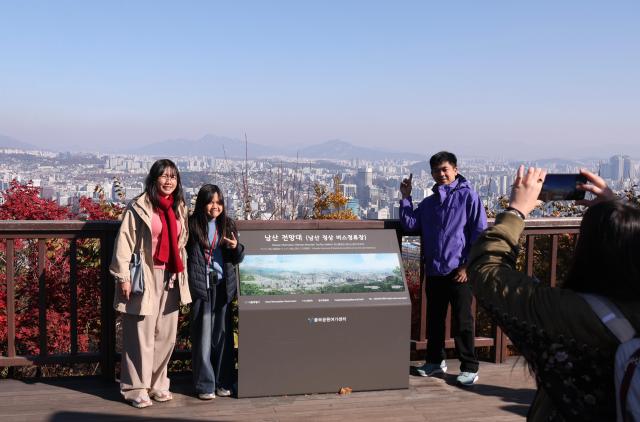
I sat on a bench under a small pavilion and unpacked. In front of me, a row of kids turned their backs to the camera and struck Superman poses for a group photo. A foreign man pushing a wheelchair pointed out falling leaves to his companion. Three older men shared coffee from stainless steel tumblers they had brought from home. Everyone was having their own autumn.
The milk's faint banana note turned out to be a plus: it stays out of the way of the chocolate and cream instead of drowning them. A small reward for a busy month.
Then a churro stand caught my eye. I'd seen it in a few Naver blog posts, and nothing beats a churro fresh from the fryer on a chilly day. It cost 4,800 won. This one, I decided, would not be counted. It was a gift to myself.
The stand opens onto a sheltered nook with a thick glass wall, a long table and chairs. To the left, Lotte World Tower in Jamsil, the tallest building in Korea at 555 meters, stood out clearly. Turning to the right, I could see Yeouido, where I go often for work. The twin buildings there were probably the LG Twin Towers.
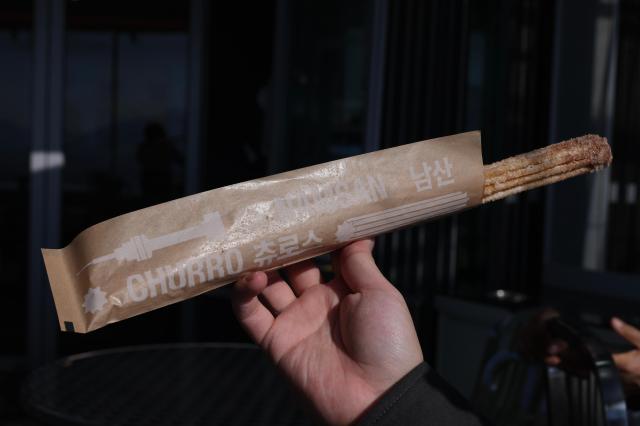
Tip: The glass-walled nook by the churro stand is the warmest seat with a view on a cold day, and there are trash cans nearby.
Stop 5: A fortune about a crate of liquor
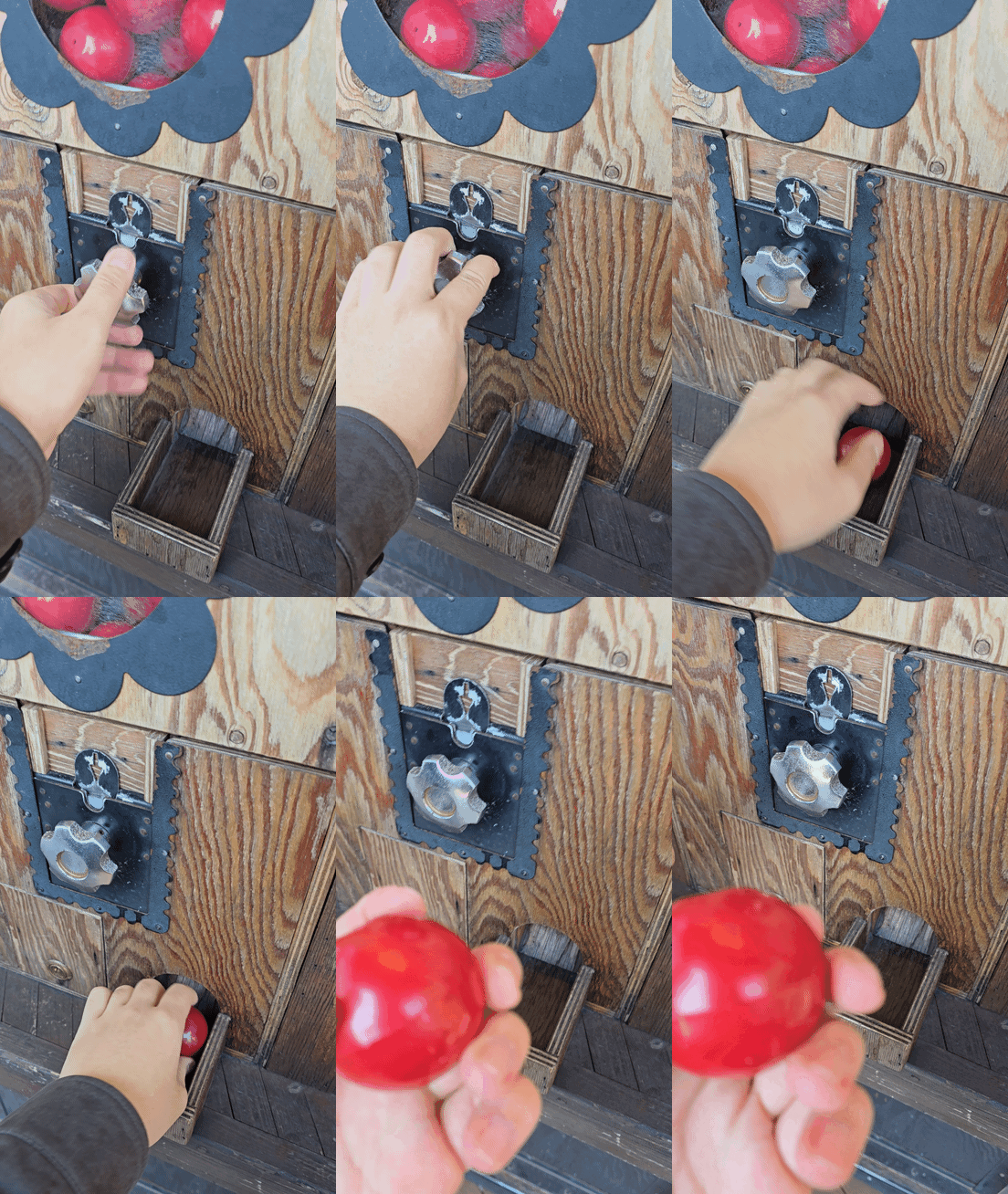
Two thousand won buys exactly one.
I was born in 1998, the Year of the Tiger, but a fortune for the whole year felt too broad. Some friends my age are sprinting around offices right now; others are studying day and night at cramped desks in study rooms. A fortune shared by all of us wouldn't really be mine.
So I picked romance. I put in a coin, the one that had rolled loose a moment earlier, and cranked the metal lever. A red capsule dropped out with a small "tap," with less drama than a gacha machine. The slip said it was a hwatu fortune, read from Korean flower cards. I have rarely been to a shaman, a tarot reader or a saju reader, so I had no frame of reference.
"The scent of peony blossoms rides the wind and wakes your destined match to your presence," it read. "A new connection may make you laugh out loud once, and once leave you holding a whole crate of liquor, so prepare your heart and handle it wisely."
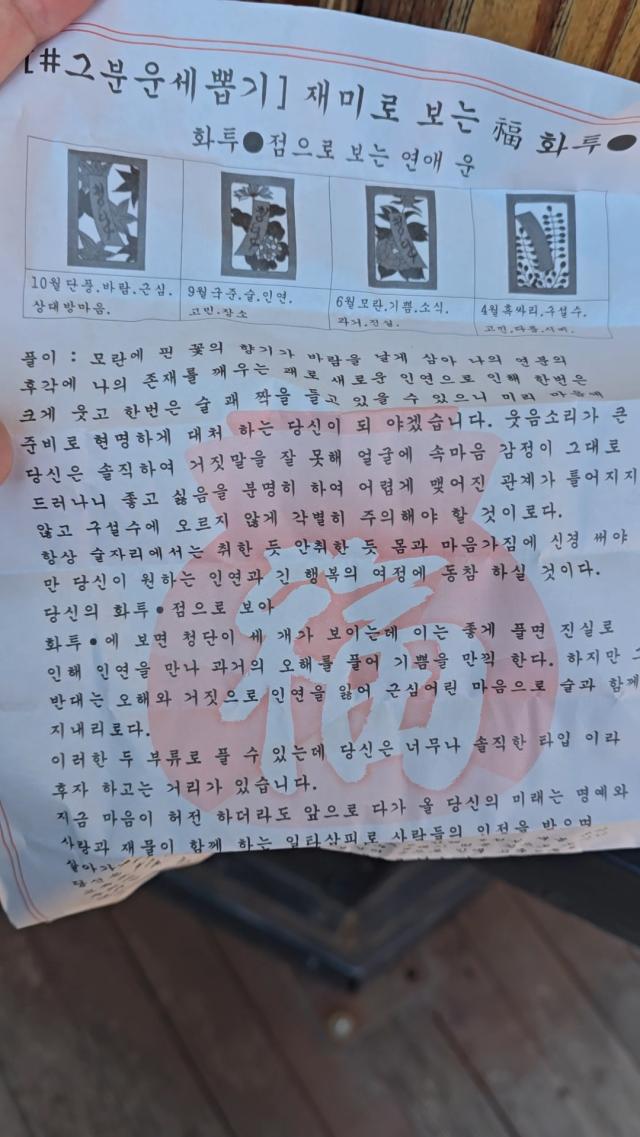
The second line was more direct: "You laugh loudly and are honest, and you are poor at lying, so your feelings show on your face. Be clear about what you like and dislike, but take special care that hard-won relationships do not sour and that you do not become the subject of gossip."
Translation: keep a poker face. The ornate, old-fashioned wording makes the same advice sound grander than it is, which may be the whole trick.
Stop 6: The top of Seoul
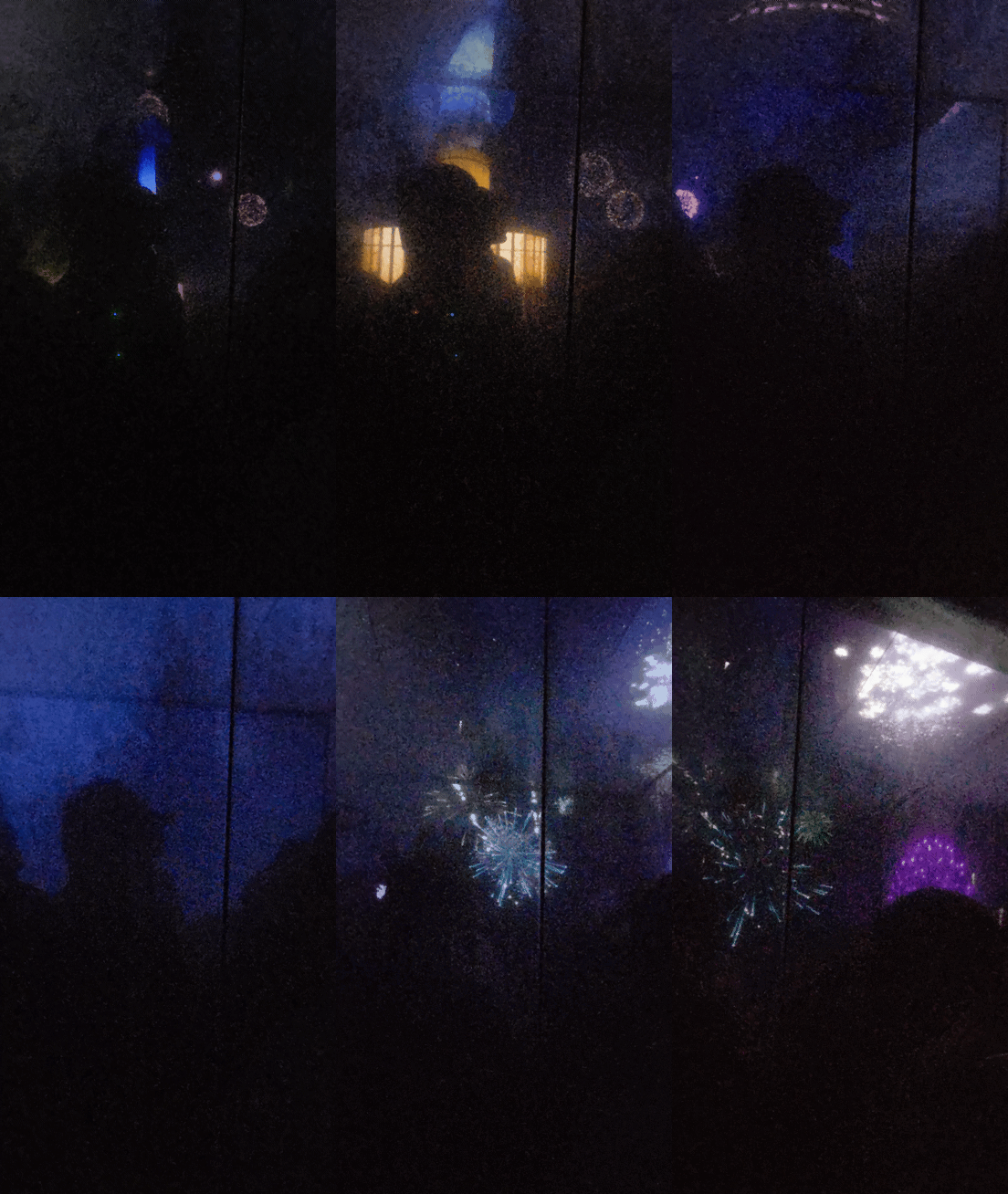
The observatory is on the fifth floor. The elevator ride is short and windowless. As it climbs, the lights dim and a video of Seoul at night plays, with fireworks reflected faintly on the closed metal doors. The soft glow, the city lights and the sound of fireworks made the ride briefly dreamlike.
Some background for the view: Namsan, literally "South Mountain," was known in the Joseon era as Mongmyeoksan. The tower on top was built as Korea's first combined broadcast tower, funded jointly by three broadcasters. Construction began in December 1969 and finished in July 1975, but the observation deck didn't open to the public until October 1980. After a renovation, it reopened in December 2005 as N Seoul Tower, run by CJ Foodville. The "N" stands for new, nature and Namsan. The tower is about 237 meters tall, and with the mountain beneath it, the top sits around 480 meters above sea level. That's why you can see it from most of the city on a clear day.
Most, not all. In 2017, Dobong District in northern Seoul put its own air-quality lights on its district office after a local newspaper reported that the tower's lights couldn't be seen from the neighborhood.
Those lights are worth knowing about. The tower began signaling air quality in 2011, glowing sky blue on days when fine dust stayed at Jeju Island levels. Today it runs four colors, from blue to red, keyed to Seoul's ultrafine dust readings. Blue means 15 micrograms per cubic meter or less, and on a blue day, the operator says, the view runs past Gangnam into Gyeonggi Province.
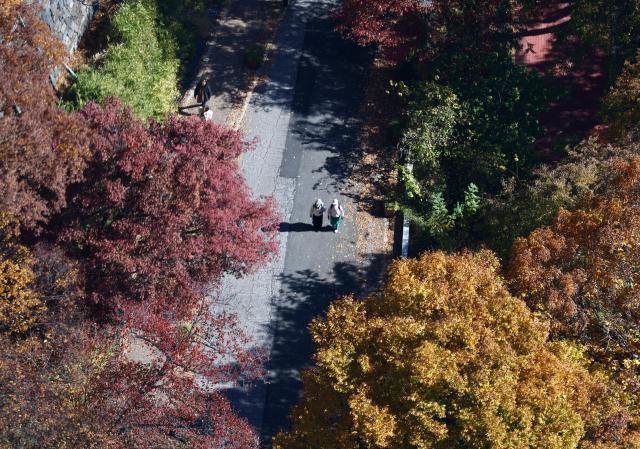
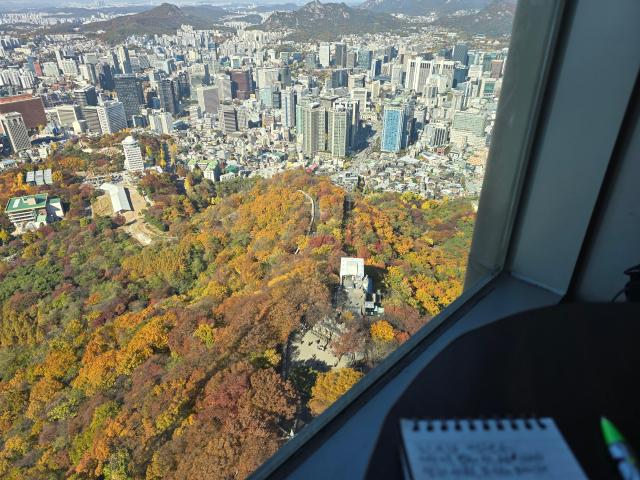
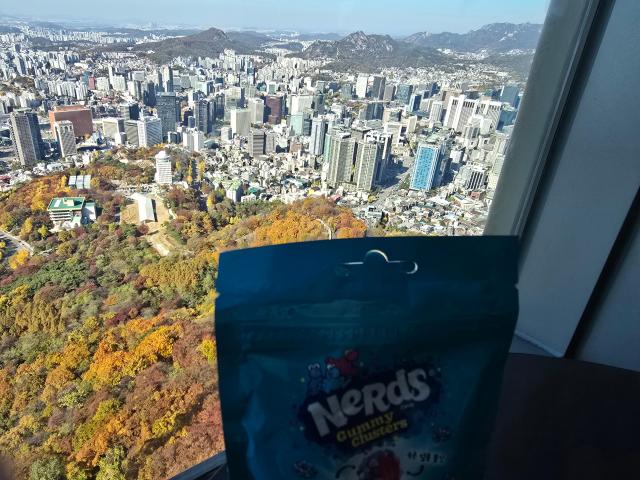
Through the window, the leaves below were just starting to turn: deep red, yellow, purple, dark brown, pale green and lime. It looked like a low-spec video game, where every pixel shows its own color until you zoom out and they become one picture.
I worked quietly through a bag of Nerds Gummy Clusters, 3,000 won from a discount snack shop in Sinchon, bought in memory of eating Nerds in the U.S. as a kid, back when they were sold under the Willy Wonka brand. They weren't as sweet as I remembered, but chewing them still brought the memories back.
Below, a beacon ritual was under way. Guards in deep red, yellow and blue Joseon uniforms lit the chimneys of the beacon mound one by one. In the Joseon era, Namsan's beacons were where fire signals from about 680 beacon posts across the country came together, so the capital could learn what was happening at the borders. Today, Seoul stages the ritual as a free show. With my phone nearly dead from filming, smoke might have been my fastest way to reach anyone.
So was I. Blame the weather, and the view.
Tip: Check the tower's light before you go. If it's glowing blue the night before, expect a long, clear view the next day.
Stop 7: Lunch at the base
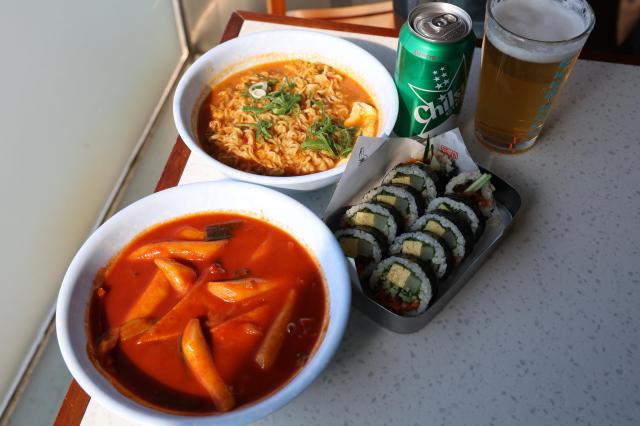
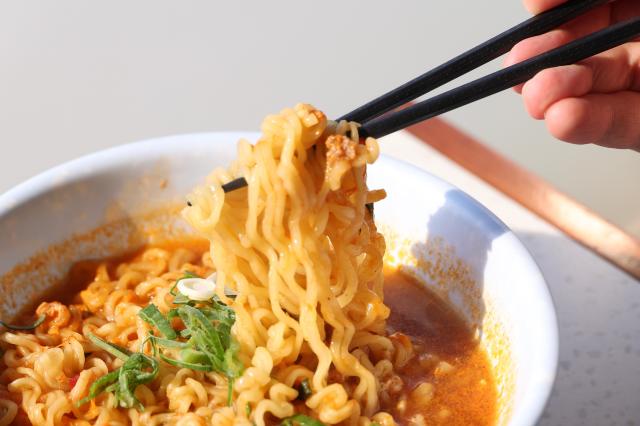
On the ground floor, there was nothing to decide. It was cold, and I needed hot ramyeon. The photographer with me nodded. We went to Durumi Bunsik, a snack bar where you can earn CJ points, which fits, since CJ Foodville runs the tower. One look at the menu showed it wasn't just a place for kids.

The kimbap had more than twice as much egg as ham and plenty of crunchy cucumber. As a kid, I always picked out the cucumber and pickled radish. Only after I lived on my own did I realize they were the supporting cast, and possibly the only part with any vitamins. Dipped in the tteokbokki sauce, it got twice as good.
The tteokbokki was the kind I like: not too sweet, with the sweetness coming more from green onion than sugar. It ran a little salty, but the beer balanced it out. (I prefer a bitter, long-aged lager that scratches the throat, but a lighter beer is my rule for daytime drinking.)
Stop 8: Love locks, and the way down
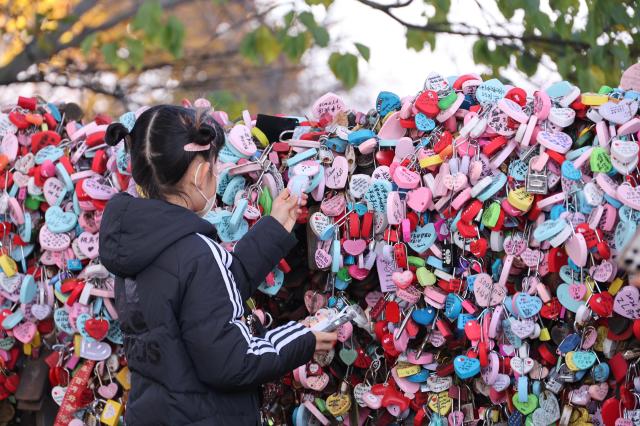
Some looked weathered by years of rain and wind. Others hadn't a scratch on their paint and must have gone up yesterday or today. Some looked like resolutions starting to crack, a sign the year is nearly over. Touching them would be rude, so I only looked. If someone climbed all this way to hang one, I hope it stays. A lock that doesn't open is a kind of promise: let's not change.
That is the only reason I kept my hands off. It had nothing to do with the rusty ones that looked like they could give me tetanus.
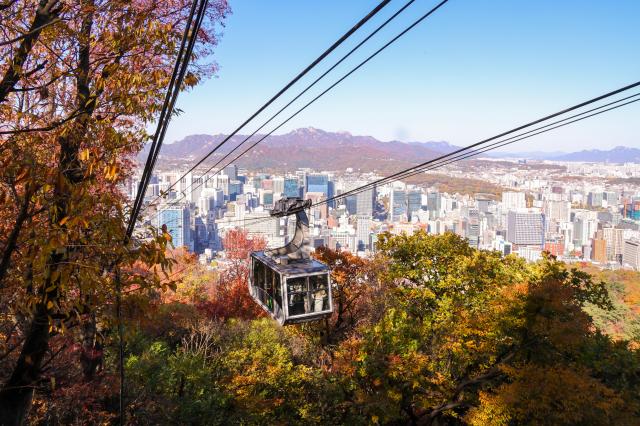
The cable car line was long, and I needed to digest, so I set off down on foot like a real hiker.
Time to get back to work.
________________________________________
Know before you go
Getting there: Chungmuro Station, then about a four-minute uphill walk to the indoor bus stop at the Namsan Yejang Bus Transfer Parking Lot, beneath Namsan Yejang Park.
Bus: 01A or 01B, 1,400 won by transit card. Both go to the tower; the 01B is the shorter loop. There’s a bus about every five minutes, and the last stretch to the tower is a four-minute walk.
On foot instead: about 1 hour 10 minutes from Jangchung Gymnasium, with a 230-meter climb.
Observatory: 29,000 won for ages 13 and up, 23,000 won for ages 3 to 12, free for younger children.
Clear-day check: a blue tower light means low fine dust and the best views.
Don't miss: the free beacon ritual, the churro stand's glass-walled nook, and Memory 6 at the bus stop.
The damage (one person, roughly)
Mojito 6,300 · Bus 1,400 · Banana milk 1,800 · Pepero 2,000 · Churro 4,800 · Fortune 2,000 · Observatory 29,000
Total: 47,300 won (about $33), not counting the souvenir rum or lunch (35,000 won for a set for two)
The calorie ledger
Mojito +130 · Walk to bus stop −14 · Banana milk +142 · Pepero +185 · Churro: not counted (선물) · Hike: skipped (−250 not earned) · Lunch: we stopped counting
Official net: +443 kcal

Copyright ⓒ Aju Press All rights reserved.
