

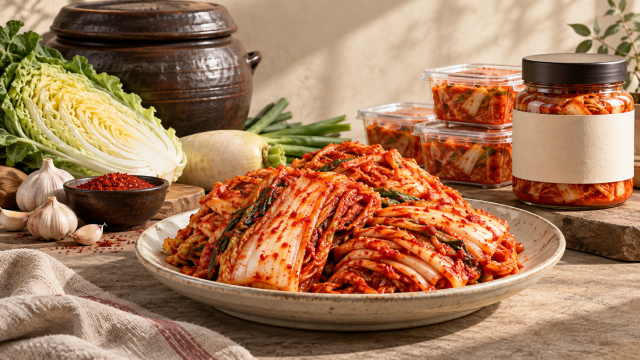
1. What are kimchi and kimjang?
Kimchi is the food; kimjang is the tradition of making and sharing it.
Kimchi is Korea’s staple vegetable side dish, commonly made by salting and seasoning cabbage or radish and allowing it to ferment. Familiar cabbage kimchi combines napa cabbage, salt, red-pepper flakes, garlic and ginger, often with scallions and fermented seafood or fish sauce. Lactic-acid bacteria develop its characteristic tang as it ripens.
Kimjang traditionally brings families and communities together in late autumn to prepare kimchi for winter. Recipes vary between households and regions, preserving local ingredients and inherited tastes. UNESCO recognized South Korea’s kimjang tradition as intangible cultural heritage in 2013.
The U.S. Dietary Guidelines for Americans, 2025–2030 list kimchi alongside sauerkraut, kefir and miso as fermented foods that support a diverse gut microbiome, which may benefit health. “Fermented food with potential gut-health benefits” is more precise than “superfood.” (source: cdn.realfood.gov)
2. Who buys the most Korean kimchi overseas?
Japan is the largest overseas market for Korean-made kimchi, followed by the United States.
| Destination | Korean kimchi exports, 2025 |
|---|---|
| Japan | $56.06 million |
| United States | $43.74 million |
| Canada | $9.29 million |
| Netherlands | $9.27 million |
| Australia | $7.69 million |
Source: Korea International Trade Association statistics published by the World Institute of Kimchi; full-year 2025 data, accessed Oct. 6, 2026. These figures rank export destinations by value, rather than total kimchi consumption or consumers’ nationalities. They exclude kimchi produced locally overseas. Korea’s total kimchi exports reached a provisional record $164.4 million in 2025, although growth was modest at 0.5 percent, according to the agriculture ministry. (source: mafra.go.kr)
3. Are more Koreans buying kimchi instead of making it?
The survey trend points toward buying, while Kurly’s latest figures show smaller packs growing fastest.
| Household kimchi sourcing | 2024 | 2025 |
|---|---|---|
| Making kimchi at home | 64.5% | 62.3% |
| Buying commercially made kimchi | 29.5% | 32.5% |
Source: Korea Rural Economic Institute, “2025 Consumer Kimjang Intentions and Major Vegetable Supply Outlook,” released Nov. 7, 2025. The 2025 survey covered 1,000 consumer panelists. (source: krei.re.kr)
According to online grocery platform operator Kurly, packaged-kimchi transaction value rose 35 percent year on year in July–September 2026, while its product range expanded 28 percent.
| Kurly pack-size category | Year-on-year transaction-value growth |
|---|---|
| Small packs, including 1kg-range products | +39% |
| Medium packs, 2–4kg range | +26% |
| Large packs, 5–10kg range | +18% |
Source: Kurly press release, Oct. 6, 2026.
Kurly attributes the stronger small-pack demand to convenience and practicality for one- and two-person households. Its figures measure spending on its platform, rather than nationwide sales volumes. The small-pack category includes products such as 1.5kg packs; it should not be labeled “1kg or less.”
4. Why are chefs, hotels and department stores competing over kimchi?
Convenience attracts ready-made kimchi buyers; distinctive recipes, ingredients and brand reputation support premium prices.
Hyundai Department Store plans to launch 12 varieties under its Myungin Myungchon traditional-food brand at its Apgujeong flagship on Oct. 13. The range uses ingredients sourced from food artisans, including salt and fermented seafood seasonings.
| Hyundai’s announced product | Price per kilogram |
|---|---|
| Cabbage kimchi | 30,000 won |
| Young-radish kimchi | 26,000 won |
| Stuffed-cucumber kimchi | 26,000 won |
| Turnip kimchi | 32,000 won |
Source: Hyundai Department Store’s Oct. 5, 2026.
Josun Hotels & Resorts shows how substantial the business has become. Its kimchi sales reached 54 billion won in 2025, after average annual growth of 23.8 percent during 2021–2025. It targets 62 billion won in 2026 and 100 billion won by 2030.
Kurly’s selection spans mass-market brands such as Jongga and Bibigo, hotel kimchi and a Jongga collaboration based on recipes from San Ho Won, the San Francisco Korean restaurant. The expanding selection lets shoppers choose kimchi by maker and flavor as well as quantity.
Data and tables compiled and edited by AJP.
Copyright ⓒ Aju Press All rights reserved.
