

Global demand for data center capacity will climb from 82 gigawatts in 2025 to 219 GW by 2030, according to McKinsey & Company, with AI accounting for about 70 percent. The consultancy estimates the build-out will require $6.7 trillion in investment.
Data centers consumed about 415 terawatt-hours of electricity in 2024. The International Energy Agency expects that to more than double to about 945 TWh by 2030. South Korea's government projects domestic demand will nearly quadruple from 8.2 TWh in 2025 to 30 TWh by 2038.
Virtually every watt a server uses ends up as heat that must be carried away.
The fans and chillers doing the job are testing neighbors' patience.
Local opposition blocked or delayed 45 U.S. data center projects worth $68 billion in the second quarter of 2026, according to research firm Data Center Watch.
Residents near Microsoft's Fairwater campus in Mount Pleasant, Wisconsin, complained in April of a tonal hum traced to cooling fans running at high speed. Microsoft said it "did not expect the tonal quality of the sound to travel as far as it has."
In Korea, sites with ready access to power and water often face strong local resistance, said Kim Jong-ki, a senior research fellow at the Korea Institute for Industrial Economics and Trade, calling for a siting strategy built on public acceptance.
"Because these facilities use so much electricity, there are concerns about things like electromagnetic waves," Kim said.
The sea offers an escape from crowded neighborhoods and a ready source of cooling water.
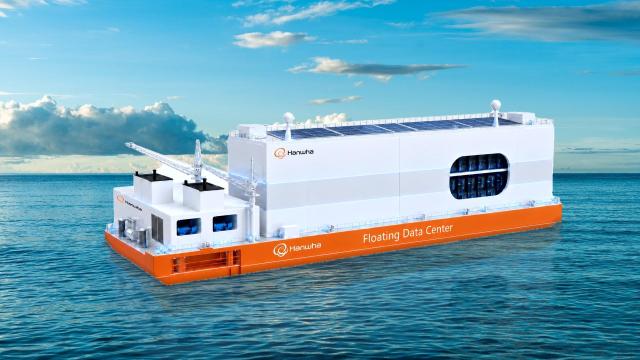
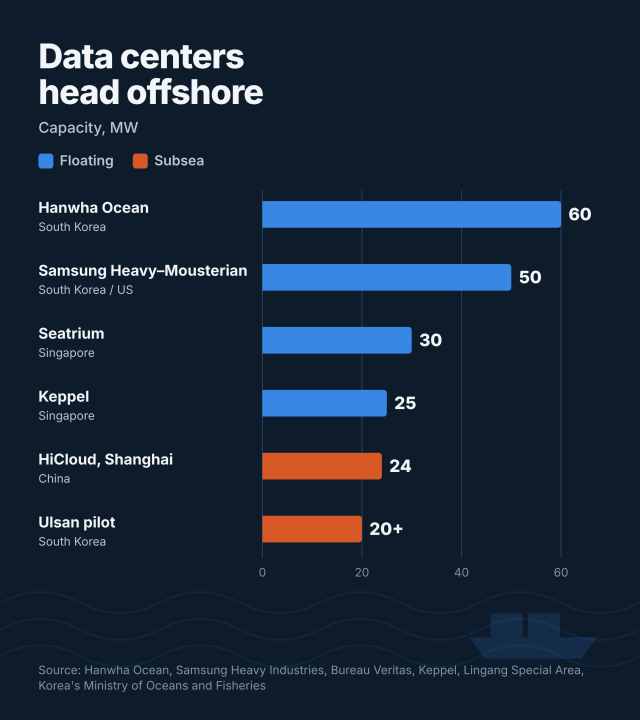
Hanwha Ocean unveiled a model of its self-developed 60-megawatt floating data center at Gastech 2026 in Bangkok in September. The vessel generates its own power and uses seawater for cooling.
The company aims to "deliver innovative solutions that address the limitations of land-based data centers," said Shon Young-chang, its head of product and technology strategy.
Samsung Heavy Industries signed an engineering contract in July with U.S. developer Mousterian for 50-megawatt floating units planned for Texas. Rivals in Singapore and Japan are pursuing similar designs.
Microsoft went deeper with Project Natick, sinking a sealed server pod off Scotland's Orkney Islands from 2018 to 2020.
"Our failure rate in the water is one-eighth of what we see on land," said Ben Cutler, who led the project.
Microsoft confirmed in 2024 that Natick was no longer active. China has since scaled up the concept with a seawater-cooled subsea data center off Shanghai powered by an adjacent offshore wind farm.
Others are looking beyond the planet.
"These giant training clusters, those will be better built in space, because we have solar power there, 24/7," Amazon founder Jeff Bezos said at Italian Tech Week in Turin in October 2025.
Google put a prototype satellite carrying four of its AI chips into orbit on Oct. 2 under Project Suncatcher, though the company calls cooling chips in a vacuum "a crucial research challenge."
Leaving land also creates a challenge that cooling cannot solve: connecting the computers.
"GPUs need a well-built communications network to work," said Lee Yu-soo, an economics professor at Soongsil University. U.S. AI data centers cluster near cities partly for efficient communications links, he noted.
"The question is whether you can have all those facilities in place when you go somewhere that extreme."
One answer may require far less travel.
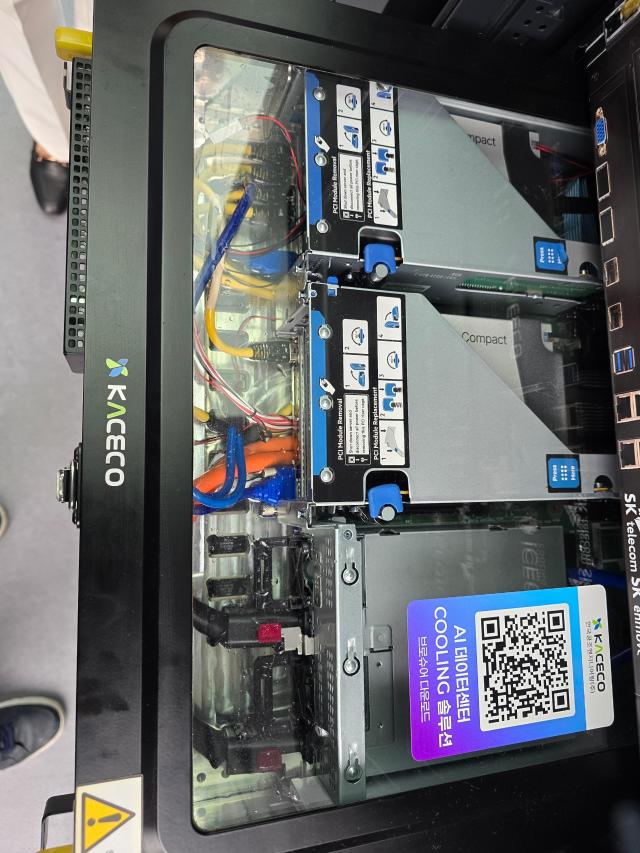
"The fastest, most practical answer right now is immersion," said an industry expert who requested anonymity, shifting the focus from where data centers sit to how they shed heat.
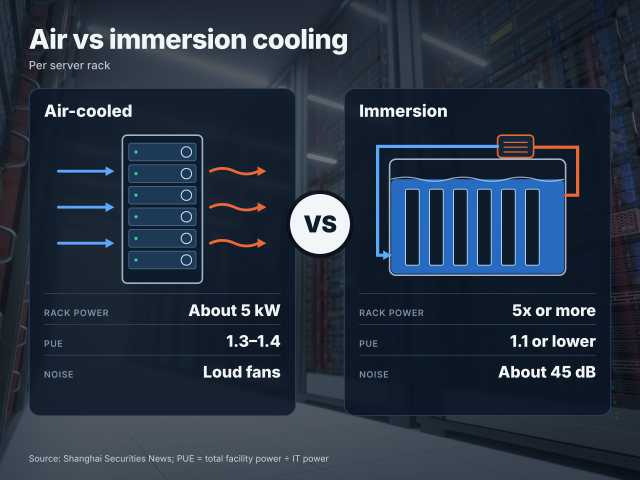
Most data centers still blow chilled air across server racks. But increasingly powerful chips are pushing that approach toward its limits. Nvidia's B200 chip alone draws up to 1,000 watts.
"With air cooling, the sound of the fans spinning creates quite a lot of noise," Lee said, adding that changing cooling methods could ease the problem.
Nvidia has adopted direct-to-chip liquid cooling for systems such as its GB200 NVL72, circulating coolant through cold plates attached to heat-generating components.
LG Electronics supplies the cold plates and the chilling instrument around the Nvidia GPUs in its datacenters. LG said in July that its 600-kilowatt coolant distribution unit had passed more than 100 technical criteria to earn Nvidia's AI infrastructure validation.
Designed to work alongside existing air cooling, the system illustrates how liquid cooling is moving into data centers without requiring servers to take a full bath.
The industry expert described that as an intermediate step.
"Liquid cooling is still indirect cooling," he said. "Compared with exchanging heat directly in the coolant, its thermal efficiency isn't as good, and in the end it uses more electricity."
Immersion cooling takes the next step by submerging entire server boards in a nonconductive fluid. Industry insiders say data center operators are considering adoption around 2030, while telecom operators are also exploring its use in base stations.
SK Telecom said a four-month immersion cooling test in 2023 cut cooling power consumption by 93 percent and total power consumption by 37 percent compared with air cooling. The trial used fluid supplied by SK Enmove.
The choice of fluid, however, brings its own trade-offs.
Early systems used costly fluorinated fluids pioneered by 3M. South Korean refiners, including SK Enmove, GS Caltex, S-Oil and HD Hyundai Oilbank, have since developed cheaper oil-based alternatives drawing on their lubricant businesses.
"It's like the oil at a fried chicken shop," an expert speaking on condition of anonymity said. "You heat it and cool it again and again, and you can't use it forever."
That expert argued that fluorinated fluids could prove cheaper over three to five years once total ownership costs are counted, potentially drawing even single-phase systems back to them.
A further step is two-phase immersion. Rather than remaining liquid, the coolant boils as it absorbs heat from the chips. The vapor then condenses on a coil and drips back into the bath.
The process uses the heat absorbed during boiling to cool the equipment. Conventional oil-based immersion fluids are not designed for that job.
China's Juhua Group has launched a fluorinated immersion cooling solution that can bring a data center's power usage effectiveness — the ratio of total facility power to computing equipment power — to 1.07, according to Shanghai Securities News.
Moving offshore, meanwhile, does not make the heat disappear. Other experts cautioned that releasing heat from large data centers into coastal waters could affect marine ecosystems.
For all the talk of oceans and orbits, the coolest address for AI may turn out to be a bathtub.
AJP Takeaways
- McKinsey & Company projects global data center capacity demand will rise from 82 gigawatts in 2025 to 219 GW by 2030. South Korea’s government expects domestic data center power demand to nearly quadruple to 30 terawatt-hours by 2038.
- Hanwha Ocean unveiled a 60-megawatt floating data center in September 2026, and Google launched a prototype AI satellite on Oct. 2, 2026. Sea and space projects face hurdles in communications, cost and cooling.
- SK Telecom said in November 2023 that immersion cooling cut total power use by 37 percent compared with air cooling in a four-month test. SK Enmove, GS Caltex, S-Oil and HD Hyundai Oilbank are testing oil-based immersion fluids.
- Two-phase immersion cooling uses fluorinated fluids that boil off chips to remove heat. These fluids are PFAS, and 3M stopped making them by the end of 2025.

Copyright ⓒ Aju Press All rights reserved.
