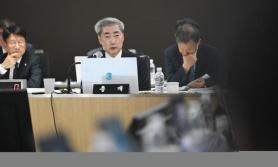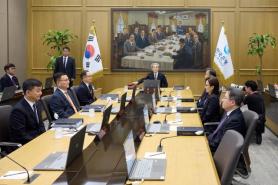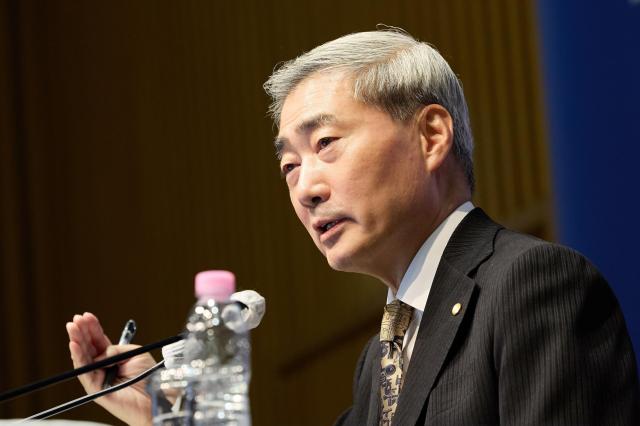
SEOUL, October 22 (AJP) - Bank of Korea Governor Shin Hyun-song on Thursday credited the board’s two successive summer rate hikes with helping cool inflation and steady currency and debt markets while signaling that rates won't likely come down before 2028.
Speaking after the monetary policy board unanimously held the base rate at 3.00 percent, Shin described the pause as the payoff from acting early.
The BOK raised rates by a quarter percentage point in both July and August after holding them at 2.50 percent for more than a year.
“At the August increase, I said we had dealt with a hoe with what would otherwise have required a spade. This hold is the fruit of that hoeing,” he said, invoking a Korean proverb about addressing a problem before it demands a bigger intervention.
Shin said the unanimous decision reflected “considerable agreement on economic conditions, including inflation and growth, and on the overall assessment of our preemptive monetary policy.”
“Our preemptive response helped keep domestic financial markets stable despite the U.S. Federal Reserve’s rate increase in September, and the (dollar-won) exchange rate also stabilized,” he said.
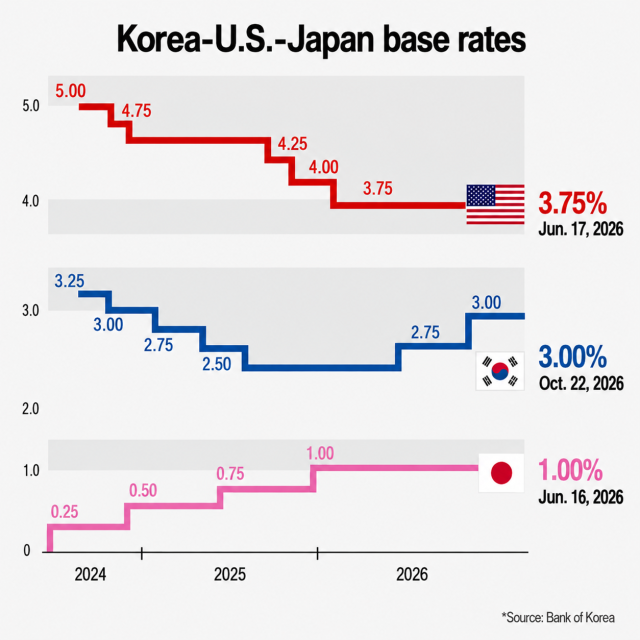
“Growth and inflation appear likely to be stronger than projected in August, so we need to maintain the current restrictive policy stance,” Shin said. “We will respond until we are confident that inflation will settle sustainably at the target level of 2 percent.”
That did not mean forcing inflation back to target next year regardless of other economic conditions, he added.
“The principle is to achieve the inflation target within the monetary policy horizon while taking other conditions into account, rather than achieving it immediately next year,” he said. “We expect inflation to approach the target level in the year after next.”
His remarks point to a prolonged period of policy restraint as inflation remains above target through 2027, with a return toward 2 percent expected around 2028. They do not, however, set a fixed timetable for further increases.
Shin said the earlier hikes had given the board room to wait for more evidence before deciding its next move.
“Upside risks to growth and inflation appear to have increased compared with the August forecasts, but we judged that it would not be too late to assess them further through incoming data, including third-quarter real GDP and October inflation,” he said.
The unanimous pause and Shin’s measured tone supported the won and government bonds.
The won strengthened 4.3 won to 1,323.2 per U.S. dollar at around 2 p.m., while government bond yields edged lower. The three-year yield fell 2.4 basis points to 3.808 percent and the 10-year yield declined 3.2 basis points to 4.135 percent.
The BOK did not release an updated board interest-rate dot plot in October. The next update is expected in November, at its final rate-setting meeting of the year.
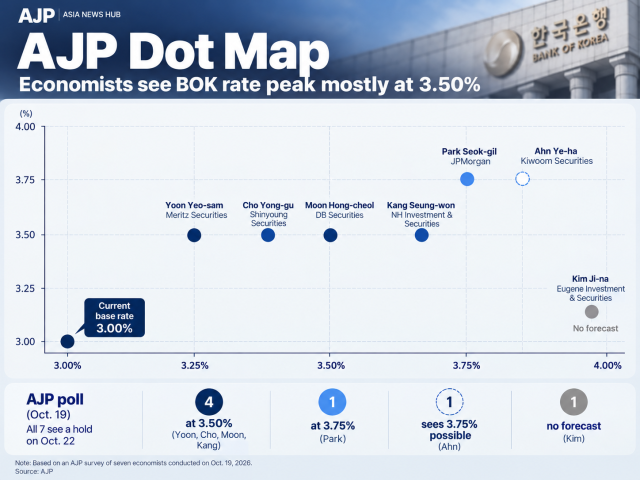
An AJP poll suggests economists see further tightening ahead, with 3.50 percent emerging as the most widely expected peak.
Four of the six economists who provided a terminal-rate forecast expected 3.50 percent. One forecast 3.75 percent, while another saw scope for rates to reach that level if strong semiconductor-led growth persists.
“Rates would need to rise to 3.50 percent before monetary policy can be considered restrictive under the current economic conditions,” Kang said.
“A rate cut would only be possible once it is clear that the semiconductor cycle has turned down,” he added.
JPMorgan economist Park Seok-gil is among those placing the peak at 3.75 percent. He expects three further quarter-point increases through the second quarter of 2027.
Whether the cycle stops around 3.50 percent or extends toward 3.75 percent will depend largely on the durability of Korea’s growth momentum and the inflationary pressure accompanying it.
The BOK said Thursday that growth this year and next would “considerably exceed” its August forecasts of 3.3 percent and 2.9 percent, respectively. Strong exports and investment are driving the expansion, while improving income conditions are expected to gradually broaden the recovery in consumption.
Recent trade data show little sign of a slowdown in the semiconductor-led expansion. Exports surged 105.4 percent from a year earlier to $61.6 billion in the first 20 days of October, with semiconductor shipments reaching a record $27.5 billion for the period.
Inflation, meanwhile, has eased but remains above target.
Consumer prices rose 2.9 percent from a year earlier in September, while core inflation excluding food and energy stood at 2.8 percent. Upstream cost pressures remained substantial: producer prices increased 7.7 percent and won-denominated import prices rose 17.6 percent.
The BOK expects this year’s headline and core inflation rates to remain broadly in line with its August forecasts of 2.7 percent and 2.5 percent, respectively.
The outlook for next year is less favorable. Both measures are now expected to exceed the previous forecasts of 2.3 percent and 2.5 percent as accumulated cost increases feed through to prices and demand-side pressures strengthen.
That combination of stronger growth and persistent inflation leaves little room for an early shift toward easing. A sustained slowdown in semiconductors or the broader economy would weaken the case for additional hikes, but Thursday’s pause offered no indication that the tightening cycle was over.
The BOK holds its final policy meeting of the year on Nov. 26, when it will also release updated growth and inflation forecasts.
Copyright ⓒ Aju Press All rights reserved.