

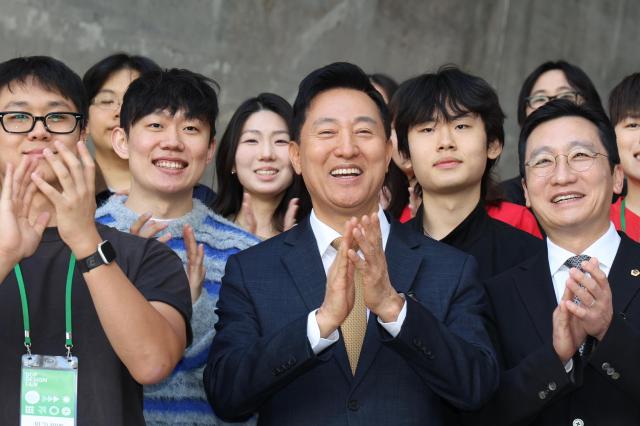
The Seoul High Court ruled that the testimony of Myung Tae-kyun, a political broker at the center of the case, was not sufficiently credible to support the charges against Oh.
"The statements made by Myung concerning the charges in this case are, taken as a whole, difficult to accept at face value," the court said.
The acquittal lifted an immediate threat to the five-term mayor’s political career and preserved the conservative People Power Party’s (PPP) field of potential presidential contenders.
Prosecutors immediately vowed to challenge the ruling at the Supreme Court, which could take up the case as early as coming January.
The judges noted that Myung began making detailed allegations about Oh's involvement in illegal political funding in December 2024, after the mayor publicly indicated that he intended to sue him.
The ruling reversed a July decision by a lower court that found Oh guilty of arranging illegal payments for opinion polls conducted ahead of Seoul's April 2021 mayoral by-election.
Oh had been accused of receiving the results of 10 opinion polls conducted by Myung, including three released publicly and seven kept private, and arranging for a political supporter to cover approximately 33 million won ($25,000) in expenses.
Prosecutors alleged that Oh used Kang Cheol-won, a former senior Seoul city official who worked on his election campaign, to arrange payments by businessman Kim Han-jung, an Oh supporter.
The lower court found that five of the 10 polls had been commissioned on Oh's behalf and that Kim had covered approximately 21 million won in expenses. It fined the mayor 10 million won and ordered the recovery of 21 million won.
The case carried unusually high political stakes because of South Korea's strict campaign finance laws.
Under the Political Funds Act, elected officials whose convictions for illegally receiving political funds become final with a fine of at least 1 million won must leave office. They are also barred from holding public office for five years.
Had the original conviction been upheld by the Supreme Court, Oh would have lost his position as mayor of the capital and been disqualified from seeking the presidency during that period.
Lawmakers from both the ruling Democratic Party (DP) and the opposition PPP stressed that the case's political implications would remain uncertain until the judicial process was completed.
"The first- and second-instance rulings are contradictory, making the Supreme Court's final decision crucial," Rep. Jin Seong-joon of the DP said.
"Both the ruling and opposition parties will watch cautiously until then," he added.
Rep. Kim Dae Sik of the PPP said the legal dispute had become politically charged, making its ultimate outcome difficult to predict.
"Legal experts tell me he is not guilty, but the trial has taken on a political character, so I don't know what the final outcome will be," Kim said.
"If a conviction becomes final, the conservative camp will lose a potential presidential candidate," he added.
Another PPP lawmaker, Rep. Ahn Sang-hoon, emphasized the significance of Oh's political survival for the conservative opposition.
"We need a ruling that allows him to remain mayor so that capable conservative presidential hopefuls can compete fairly and bring about a change in government," Ahn said.
Rep. Kim Gunn, also of the PPP, cautioned against treating the appellate decision as the end of the case.
"Today's ruling is not the end. We still have to watch what happens at the Supreme Court," Kim said.
The case is among several political funding controversies involving Myung, whose opinion polling activities and connections with prominent conservative politicians have been examined by investigators.
On Oct. 7, the same appellate court panel acquitted former President Yoon Suk Yeol of political funding charges involving opinion polls allegedly provided free of charge by Myung. The allegations against Yoon differed from those involving Oh, which centered on payments allegedly arranged through a third party.
Copyright ⓒ Aju Press All rights reserved.
