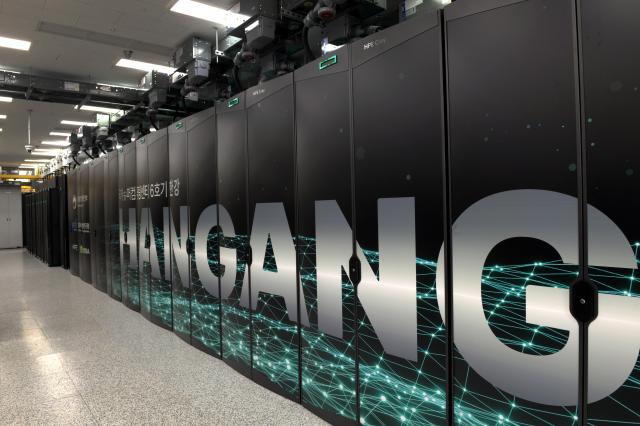
Hangang, the country's sixth supercomputer, was switched on Monday at the Korea Institute of Science and Technology Information (KISTI) in Daejeon.
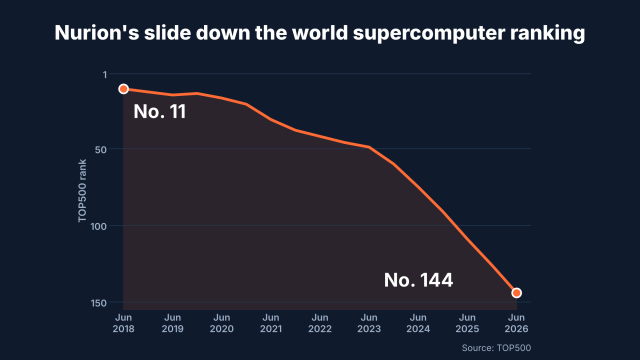
Its theoretical peak of 614 quadrillion calculations per second is 24 times that of Nurion, the 2018 machine it replaces.
That firepower comes from 8,496 GPUs, including Nvidia's GH200 chips, and 9,936 CPUs. Hewlett Packard Enterprise built the system under a 382.5 billion won ($285.6 million) contract.
Formal service begins Dec. 14.
The science ministry expects Hangang to rank around the top 10 when the TOP500 list of the world's fastest computers is updated in Chicago later this month.
No South Korean system made the top 10 in June.
Hangang was due to enter service in 2024, but its procurement tender failed four times as the generative AI boom drove up GPU prices, the ministry has said, forcing a 53 percent budget increase.
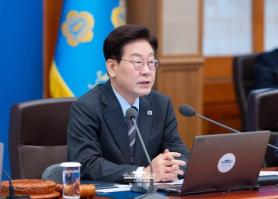
"Scientific research is not done through experiments and theory alone," KISTI President Lee Sik said at Monday's ceremony.
"Competing with supercomputers, I think, is a little late for us. We have never developed one," said a supercomputing expert who asked not to be named.
"Fifteen years ago, or even ten, I would have argued strongly that we should do this," he said. "Now the gap has grown too wide. It will be hard."
While Hangang was still under construction, the U.S. Department of Energy unveiled Solstice, an Nvidia-Oracle AI supercomputer that will run on 100,000 Blackwell GPUs, nearly 12 times Hangang's count.
"AI is the most powerful technology of our time, and science is its greatest frontier," Nvidia CEO Jensen Huang said at its October 2025 launch.
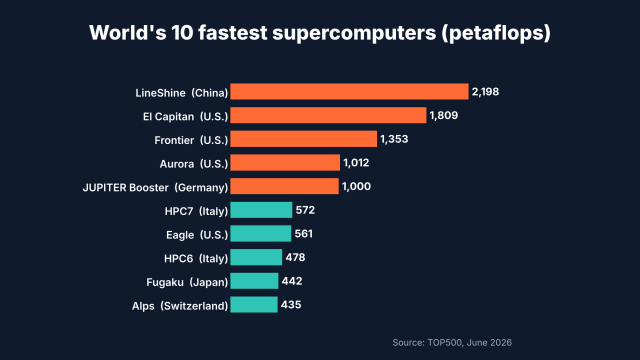
China's LineShine took the top spot on the TOP500 in June at 2.2 exaflops, becoming the first Chinese system to lead the list since 2017.
The CDC 6600, widely regarded as the first supercomputer, managed up to about 3 million calculations per second in 1964. Hangang is about 200 billion times faster.
Quantum computers promise a leap of a different order. Google said in December 2024 that its Willow chip finished in under five minutes a benchmark that would take Frontier, now the world's third-fastest supercomputer, 10 septillion years.
"This is the first time in history that any quantum computer has successfully run a verifiable algorithm that surpasses the ability of supercomputers," Hartmut Neven, founder of Google Quantum AI, wrote in a company blog post with a colleague.
Training compute for frontier AI models grew four- to fivefold a year from 2010 to 2024, according to research group Epoch AI, a pace at which a 24-fold leap takes about two years.
South Korea took eight to make it from Nurion to Hangang.
About 30 percent of Hangang's capacity is reserved for national strategic research such as K-Moonshot, which uses AI to tackle 12 national missions by 2035.
"Hangang is a core foundation that will lead new scientific discoveries by supporting the convergence of AI and science and technology," said Kim Seong-soo, head of the science ministry's research and development policy office.
KISTI plans to link Hangang with IonQ's 100-qubit Tempo quantum computer in the first half of next year, Korea's first on-site hybrid of the two.
The expert called the plan a good step toward hybrid computing, which pairs classical supercomputers with quantum machines and increasingly folds in AI.
"It's just the beginning," he said.
"It hasn't fully taken off yet, but the field has started."
AJP Takeaways
- South Korea's sixth national supercomputer, Hangang, began operating at the Korea Institute of Science and Technology Information in Daejeon on Nov. 2, 2026, with a theoretical peak of 614 petaflops, 24 times the 2018 Nurion system. Formal service begins Dec. 14, 2026.
- No South Korean system ranked in the top 10 of the June 2026 TOP500, which China's LineShine led at 2.2 exaflops. The U.S. Department of Energy is building a 100,000-GPU AI supercomputer called Solstice with Nvidia and Oracle.
- KISTI plans to link Hangang with IonQ's 100-qubit Tempo quantum computer in the first half of 2027. About 30 percent of Hangang's capacity is reserved for national strategic research such as the K-Moonshot program.
Copyright ⓒ Aju Press All rights reserved.