

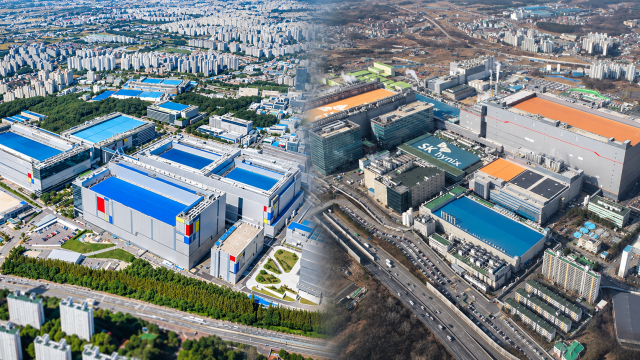
*Editor’s note: South Korea has basked in the glow of Nvidia’s epic rise and now stands exposed to the fallout from the sudden departure of Jensen Huang, a central architect and driver of the AI boom. His exit comes as scrutiny of soaring AI spending and resistance to data center construction test the durability of a boom that has powered Korea’s semiconductor earnings and export surge. In this four-part series, AJP examines the ripple effects on chipmakers, the wider AI supply chain and the broader economy.
SEOUL, November 13 (AJP) — The music at the AI binge has been dialed down and its main host has been shown the door. For South Korea, the party goes on — while bracing for a slowdown or plateau from 2027.
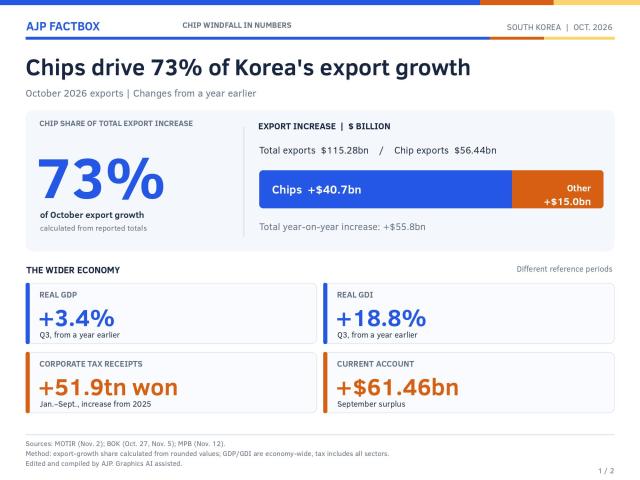
Korea still enjoys the heyday of a chip upturn that began in the second half of 2025, bolstering corporate balance sheets and government finances as never before.
But Huang’s sudden departure has hastened a sober reckoning over how the windfall should be managed to prepare a country highly reliant on external demand for AI chips and infrastructure for an eventual downturn.
The government has earmarked a 162.3 trillion won ($122 billion) Future Response Fund for 2027, channeling part of an exceptional tax revenue windfall into investment while setting aside resources for leaner years.
The challenge is how much of today’s gains can be converted into productive businesses, stronger household incomes and lasting fiscal capacity before the investment cycle changes.
The prospect of a peak does not mean orders are about to dry up. SK hynix said in October that long-term agreements with 14 major customers covered more than half its expected production capacity for 2027 and 2028.
Those contracts offer visibility over demand. They do not insulate Korea from a slowdown in new AI investment or guarantee that the tax windfall will persist. What they offer is time to put the proceeds to work.
Spending the windfall without exhausting it
The Future Response Fund is the government’s central attempt to turn exceptional tax receipts into a longer-term economic advantage.
Under the proposed 2027 budget, 45.4 trillion won would finance programs for young people, growth industries, regional development, education and talent. Another 12.5 trillion won would reduce planned government bond issuance, while 104.4 trillion won would remain in reserve.
The fund is not dedicated to AI. Its broader purpose is to support future growth while preserving resources that could become valuable when tax receipts weaken.
The distinction matters because much of the revenue surge reflects corporate earnings that may not be sustained at their current pace. Corporate tax receipts are projected to reach 216.7 trillion won in 2027, compared with a revised estimate of 136.4 trillion won for 2026.
An official at the Ministry of Planning and Budget (MPB) acknowledged that strong earnings at chipmakers and AI-related businesses had improved government finances.
"The 2027 revenue outlook reflected corporate earnings generated this year, while the prospects beyond next year remain uncertain. The ministry could not readily isolate the contribution of individual industries," the official told AJP.
The government’s medium-term projections reinforce the need to prepare for the boom to peak. Next year’s tax windfall will largely reflect profits earned during the current heyday; it should not be mistaken for a promise that earnings will keep accelerating through 2027 and beyond.
National tax revenue growth is expected to slow to 3.8 percent in 2028, while total government spending is projected to rise 9.0 percent.
The managed fiscal deficit is consequently projected to widen from 3.1 trillion won in 2027 to 48 trillion won in 2028. Those forecasts do not assume a collapse in chip demand.
How the fund is managed could matter as much as its size.
At a September policy discussion, Korea Development Institute (KDI) researchers called for objective rules governing the accumulation and withdrawal of reserves, minimum liquidity requirements, independent performance evaluations and investment decisions based on project readiness.
Such safeguards would help distinguish money available for a downturn from funds already tied up in projects that may take years to generate returns.
More AI capacity is not necessarily the answer
One potential destination for the windfall is Korea’s domestic AI infrastructure. The country is seeking to expand its computing capacity and data center industry while its manufacturers supply equipment to the global buildout.
A slowdown in U.S. data center construction could create openings. Rising costs and tighter financing may increase demand for equipment that uses less electricity or lowers cooling costs. Regulatory resistance to American projects could also make some Korean locations relatively more attractive.
But delayed investment in the United States would not automatically become demand in Korea. A domestic data center would still need sufficient electricity, financing and customers willing to pay enough to cover construction and operating costs.
The quality of new capacity therefore matters more than the amount built.
Publicly supported projects could be assessed against three conditions: confirmed customer demand, reliable power supply and a credible path to operating returns. Where those conditions remain uncertain, phased investment would limit the risk of committing public money to facilities that struggle to attract paying customers.
The same logic applies to suppliers.
Businesses that reduce electricity consumption, cooling costs or the expense of running AI services could earn recurring revenue from facilities already in operation. Companies dependent on an uninterrupted expansion of construction budgets would face greater pressure when new orders weaken.
For Korea, the opportunity lies in developing technologies and services that customers will continue to need after the initial construction wave.
Strong orders offer time to prepare
Near-term indicators still point to exceptionally strong demand for Korean chips. Semiconductor exports surged 331.2 percent from a year earlier in the first 10 days of November, extending October’s momentum.
Park Sang-hyun, an economist at iM Securities, cautioned in a Thursday report against treating concerns over slower AI investment as evidence that the cycle had already turned.
Korean chip exports and U.S. investment indicators should guide that assessment, he argued, rather than excessive fears of a downturn.
SK hynix’s longer-term agreements provide another buffer. The company said the contracts include pricing mechanisms that reflect market conditions, offering flexibility alongside demand visibility.
Still, committed production and new investment move on different schedules.
Existing contracts could support shipments even as overseas customers postpone additional projects. Corporate tax payments could remain strong because they reflect profits earned earlier.
Exports and government revenue may therefore continue improving after expectations for the next investment cycle begin to weaken. Waiting for a slowdown to appear fully in official statistics could leave policymakers with less room to adjust.
Such lags reinforce the need for Korea to prepare now for a slowdown or plateau from 2027, while revenue remains abundant and fiscal choices are still open.
Turning chip profits into broader prosperity
The lasting return will also depend on how far the boom’s benefits spread beyond chipmakers.
A KDI study released Thursday found that higher chip prices support household consumption with a substantial delay. The positive effect begins to emerge about four quarters after a price shock and peaks after seven to eight quarters.
KDI estimated that recent chip price gains could raise private consumption growth by about 0.6 percentage point in 2027.
Households may thus feel more of the benefits next year even as investors look further ahead to the sustainability of AI spending.
But chip earnings alone cannot sustain that improvement. KDI argued that lasting consumption growth requires higher productivity, employment and wages outside the semiconductor industry.
For the Future Response Fund, the earning power of other businesses and workers becomes a central test.
Support for commercially viable technologies, workforce skills and productivity improvements could help more companies benefit without depending directly on another rise in chip prices. It would also broaden the tax base and household incomes available to support the economy when the cycle weakens.
Huang’s exit has brought the approaching test into sharper focus. Korea’s task is to use the remaining heyday to prepare for growth to level off, with investments that keep generating income and reserves that remain available when the cycle turns.
How chipmakers and the wider supply chain make that adjustment will shape the next phase of the AI economy.
Copyright ⓒ Aju Press All rights reserved.