SEOUL, September 10 (AJP) - President Lee Jae Myung's second Cabinet reshuffle is spilling into a broader debate over electoral reform in South Korea, as controversy surrounding a ministerial nominee has revived calls across the political spectrum to overhaul a voting system blamed for encouraging satellite parties and distorting voter choice.
People Power Party (PPP) floor leader Jeong Jeom-sig on Thursday formally proposed that the ruling Democratic Party (DP) begin negotiations to abolish the country's semi-linked proportional representation system, seizing on the controversy surrounding Gender Equality and Family Minister nominee Yong Hye-in.
"The fundamental cause of all this is the fundamentally flawed semi-linked proportional representation system," Jeong said at a PPP Supreme Council meeting at the National Assembly.
Jeong argued that the DP bore responsibility for Yong's political rise, saying the party had effectively enabled her to win proportional representation seats twice and helped keep her minor Basic Income Party represented in parliament.
Yong, currently the Basic Income Party's sole lawmaker, won proportional representation seats in both 2020 and 2024 through electoral alliances led by the DP. In 2024, she entered parliament through the Democratic Alliance of Korea, a DP-led satellite party, before returning to her own party after the election.
The controversy intensified after Yong indicated that she intended to retain her parliamentary seat if appointed minister. South Korean law permits lawmakers to concurrently serve as Cabinet ministers, but proportional representation lawmakers have traditionally resigned their parliamentary seats upon joining the Cabinet so the next candidate on their party list can take over.
Yong has said her resignation would leave the Basic Income Party without parliamentary representation.
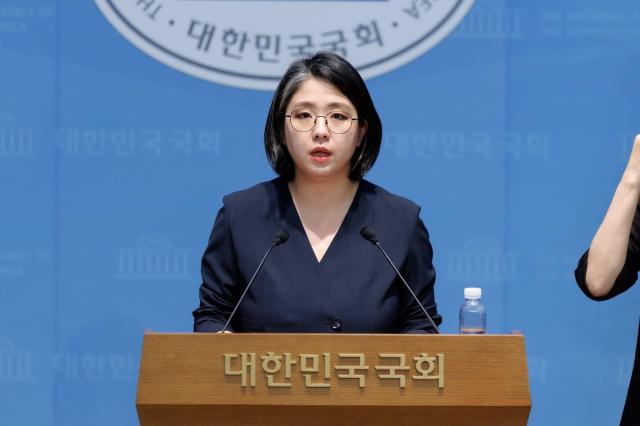
Yong defended her position at a press conference Thursday, saying lawmakers are legally permitted to serve concurrently as Cabinet ministers and arguing that proportional representation lawmakers should not be held to a different standard. She added that she was open to a broader legislative debate over whether lawmakers should be allowed to hold Cabinet posts at all.
"If left-wing parties that fall short of the necessary standards gather around the DP, their 'host party,' like pop-up parties whenever an election approaches, they enter the National Assembly after receiving proportional representation rankings through the DP's choice rather than the people's choice and then act as the DP's front line," Jeong said. "It is time to get rid of such a low-quality system."
Jeong also attacked the circumstances under which the semi-linked system was introduced, calling it "an evil law born from a backroom trade over the establishment of the Corruption Investigation Office for High-ranking Officials" after breaking what he described as the longstanding practice of changing electoral rules through bipartisan agreement.
The electoral reform bill and legislation creating the anti-corruption agency were in fact placed together on a legislative fast track in April 2019 by a DP-led bloc. The election bill passed on Dec. 27, 2019, over fierce resistance from the then-main opposition Liberty Korea Party, the predecessor of today's PPP, while legislation establishing the corruption investigation agency passed three days later. Whether the measures amounted to a political "trade" is a partisan characterization by the PPP.
Jeong's proposal has opened a wider debate that extends well beyond whether the current semi-linked formula should simply be abolished.
South Korea's 300-member National Assembly currently combines two electoral systems. Of the total, 254 lawmakers are elected from single-member constituencies under a simple plurality system, meaning the candidate with the most votes wins the seat. The remaining 46 lawmakers are elected through closed party lists using proportional representation. Voters therefore cast one ballot for a constituency candidate and another for a political party.
Under the semi-linked proportional system, the number of constituency seats a party has already won is taken into account when allocating proportional seats. In simplified terms, if a party's share of seats won in constituencies falls short of what its nationwide party vote would justify, the system attempts to compensate for part of that gap, with a 50 percent linkage rate. Parties generally qualify for proportional seats by winning at least 3 percent of the nationwide party-list vote or at least five constituency seats.
The mechanism was intended to reduce the gap between parties' nationwide vote shares and their representation in parliament, particularly benefiting smaller parties that struggle to win first place in individual constituencies.
Instead, critics say it gave the two major parties an incentive to create separate satellite parties devoted to contesting proportional seats. A major party expecting to win many constituencies could place its proportional candidates in an allied party, allowing the allied list to compete for proportional seats without being penalized for constituency victories by the parent party.
Both major political camps used such arrangements in the 2020 and 2024 general elections, one of the central reasons the system has remained controversial.
But lawmakers interviewed by AJP showed that there is little agreement over what should replace it.
Rep. Jin Seong-joon, a three-term DP lawmaker, advocated the most fundamental departure from the present system.
"There are various practical difficulties, but I believe that abolishing constituency-based representation and completely shifting to a regional party-list proportional representation system would be consistent with the principle of proportionality," Jin said.
Under a regional party-list proportional representation system, the country would be divided into several large electoral regions, with parties presenting lists of candidates for each region and seats distributed largely according to each party's vote share within that region. Unlike South Korea's current system, which elects most lawmakers individually from single-member districts and uses a single nationwide proportional ballot to fill a much smaller number of seats, such a model could make party vote shares much more directly reflected in parliamentary representation.
Regional proportional representation is not a new idea in South Korea. The National Election Commission proposed a six-region model in 2015, while a reform debate under former National Assembly Speaker Kim Jin-pyo in 2023 also considered various combinations of regional proportional representation and single- or multi-member constituencies.
PPP Rep. Yoon Sang-hyun, a five-term lawmaker, agreed that the semi-linked system should go but cautioned against eliminating proportional representation itself.
"I believe the semi-linked proportional representation system should be abolished. But eliminating proportional representation itself is not the answer," Yoon said.
"We must not close off the channel through which regional representation and the diverse voices of the people can be reflected in the National Assembly," he said.
"Although further social discussion and careful institutional design are still necessary, the alternative I am considering is a regional parallel proportional representation system."
A parallel system, unlike the semi-linked model, would allocate proportional seats independently of how many constituency seats a party had already won. Yoon said that would eliminate both the complicated linkage formula and much of the incentive to create satellite parties.
"Constituency election results should stand on their own, while proportional seats should be allocated honestly according to each party's share of the party vote," Yoon said.
He also called for changing how candidates are selected for proportional lists.
"We also need to move away from a closed-list system in which party leadership effectively distributes the rankings," Yoon said. "We should move toward open or semi-open lists that substantially reflect the choices of voters and party members, so proportional representation candidates themselves are subject to public scrutiny and evaluation."
Yoon said legislation should explicitly prohibit arrangements between parent parties and satellite parties involving joint nominations, exchanges of candidate-list positions, shared organizations or accounting, joint command of campaigns and payment of campaign expenses.
He also floated an urban-rural hybrid model under which larger cities could gradually introduce multi-member constituencies while sparsely populated rural areas retained single-member districts to protect local representation.
PPP Rep. Yoo Sang-bum, a two-term lawmaker, also pointed to regional proportional representation as a possible alternative.
"We must not see any more 'satellite parasite parties' like the Basic Income Party," Yoo said. “Regional proportional representation was discussed during National Assembly Speaker Kim Jin-pyo's term, but the talks were suspended. I think it could be considered an alternative.”
PPP Rep. Ahn Sang-hoon went further, calling for an overhaul of the constituency system itself.
"We should use this opportunity to completely change the National Assembly election system," Ahn said. "I think large multi-member districts are the answer. Satellite parties are nothing more than a trick."
"The current single-member district system also ties lawmakers to local constituent demands and makes them indifferent to the country's bigger issues," he said. "If we elected 10 lawmakers from each of 30 districts nationwide, lawmakers would be able to devote themselves to the major affairs of state."
"If the single-member district system is retained, another option would be to establish a separate upper house that could filter legislation passed by the lower house from the perspective of the country as a whole," Ahn said.
South Korea's current semi-linked system dates to the most significant recent overhaul of parliamentary election rules, passed by the National Assembly on Dec. 27, 2019 and promulgated in January 2020. It was first used in the April 2020 general election.
For that election alone, the 50 percent linkage formula was limited to 30 of the then-47 proportional seats, with the remaining 17 distributed under the old parallel method. That temporary "30-seat cap" expired afterward. The 2024 election retained the semi-linked system without the cap, meaning the linkage formula applied across the proportional allocation.
The most recent statutory adjustment came on Feb. 29, 2024, just 41 days before that year's general election. Parliament increased constituency seats from 253 to 254 and reduced proportional seats from 47 to 46 while keeping the total number of lawmakers at 300. It did not replace the underlying semi-linked proportional formula.
The latest debate therefore amounts to something potentially far larger than another redrawing of constituency boundaries. The proposals now range from returning to a simpler parallel proportional system to introducing regional party lists, opening proportional candidate lists to voters, creating large multi-member constituencies or even eliminating the existing constituency-based structure altogether.
Yong's Cabinet nomination may have provided the immediate trigger, but the differences among lawmakers suggest that agreeing that the current system is flawed could prove far easier than agreeing on what should replace it.
Copyright ⓒ Aju Press All rights reserved.